In the modern landscape of professional football, where every inch of field position is calculated by advanced analytics and precision-engineered special teams, the “long punt” remains one of the most unpredictable and exhilarating feats in the sport.
While the average punt in the 2022 season sat at a controlled 46.7 yards, the history of the league contains a handful of anomalies—moments where power, environmental conditions, and a bit of favorable bounce combined to nearly traverse the entire 100-yard field.
This analysis explores the historical data, the mechanics of the “unbeatable” record, and why, in an era of superior athletes, these specific records have remained untouched for decades.
The Theoretical Limit: The 99-Yard Wall
To understand the magnitude of the NFL record, one must first understand the geometry of the football field.
The longest possible net punt—measured from where the ball is kicked to where it is downed or comes to rest—is 99 yards. This would require a punter to stand inches inside one goal line and have the ball downed inches before the opposing goal line.
While this 99-yard feat has never been achieved in the professional ranks, it does exist in the annals of football history.
In 1950, Nevada’s Pat Brady recorded a 99-yard punt, establishing an NCAA record that serves as the absolute ceiling for the position. In the NFL, the record stands just one yard shy of that theoretical maximum.
The Gold Standard: Steve O’Neal’s 98-Yard Kick (1969)
The pinnacle of professional punting was established on September 21, 1969, during a matchup between the New York Jets and the Denver Broncos.
Steve O’Neal, a rookie selected in the second round of the 1969 draft, stepped onto the field at Mile High Stadium and executed a play that has remained in the record books for over half a century.
The kick was born out of necessity. Backed up into the very back of his own end zone, O’Neal launched a ball that cut through the thin Denver air.
While the ball did not travel the entire 98 yards in flight, its trajectory and the turf conditions allowed for a massive secondary gain.
The ball made contact with the turf at the 33-yard line and, in a display of perfect forward momentum, rolled all the way to the Broncos’ 1-yard line.
Despite this historic 98-yard flip of the field, the Jets ultimately lost the contest 21-19. However, O’Neal’s rookie season performance cemented his place in history, creating a benchmark that no player has threatened in the subsequent 55 years.
The Chasers: Mapping the 90-Yard Elite
Following O’Neal’s 1969 masterpiece, only a few players have ever crossed the 90-yard threshold. Each instance represents a unique blend of player talent and game-time circumstances.
1. Shawn McCarthy (93 Yards, 1991)
The closest any player has come to O’Neal in the last three decades was Shawn McCarthy of the New England Patriots. During a 1991 game against the Buffalo Bills, McCarthy unleashed a 93-yard punt from his own end zone.
Similar to the 1969 record, the ball was perfectly placed, eventually coming to rest at the opponent’s 1-yard line. Despite McCarthy’s massive leg, the Patriots fell to Jim Kelly’s Bills 22-17.
2. Randall Cunningham (91 Yards, 1989)
Perhaps the most surprising entry in the top three is Randall Cunningham, a legendary quarterback for the Philadelphia Eagles.
While Cunningham is primarily remembered for his rushing yards and passing touchdowns, he was a prolific punter during his collegiate years at UNLV, where he recorded nearly 150 punts.
In a 1989 victory over the New York Giants, the Eagles utilized Cunningham’s versatility; he booted a 91-yard punt while also completing 9-of-16 passes for 140 yards.
3. The 90-Yard Club: Williams and Chandler
Two players share the fourth-longest spot in history with 90-yard kicks. Don Chandler achieved the feat in 1965 during his first season with the Green Bay Packers in a game against the San Francisco 49ers.
Decades later, in 2001, Rodney Williams of the New York Giants joined the list. Interestingly, Williams only played one season in the league, but his 90-yarder in the season opener against the Denver Broncos ensured his name would remain in the history books.
Championship Pressure: Post-Season and Super Bowl Records
While the regular season allows for more opportunities to “swing for the fences,” punting in the playoffs and the Super Bowl is often defined by risk mitigation.
Consequently, the record distances in these high-stakes games are significantly shorter than the all-time regular-season marks.
- The Playoff Record: The record for the longest punt in NFL playoff history is shared by Ed Danowski (New York Giants, 1935) and Mike Horan (Denver Broncos, 1991), both of whom recorded 76-yard kicks.
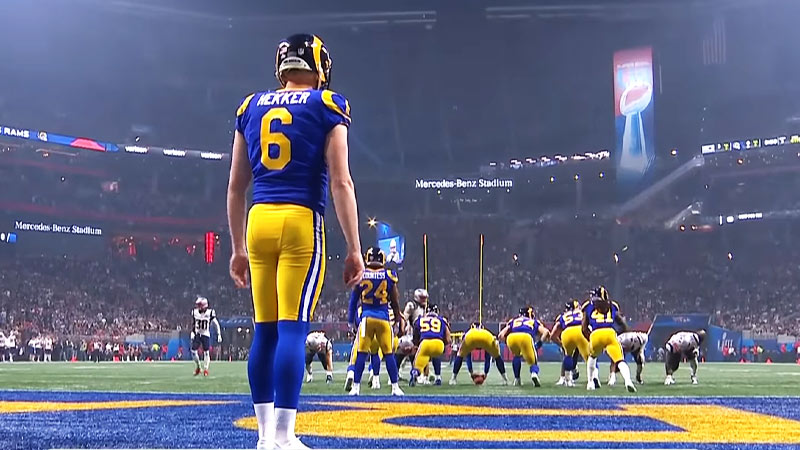
- The Super Bowl Record: During Super Bowl LIII in 2019—the lowest-scoring Super Bowl in history—Johnny Hekker of the Los Angeles Rams set a new championship record with a 65-yard punt. This surpassed the previous record of 64 yards set by Ryan Allen of the New England Patriots in 2014.
The Ray Guy Paradox: Efficiency vs. Distance
When discussing the greatest punters in history, the name Ray Guy is inevitable. As the only punter inducted into the Pro Football Hall of Fame, Guy revolutionized the position. However, an analysis of the data reveals an interesting trend: Guy’s career-long punt was “only” 74 yards.
This highlight’s a critical distinction in professional football strategy. The objective of a punter is often not maximum distance, but rather “hang time” and “placement.” A 90-yard punt that bounces into the end zone results in a touchback, netting only 70 or 80 yards.
Modern punters are trained to avoid the touchback at all costs, prioritizing the ability to pin an opponent inside the 10-yard line over raw power.
The Top 10 Longest NFL Punts
Based on official league records, here are the top distances ever recorded in a regular-season game:
- 98 Yards: Steve O’Neal (Jets), 1969
- 93 Yards: Shawn McCarthy (Patriots), 1991
- 91 Yards: Randall Cunningham (Eagles), 1989
- 90 Yards: Don Chandler (Packers), 1965
- 90 Yards: Rodney Williams (Giants), 2001
- 89 Yards: Luke Prestridge (Patriots), 1984
- 88 Yards: Bob Waterfield (Rams), 1948
- 87 Yards: David Finzer (Bears), 1984
- 87 Yards: Bob Scarpitto (Patriots), 1968
- 86 Yards: Larry Barnes (49ers), 1957
Frequently Asked Questions
Why was Steve O’Neal’s punt so much longer than others?
Beyond O’Neal’s leg strength, the kick occurred at Mile High Stadium in Denver. The higher altitude offers less air resistance, which historically aids in both punting and kicking distances. Additionally, the ball took a massive roll after landing at the 33-yard line.
Has anyone ever punted 100 yards?
No. Because the field is 100 yards long, a 100-yard punt is technically impossible unless the punter is standing out of bounds behind the end zone, which is not a legal play. The theoretical limit is 99 yards.
Why was Randall Cunningham punting if he was a quarterback?
Cunningham was an exceptional athlete who had been a punter in college. In the late 80s, NFL teams occasionally used “quick kicks” or utilized versatile players to catch the defense off guard. Cunningham’s 91-yarder is a testament to his unique skill set.
Conclusion: An Enduring Legacy
The 98-yard punt by Steve O’Neal remains one of the most resilient records in the NFL. As special teams play becomes more specialized and defensive strategies focus on limiting return yards, the era of the 90-yard field-flipper may be behind us.
Today’s punters are masters of the “coffin corner” and high-hang-time strikes, but the 1969 record stands as a reminder of a time when raw power could change the course of a game in a single, massive stroke.
Whether you are an enthusiast of the game’s history or a data-driven analyst, the 98-yard punt remains the ultimate benchmark for special teams excellence.
It represents the perfect confluence of player talent, environmental physics, and the unpredictable bounce of a prolate spheroid.