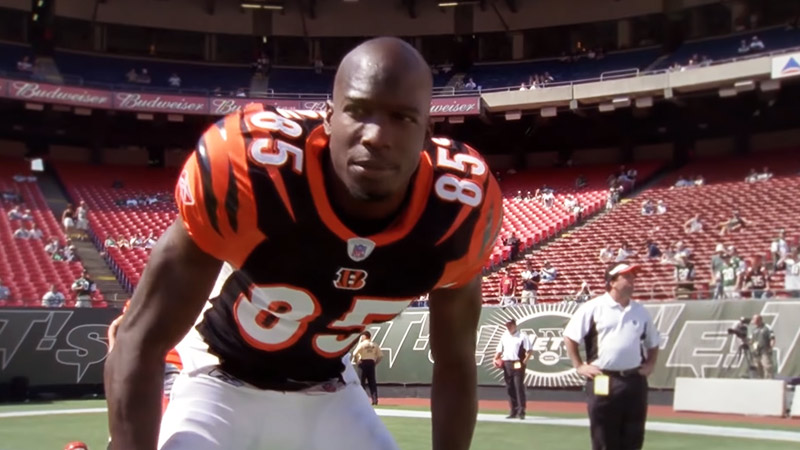
In the high-stakes arena of professional sports, where jersey sales and personal branding are worth millions, few figures have manipulated the levers of public perception as masterfully as Chad Johnson.
Known to many as “Ochocinco,” his decision to legally alter his identity was not merely a whim of a flamboyant athlete; it was a calculated maneuver that challenged the authority of a multi-billion dollar league and redefined how modern athletes view their own name as a franchise.
To understand the motivations behind this change, one must look past the end-zone celebrations and into the specific friction between individual expression and corporate regulation.
The Catalyst: A Teammate’s Jest and a Cultural Celebration
The narrative of “Ochocinco” did not begin in a marketing boardroom, but rather on the practice fields of Cincinnati.
In 2007, during Spanish Heritage Month, a lighthearted exchange occurred between Chad Johnson and his then-quarterback, Carson Palmer.
Palmer jokingly suggested a moniker that would reflect Johnson’s iconic jersey number, 85, using the Spanish words for eight (ocho) and five (cinco).
While linguistically “85” would technically be ochenta y cinco, the simplified “Ochocinco” carried a rhythmic, catchy quality that resonated with Johnson.
What started as a locker room joke quickly transitioned into a public-facing persona. Johnson recognized that the name was more than a nickname—it was a linguistic hook that differentiated him in a league filled with elite talent.
The Inciting Incident: The Velcro Patch and the $50,000 Fine
The transition from a nickname to a legal reality was accelerated by a direct conflict with the NFL’s front office. During a pre-game warm-up, Johnson took the bold step of placing a Velcro patch over the “Johnson” nameplate on his official jersey. The patch, which read “Ochocinco,” was a visual protest against the rigid uniform standards of the league.
The NFL, often colloquially referred to by critics as the “No Fun League” for its strict adherence to protocol, responded swiftly. The league issued a substantial fine to Johnson, reported to be between $30,000 and $50,000, for the unauthorized alteration of his uniform.
In the corporate world of the NFL, the uniform is a sacred asset. It represents the league’s control over the aesthetic of the “product.”
By slapping a Velcro nameplate over the official branding, Johnson wasn’t just being a “showboat”—he was challenging the league’s ownership of his physical likeness.
The Strategic Retaliation: Turning Spite into a Power Move
When his appeal against the heavy fine was upheld by the league, Johnson faced a choice: conform or escalate. He chose the latter.
In a move that displayed a sophisticated understanding of legal loopholes, he decided to legally change his last name to Ochocinco in the 2008 offseason.
This was a masterful “checkmate” move. By making Ochocinco his legal surname, he effectively forced the NFL’s hand.
Because the league requires jerseys to display a player’s legal last name, they could no longer fine him for wearing the moniker on the field. What had begun as an act of rebellion and a “spiteful” response to a fine transformed into a structural victory over the league’s bureaucracy.
The Evolution of the Personal Brand
Beyond the legal victory, the name change served as a massive marketing catalyst. It provided several key advantages that are now taught in sports management and branding courses:
- Differentiation: In a league where multiple players might share common surnames, “Ochocinco” was unique. It ensured that whenever a commentator or fan spoke of him, they were reinforcing a specific, trademarked brand identity.
- Monetization: The name change paved the way for a plethora of brand extensions. From his own cereal (“Ochocinco’s”) to featured roles in video games and reality television, the name became a vessel for a persona that was larger than the sport of football itself.
- Audience Engagement: The “Ochocinco” brand leaned into the emerging world of social media. Johnson was one of the first athletes to realize that by creating a distinct persona, he could communicate directly with fans, bypassing traditional media gatekeepers.
The Legacy of the Move: Athlete Autonomy
While the provided source focuses on the timeline and the fine, it is worth noting (from an external analytical perspective) that Johnson’s move set a precedent for the “player-empowerment” era.
Today, we see athletes like LeBron James or Kevin Durant managing their brands as corporate entities. Johnson was a pioneer in this space, proving that an athlete’s name is their most valuable intellectual property.
He demonstrated that if a league tries to suppress your individuality through financial penalties, you can use the legal system to incorporate that individuality into the very fabric of the league’s product.
The Return: A New Chapter and a Lasting Identity
By 2012, the “Ochocinco” era reached a natural conclusion in its legal form. Ahead of his marriage, Johnson chose to legally revert his surname back to “Johnson”.
This transition reflected a shift in his personal life and a desire to enter a new chapter with his family name.
However, the brand was too powerful to discard entirely. Even after the legal change back to Johnson, he retained “Ochocinco” as his middle name.
To this day, he continues to use it as his primary nickname and digital handle. It remains a symbol of a specific period in sports history when a single player managed to outmaneuver the most powerful sports league in the world using nothing but a name change and a sense of humor.
Why This Strategy Worked
From a high-level strategy perspective, the “Ochocinco” move succeeded because it was rooted in authenticity and timing.
- Authenticity: It didn’t feel like a corporate-mandated rebranding. Because it started as a joke with a teammate and a protest against a fine, fans felt “in on the secret”. It was a move for the fans, against the “establishment.”
- Conflict as Marketing: Many brands avoid conflict. Johnson leaned into it. The $50,000 fine was the best advertising money he never actually “spent” in a traditional sense, because the media coverage of the fine generated millions of dollars in earned media value.
- Consistency: He didn’t just change it for a week. He committed to the identity for years, ensuring it became synonymous with his playing career and his public life.
Frequently Asked Questions
Did Chad Ochocinco speak Spanish?
While the name “Ochocinco” is Spanish for eight-five, the name choice was more about the rhythmic sound and the tribute to his number than a deep linguistic connection. The idea famously sparked during Spanish Heritage Month in 2007 through a joke with Carson Palmer.
How much did the NFL fine him?
The league hit him with a heavy penalty for his initial Velcro nameplate stunt, with reports placing the fine between $30,000 and $50,000. This financial pressure is what ultimately drove him to legally change his name to avoid future penalties.
Why did he change his name back to Johnson?
In 2012, as he prepared for marriage, he decided to return to his original surname. However, he did not abandon the brand entirely, keeping “Ochocinco” as his middle name and continuing to use it as his primary professional identity.
Is “Ochocinco” still his legal name?
Currently, his legal surname is Johnson, but “Ochocinco” remains part of his legal identity as a middle name.
Conclusion: The Blueprint for Modern Branding
Chad Johnson’s transformation into Chad Ochocinco remains a landmark case study in the intersection of law, sports, and marketing.
It teaches a vital lesson to any professional in a regulated industry: innovation often comes from the friction between rules and creativity.
By turning a “punishment” into a “pivot,” Johnson ensured that his legacy would be defined not just by his catches on the field, but by his brilliance in the courtroom and the court of public opinion. He didn’t just play the game; he renamed it.