The orchestration of a professional football game is a masterpiece of logistics, physics, and leadership. Amidst the pyrotechnics and the deafening roar of tens of thousands of fans, there is a quiet, rhythmic center of gravity on the field: the huddle.
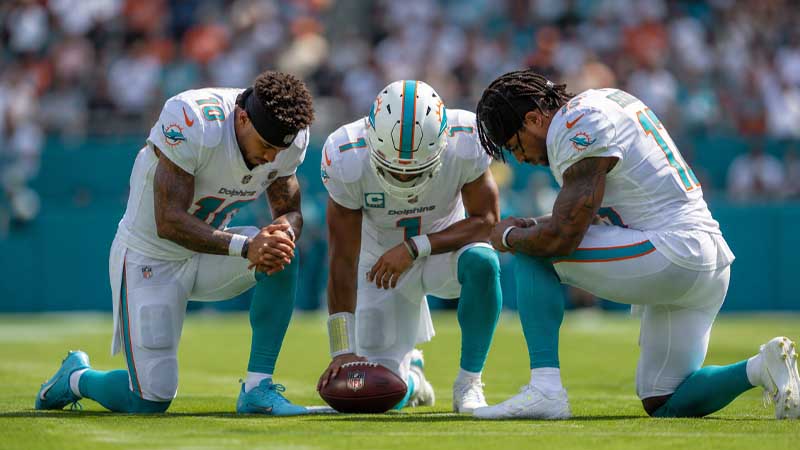
To the uninitiated observer, the sight of a quarterback dropping to one knee while surrounded by his teammates might seem like a mere moment of repose. However, in the high-stakes environment of professional sports, no movement is wasted.
The act of a quarterback kneeling in the huddle is a calculated tactical decision designed to optimize communication, manage physical fatigue, and ensure that every player is perfectly aligned before the ball is snapped.
Understanding this nuance requires looking beyond the scoreboard and into the mechanics of how elite teams operate under pressure.
The Architecture of the Huddle: A Focus on Line of Sight
In the chaos of a drive, clarity is the most valuable currency. A quarterback serves as the field general, responsible for translating complex offensive schemes from a coordinator’s headset into actionable instructions for ten other athletes. The physical stance the quarterback adopts during this exchange is fundamental to its success.
When a quarterback crouches or kneels in the huddle, he is primarily solving a problem of geometry. Professional offensive linemen are often significantly taller than their quarterbacks, creating a physical barrier if everyone remains standing.
By dropping his center of gravity, the quarterback places himself at eye level with the rest of the unit.
This eye-level positioning is critical for several reasons:
- Non-Verbal Confirmation: Much of human communication is visual. By being at eye level, the quarterback ensures that his teammates can watch his face and hand signals clearly. In a world where a single missed “hot route” or a misinterpreted protection shift can lead to a turnover, seeing the quarterback’s eyes provides a layer of certainty that audio alone cannot match.
- Focus and Authority: When the leader of the group lowers himself, it forces the surrounding players to lean in and look down or across. This naturally draws their attention away from the distractions of the stadium and centers it on the play-caller.
- Instructional Precision: Hand signals are often used to supplement verbal play calls, especially when changing a blocking assignment or a receiver’s stem. Being lower in the circle ensures these signals are visible to the players in the back of the huddle who might otherwise have their view obstructed by the massive frames of the interior linemen.
The Acoustic Challenge: Managing Stadium Decibels
The modern professional stadium is an architectural marvel designed to trap and amplify sound. For a home team, this is an advantage; for an offense trying to communicate, it is a significant hurdle. When a quarterback kneels, he is not just seeking a better view; he is seeking better acoustics.
Lowering the huddle helps the players focus and hear the play call through the sheer volume of stadium noise.
Sound waves behave differently near the ground, and by huddling in a tighter, lower formation, the players create a makeshift “sound booth.” This “cone of silence” is essential for several reasons:
- Auditory Filtering: By looking “up” or inward toward a kneeling quarterback, players are physically orienting their ears toward the source of the sound, which helps them tune out the peripheral noise of the crowd.
- Minimizing Miscommunication: Professional play calls are long and descriptive. They often include a formation, a protection scheme, a primary route concept, and a snap count (e.g., “Green Right Slot, X-Z Shallow Cross, On Two”). Missing even one word of this string can result in a penalty or a broken play. The kneeling stance ensures that the quarterback’s voice is projected into the center of the group rather than over their heads.
The Physicality of the Trenches: Strategic Recovery
The physical demands placed on professional athletes, particularly offensive linemen, are staggering.
These players often weigh over 300 pounds and are required to engage in high-intensity combat on every single snap. Over the course of a sixty-minute game, the cumulative fatigue is immense.
One of the more overlooked reasons for the huddle kneel is the brief window of physical rest it affords the “big men” upfront. Standing on a turf or grass field for three hours is exhausting, and the transition between plays is the only time these athletes have to recover.
A quick knee in the huddle gives the linemen a brief physical break, allowing them to decompress their spines and rest their legs before the next high-impact engagement.
In a game of inches, the difference between a successful block and a sack can often be traced back to the energy levels of the offensive line in the fourth quarter.
By optimizing these 25-second windows between plays, a team can maintain a higher level of physical performance throughout the duration of the contest.
Distinguishing the Huddle Kneel from the Victory Formation
Fans and analysts need to distinguish the tactical huddle kneel from the strategic “Quarterback Kneel” performed after the snap. While they share a similar physical action, their purposes are entirely different.
The Quarterback Kneel, often referred to as the “victory formation,” is a specific play used to safely run out the game clock.
When a team has the lead and the opponent has no timeouts remaining, the quarterback will take the snap and immediately drop to one knee.
This “kills” the play and keeps the clock moving without the risk of a fumble or a physical injury that could occur during a standard handoff or pass attempt.
In contrast, the Huddle Kneel is a procedural tool. It is about the preparation for the play, whereas the victory formation is the play itself. One is about communication and recovery; the other is about game theory and clock management.
The Evolution of Communication and the Modern Huddle
As the game has evolved, so has the necessity of the huddle. In the early days of the sport, the huddle was a revolutionary way to keep signals secret from the opposing team.
Today, even as many teams move toward “no-huddle” or “up-tempo” offenses to tire out defenses, the traditional huddle remains a staple for most of the league.
The decision to kneel in the huddle is often a reflection of the team’s culture and the quarterback’s leadership style.
Veteran quarterbacks who prioritize precision and calmness often utilize the kneel to settle their unit. It creates a moment of poise in an otherwise frantic environment.
Furthermore, the rise of “silent counts”—where the ball is snapped based on a visual cue rather than a verbal command—makes the huddle kneel even more important.
If the team is going to rely on non-verbal cues at the line of scrimmage, they must be perfectly synchronized in the huddle. The kneeling stance facilitates this high-level synchronization.
Leadership from the Ground Up
The quarterback is the only player on the field who is in constant communication with the coaching staff via a radio in his helmet. This role as a conduit requires a high level of executive function.
By kneeling, the quarterback demonstrates a level of service-based leadership. He is making himself accessible, ensuring he is heard, and providing his teammates with the best possible conditions to succeed.
This level of detail is what separates championship organizations from the rest of the pack. They recognize that every second on the field is an opportunity to gain an advantage.
Whether it is the five inches of visibility gained by kneeling or the three seconds of leg rest provided to a tackle, these marginal gains compound over the course of a season.
Conclusion: The Strategic Value of the Kneel
The next time you watch a game and see the quarterback drop to a knee in the huddle, recognize it for what it is: a sophisticated tool of professional management.
It is a symbol of a leader ensuring that his team is informed, rested, and ready to execute.
In a sport defined by brute force and high-speed collisions, the huddle kneel is a reminder that the most important work often happens in the quiet moments of preparation.
By prioritizing line of sight, acoustic clarity, and physical recovery, the quarterback sets the stage for the explosive plays that follow. It is the foundation of a successful drive and a testament to the intricate strategy that governs the gridiron.