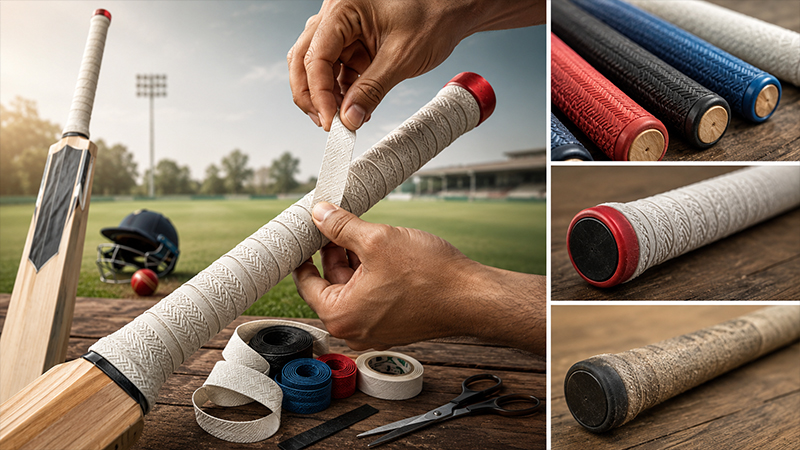
In the competitive landscape of professional sports, the equipment serves as a direct extension of the athlete’s physiological capabilities.
For the cricketer, the bat handle is the primary interface between intent and execution. While significant attention is often directed toward blade quality and grain density, the integrity of the handle grip is frequently overlooked.
This professional analysis explores the technical protocols of handle maintenance, ensuring that players maintain a mechanical advantage through precision care and strategic application.
The Mechanical Criticality of Handle Integrity
The handle of a cricket bat is not merely a lever; it is a sophisticated dampening system designed to manage high-velocity impact.
When a grip loses its structural adhesion, the results are immediate and detrimental: decreased torque, compromised directional control, and increased risk of hand injury due to excessive vibration.
Maintaining a precise grip facilitates “soft hands” in defensive play and “explosive extension” in aggressive strokes.
When the rubber surface begins to degrade or slide, the player subconsciously compensates by over-tightening their hold, leading to muscle fatigue and a loss of timing.
Therefore, grip maintenance is a fundamental requirement for consistent high-level performance.
Protocols for Resolving Structural Slippage
One of the most common issues encountered by players during intensive sessions is the upward migration or “bunching” of the grip.
This is often caused by the friction of the gloves pulling against the rubber during the backlift. Resolving this without a full replacement requires specific mechanical adjustments.
The Pneumatic Tapping Protocol
A non-invasive method to reset a sliding grip involves the use of internal air pressure. By repeatedly tapping the top of the handle with the palm, a player can create subtle air pockets that break the static friction between the rubber and the twine binding.
This allows the grip to slide back into its original, factory-set position without the need for tools.
The Roll-Down Structural Reset
In cases where bunching is more severe, a mechanical reset is necessary. The operator should roll the top section of the grip down toward the shoulders of the bat.
This compresses the rubber, allowing for a firm, manual push to reset the base of the grip. Once the base is anchored, the rubber can be pulled back up the handle, ensuring even tension across the entire surface area.
Advanced Adhesion Strategies (The Tape Protocol)
For players who exert significant torque or those playing in high-humidity environments, standard friction may be insufficient to keep the grip stationary.
A traditional, long-term solution involves augmenting the handle binding before the grip is applied.
By wrapping electrical tape around the handle, binding with the sticky side facing out, an adhesive layer is established.
When the grip is subsequently rolled over this surface, it bonds with the tape, creating a reinforced barrier against movement. This method is highly effective for heavy hitters who require absolute stability during high-impact shots.
Systematic Protocols for Grip Installation
When the tactile quality of the rubber diminishes—characterised by smoothing or tearing—a full replacement is mandatory. Professional standards dictate two primary methodologies for installation.
1. The Standard Industrial Protocol: The Grip Cone
The grip cone remains the industry standard for ensuring an even, damage-free application. The process follows a specific sequence:
- Preparation: The new grip is rolled onto the wide base of the bat cone until it forms a compact “doughnut” or “O” shape.
- Alignment: The hollow, narrow end of the cone is placed over the top of the bat handle, creating a continuous bridge for the rubber to traverse.
- Deployment: The rolled grip is slid off the cone and directly onto the handle, where it is unrolled toward the shoulders. This ensures the rubber maintains its elasticity and avoids micro-tears during the stretching process.
2. The Alternative DIY Protocol: The Low-Friction Barrier
In environments where specialised equipment like a grip cone is unavailable, an alternative low-friction method can be utilised. This involves using a thin plastic bag (such as a sandwich bag) as a temporary sleeve over the handle.
The reduced friction of the plastic allows the tight rubber grip to slide over the twine, binding with minimal resistance. Once the grip is accurately positioned, the plastic bag is cut and extracted from beneath the rubber, leaving the grip perfectly seated.
Finishing Protocols and Edge Security
The final phase of handle maintenance involves securing the interface where the grip meets the bat’s shoulders. This is a high-stress point where grips typically begin to roll upward during play.
To prevent this, a specialised finishing tape or high-grade electrical tape should be wrapped firmly around the bottom edge of the grip.
This creates a mechanical seal that prevents the grip from shifting during the execution of powerful strokes, particularly those involving significant wrist rotation.
Material Analysis and Performance Mapping
Understanding the material science behind grips is essential for tailoring equipment to specific player needs.
- Chevron/Octopus Textures: These patterns provide multi-directional friction, ideal for players who rely on aggressive, high-speed bat paths.
- Diamond/Matrix Textures: These offer a softer feel and greater vibration dampening, preferred by “touch” players who prioritize placement over power.
- Multi-Grip Systems: Some professional players prefer the “double grip” approach. While this increases the handle diameter, it also significantly enhances shock absorption, reducing the impact on the player’s elbows and wrists during long innings.
Environmental and Lifecycle Management
The lifecycle of a cricket bat grip is dictated by usage frequency and environmental exposure. Rubber is a polymer that degrades when exposed to UV light and moisture.
- Moisture Management: After playing in damp conditions, the grip should be wiped down. Moisture trapped between the grip and the binding can lead to rot in the twine or even the willow handle itself.
- Heat Sensitivity: Storing a bat in a high-heat environment (such as a car trunk) can cause the rubber to become brittle or the adhesive on the binding tape to fail.
- Replacement Cycle: For competitive players, grips should be inspected monthly. Any signs of “glazing” (where the rubber becomes shiny and loses its tackiness) indicate that the grip is no longer performing at an optimal level.
Enhanced FAQ for Professional Maintenance
Q: How many grips should I use on one bat?
A: Most professionals use one or two. A single grip offers maximum “feel” of the willow, while two grips increase the handle diameter, which can help players with larger hands or those seeking to reduce the “sting” of off-centre hits.
Q: Can I use soapy water to slide a grip on?
A: While soapy water reduces friction, it can trap moisture against the wood, potentially leading to handle damage. The plastic bag method or a grip cone is the preferred professional standard.
Q: How tight should the finishing tape be?
A: The tape should be firm enough to compress the rubber edge but not so tight that it restricts the natural flex of the handle. Two to three rotations of high-quality electrical tape are generally sufficient.
Conclusion: The Competitive Advantage of Precision
In professional cricket, the margin between a successful boundary and a caught-behind often comes down to millimetres of control.
By adhering to these rigorous maintenance protocols—from the tapping method for minor adjustments to the sticky-side-out tape hack for long-term stability—players ensure that their equipment never becomes a liability.
A well-maintained handle is the foundation of confident batting. Whether using a standard grip cone or the plastic bag DIY hack, the goal remains the same: a seamless, secure, and responsive interface that allows the athlete to focus entirely on the delivery.