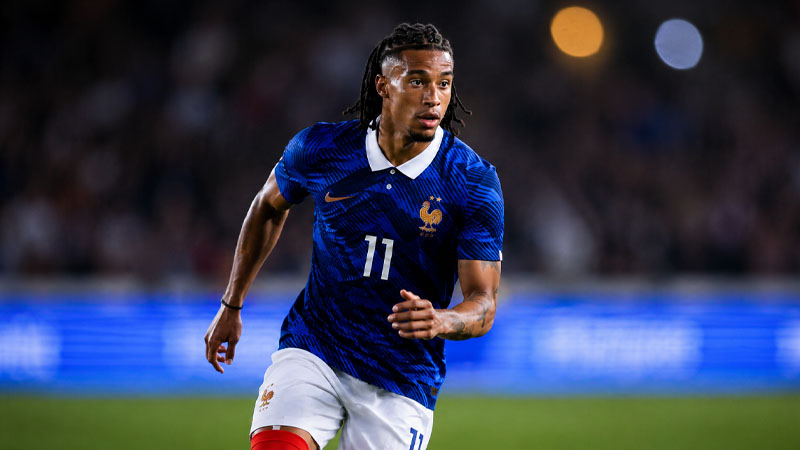
In the landscape of modern elite football, few players embody the complexities of global identity as vividly as Michael Olise.
A mercurial talent whose technical floor and creative ceiling have made him a focal point of European scouting reports, Olise represents more than just a tactical asset for a team like Bayern Munich; he represents a unique case study in international eligibility.
Born in England to a Nigerian father and a Franco-Algerian mother, Olise possessed the rare legal and cultural standing to represent any of four major footballing nations: England, France, Nigeria, or Algeria.
His ultimate decision to commit to the French national setup—a journey that culminated in a standout performance at the 2024 Olympic Games—was not a matter of convenience.
Instead, it was the result of a lifelong emotional connection, tactical alignment, and the powerful influence of historical icons.
This analysis explores the multifaceted reasons why Michael Olise chose to wear the French jersey and what his decision signals for the future of international football recruitment.
The Architecture of a Four-Way Eligibility
To understand Olise’s choice, one must first map the geography of his heritage. He is a product of London, born and raised in England, which provided his initial path into the sport.
However, the domestic environment of his upbringing was heavily influenced by his mother’s Franco-Algerian roots and his father’s Nigerian background.
1. The English Connection (Birthplace and Training)
As a London-born athlete, Olise was part of the English football ecosystem from a young age. His development within English academies provided the foundation for his professional career, and the Football Association (FA) was well aware of his potential. Despite this, England remained just one of several options for the young winger.
2. The Nigerian Heritage (Paternal Roots)
Through his father, Olise was eligible for Nigeria. The Super Eagles have a long history of successfully recruiting “dual-nationality” players from the English leagues.
For many, the prospect of representing a nation with such a passionate fanbase and a rich history in the Africa Cup of Nations is enticing. However, for Olise, the pull toward his maternal roots proved stronger.
3. The Algerian Background (Maternal Heritage)
Through his mother, Olise also held eligibility for Algeria. The Algerian national team has seen a resurgence in recent years, often building squads around players with dual French and Algerian citizenship. While this was a viable path, it remained secondary to his primary ambition.
4. The French Ties (Maternal and Cultural Connection)
The most significant pillar of Olise’s identity is his maternal connection to France. Holding dual citizenship, Olise grew up with a foot in two cultures.
While he navigated the streets of London, his internal footballing compass was often pointed toward Paris and the prestige of the French national team.
The Emotional Catalyst: Childhood Dreams and National Icons
Professional athletes at the highest level are often driven by the memories of their youth. For Michael Olise, the image of a successful footballer was inextricably linked to the French “Golden Generation.” He has explicitly stated that playing for Les Bleus was always his primary dream.
The influence of national icons cannot be overstated in this decision. Growing up, Olise admired legendary figures such as Zinedine Zidane and Thierry Henry.
These players were not just athletes; they were cultural symbols of a multicultural, successful France that dominated the world stage in the late 1990s and early 2000s.
For a young player of multi-national heritage, seeing Zidane—a player of Algerian descent—lead France to a World Cup victory provided a powerful blueprint for his own career.
This emotional tie is often the “X-factor” that data-driven recruitment cannot fully account for. While the English FA could offer proximity and the Nigerian federation could offer an immediate starting role, France offered the chance to fulfil a childhood ambition of following in the footsteps of his idols.
The Strategic Fit: France’s History of Success
Beyond the emotional connection, Olise’s decision was also a shrewd career move. France currently possesses what many analysts consider the deepest talent pool in world football.
Choosing to represent France is a testament to Olise’s confidence; he did not choose the path of least resistance, but rather the path with the highest competitive ceiling.
Tactical Synergy and Development
Olise previously represented France at youth levels, which allowed him to integrate into the French Football Federation’s (FFF) tactical systems early on.
He found a strong connection to the French setup, noting their consistent history of success and professional structure. For a player who values technical precision and high-level tactical execution, the French philosophy of play aligned perfectly with his personal style.
The Prestige of the Setup
By choosing France, Olise positioned himself within a system that is a perennial contender for European and World titles. The “value” of a French international cap is among the highest in the sport, offering a level of global visibility and professional prestige that few other nations can match.
The Olympic Milestone: The Thierry Henry Factor
If there was any lingering doubt about Olise’s commitment to France, it was erased during the 2024 Olympic Games. This tournament served as a critical turning point in his international narrative.
Playing under the management of Thierry Henry—one of the very idols who inspired his dream—Olise became the heartbeat of the French Olympic squad.
Henry, recognizing Olise’s unique creative abilities, gave him the freedom to operate as a primary playmaker.
The result was a silver-medal performance that captivated the French public and solidified his status within the national hierarchy.
The mentorship of Henry provided a bridge between Olise’s childhood aspirations and his adult reality. To be coached and validated by a figure like Henry served as the ultimate confirmation that his choice to represent France was the correct one.
This experience did more than just win a medal; it cemented his place in the French setup and demonstrated to the senior team management that he was ready for the highest level of international competition.
Analytical Perspective: The Future of Multi-National Talent
Olise’s story is a harbinger of the future of international football. As the world becomes more interconnected, more players will find themselves at the crossroads of multiple national identities.
For national federations, the lesson of Michael Olise is clear: recruitment is no longer just about geography; it is about culture, inspiration, and long-term vision.
France’s ability to win Olise’s loyalty was not just a result of his mother’s citizenship, but a result of a decades-long cultural project that made the French jersey a symbol of excellence for children across the globe.
Frequently Asked Questions
Could Michael Olise have played for England?
Yes. Since he was born and raised in England, he was fully eligible for the English national team. He participated in English youth systems but never made a senior appearance, allowing him to switch his permanent allegiance to France.
Why didn’t he choose Nigeria or Algeria?
While he has deep respect for his father’s Nigerian roots and his mother’s Algerian heritage, his personal career aspirations and childhood dreams were more closely aligned with the French national team. He felt a stronger connection to the French footballing history and their specific system of play.
What role did Thierry Henry play in his decision?
Henry was a massive influence, both as a childhood idol and as his coach during the Olympics. The opportunity to win a silver medal under Henry’s guidance helped solidify Olise’s commitment to the French setup.
Is Michael Olise’s decision final?
Once a player represents a nation in a competitive senior international match, their eligibility is typically locked to that nation under FIFA rules. Following his involvement in the French senior setup and the Olympics, his future remains firmly with Les Bleus.
Heritage and Decision Factors
| Nation | Eligibility Basis | Status |
|---|---|---|
| France | Maternal Heritage / Dual Citizenship | Primary Choice |
| England | Birthplace / Upbringing | Eligible (Declined) |
| Nigeria | Paternal Heritage | Eligible (Declined) |
| Algeria | Maternal Heritage | Eligible (Declined) |
Key Decision Drivers:
- The “Dream” Factor: A lifelong desire to play for France.
- Iconic Influence: Admiration for Zidane and Henry.
- Success Track Record: Preference for the French team’s history of winning.
- Olympic Validation: A silver medal win under the French flag.
Final Reflections
Michael Olise’s journey to the French national team is a narrative of identity, ambition, and the power of sporting legacy.
By choosing France, he has not only fulfilled a personal dream but has also challenged himself to succeed in the most competitive environment in international football.
As he continues his career at both the club and international levels, his “multilateral heritage” will remain a core part of his story—a story that began in London but found its heart in the blue of France.