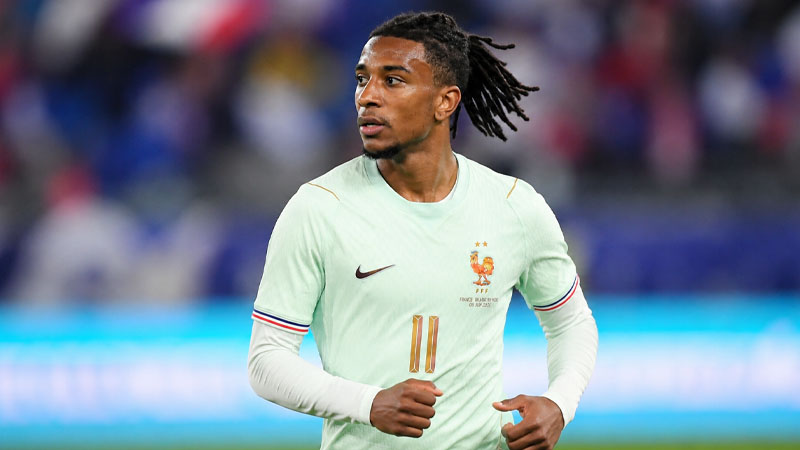
The modern football landscape is increasingly defined by athletes whose identities transcend single borders.
At the forefront of this evolution stands Michael Olise, a talent whose international trajectory has sparked intense discussion across London, Paris, Lagos, and Algiers.
While his technical prowess on the pitch is undeniable, it is his unique heritage—a complex tapestry of five distinct nations—that makes him one of the most culturally significant figures in the sport today.
The Architect of a Multi-National Identity
To understand Michael Olise is to understand the geography of his upbringing and his ancestry. Born in Hammersmith, London, Olise is a British citizen by birthright.
Growing up in the English capital, he developed his foundational skills within the English academy system, even representing England at the youth level during the early stages of his career. However, his domestic origins only tell a fraction of the story.
His family background provides a roadmap of eligibility that few players in history can match. Olise’s heritage includes:
- France: His primary international allegiance, held through his Franco-Algerian mother.
- Great Britain: His country of birth and citizenship.
- Nigeria: Eligibility derived through his British-Nigerian father.
- Algeria: Connections through both his maternal roots and paternal heritage.
- Haiti: A further link was established via his wider maternal heritage.
This five-way eligibility placed Olise in a rare position where multiple continental giants—the Super Eagles of Nigeria and the Desert Warriors of Algeria, alongside the Three Lions of England—all maintained a keen interest in his development.
The French Selection: A Personal Affinity
Despite the various paths available, Olise’s decision to commit to France was not merely a tactical career move but a choice rooted in identity.
While many players born in the United Kingdom choose to represent the home nations, Olise has long maintained a deep personal affinity for France.
This connection was solidified when he made the high-profile decision to switch his international allegiance from the English system to the French youth setups.
For many observers, the move was a testament to the player’s internal sense of belonging. In an era where “dual-national” is a common term, Olise’s preference for Les Bleus underscores that birthplace does not always dictate a player’s emotional or cultural home.
From Olympic Silver to Senior Stardom
The validation of Olise’s choice arrived on the world stage in 2024. Representing France at the Olympic Games, he was instrumental in leading the squad to a silver medal.
His performances during the tournament acted as a bridge between his reputation as a rising star and his status as an elite international.
Following his success at the Olympics, Olise achieved the pinnacle of his international journey by making his debut for the French senior national team.
By stepping onto the pitch for the senior side, he officially committed his future to France, effectively closing the door on the other four nations that had hoped to secure his services.
This milestone marked the culmination of years of speculation and confirmed his role as a key component of France’s next golden generation.
The Broader Impact on International Football
Olise’s story is emblematic of a broader trend in global football where heritage is becoming as influential as geography.
National federations are now forced to operate like corporate recruiters, identifying talent with multiple citizenships earlier than ever before.
For the Nigerian and Algerian federations, Olise represents the “one that got away”—a player who could have transformed their respective attacking lineups.
For England, his departure from their system highlights the challenges of retaining elite talent in a multicultural society where players have genuine emotional ties to other nations.
Frequently Asked Questions
Why did Michael Olise choose France over England?
While born and raised in London, Olise has a significant personal connection to France through his mother. His choice was driven by this internal affinity and the clear pathway provided by the French Football Federation, starting from the youth levels and culminating in his senior debut.
Could he have played for Nigeria or Algeria?
Yes. Through his father’s Nigerian roots and his mother’s Algerian heritage, he was fully eligible for both African nations. Both countries reportedly monitored his progress closely before he committed to France.
What is his current international status?
He is a full French international. Having made his senior team debut for France, he is now tied to the nation for competitive fixtures, moving past his earlier status as an England youth representative.
What are his major international achievements?
His standout achievement to date is winning the silver medal with the French team at the 2024 Olympic Games, a feat that served as a precursor to his integration into the senior squad.
The Blueprint for Future Generations
The case of Michael Olise serves as a masterclass in navigating a complex identity in a high-stakes professional environment. He has managed the pressures of multiple federations with a level of maturity that matches his on-field composure.
By choosing the path that aligned with his personal heritage rather than his immediate surroundings, he has set a precedent for other multi-national athletes.
As he continues to develop his career at the highest levels of European club and international football, Olise remains a symbol of the modern, interconnected world.
His story is no longer just about where a player is from, but about the diverse roots that shape who they are.
Conclusion: A Legacy in the Making
Michael Olise’s journey from Hammersmith to the heart of the French national team is a narrative of cultural pride and professional excellence.
By embracing his Franco-Algerian and British-Nigerian roots, he has crafted a unique identity that resonates far beyond the pitch. For fans and analysts alike, he represents the future of the game—a future that is global, diverse, and defined by personal choice.