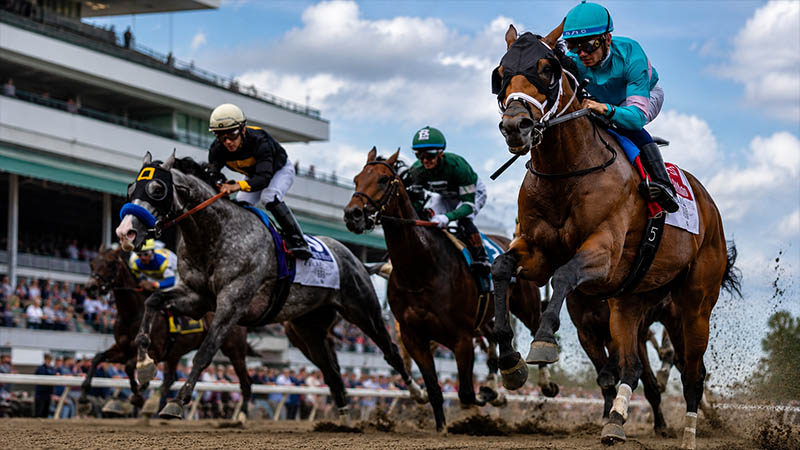
On their face, college football and horse racing seem as far apart on the sporting spectrum as tiddlywinks and shot put. One is a billion-dollar industry commanding national attention from August to January; the other is a niche sport occupying a brief five-week blip of the calendar.
Yet, beneath the surface, both are besieged by the same afflictions: greed, self-interest, and a comical inability to work together.
In trying to maximize their own immediate returns, horse racing entities are executing a “bait-and-switch” that leaves the Triple Crown in peril, drawing directly from the college sports playbook where backdoor meetings are all about self-preservation.
The Preakness Shift and the Triple Crown in Peril
The latest controversy in horse racing centers on a major calendar disruption. Maryland Governor Wes Moore recently announced that the Preakness Stakes—the traditional second leg of the Triple Crown—is moving from its traditional third Saturday in May to the fourth Sunday of the month.
Taken alone, it seems like a good idea. For years, horsemen and horsewomen have argued that running the Preakness a mere two weeks after the Kentucky Derby no longer suited today’s equine athletes.
Indeed, three of the last five Derby winners bypassed the Baltimore-based race, putting the Triple Crown quest to rest before it even got started.
However, much like college sports, no single decision happens in a vacuum. Just two days before Maryland’s announcement, Churchill Downs, Incorporated and the New York Racing Association (NYRA) announced a partnership to form a six-race thoroughbred racing series, which includes the Triple Crown’s third leg, the Belmont Stakes.
Crucially, the Belmont is holding firm on its traditional run date on the first Saturday in June.
The result? Instead of having a reasonable recovery period, horses will now need to run the Belmont just 13 days after the Preakness.
In a sport that constantly preaches how it puts the safety of its animals first, horses will be asked to run the longest race (the Belmont at one-and-a-half miles) after the shortest period of recovery.
It is a maneuver Governor Moore celebrated during a Maryland-thumping news conference, saying, “If you want to win the Triple Crown, we’ll see you in Baltimore”—conveniently bypassing the fact that winning the Triple Crown also requires going to Louisville and Long Island.
The “Backdoor” Playbook: No Commissioner, No Cooperation
This calendar collision is a direct consequence of decentralized power. Much like college sports, horse racing operates without a central commissioner to keep things on track and keep the greater good at the forefront. Instead, horse racing entities solve only for themselves, jockeying for position and precious broadcast deals.
The self-interest and infighting have been fierce. Churchill Downs tried to buy the Preakness’s intellectual property in April, prompting Maryland’s Governor Moore to loudly rebuke: “We cannot control our own future if we don’t own it”.
Had they worked together, NYRA, Churchill, and the Maryland Jockey Club could have adjusted the calendar in a way that kept their races intact and the Triple Crown viable. Instead, each faction carved out its own slice of the pie, resembling the power conferences of college football:
- Churchill Downs (acting like the SEC) keeps its tradition and lines its pockets with additional revenue through the Derby and the new series.
- NYRA (acting like the Big Ten) gets four series races on its tracks and a share of the revenue pot.
- Maryland (acting like the ACC) gets to cling to its own small corner of the market.
What’s Lost in the Shuffle?
Some insiders, including trainer Bob Baffert, have defended the new order. Baffert, who won the last two Triple Crowns, believes the new calendar keeps the difficulty of the Triple Crown alive while incentivizing Derby winners to run in the Preakness. He contends that the “superhorses” will still attempt the Belmont and that winning two legs makes it harder to bypass the third.
But recent history indicates otherwise, and the entire situation could have been fixed with just a little teamwork.
The Triple Crown is synonymous with horse racing, familiar even to casual fans. Other than the Derby, Preakness, and Belmont, only the Breeders’ Cup pulls in more than $100 million in bets each year. Dating back to Sir Barton in 1919 and Justify in 2018, the Triple Crown is revered for its difficulty, rarity, and history.
The raw magic of the event is undeniable. For sports fans, few moments compare to the cathartic and euphoric roar that followed American Pharoah from the final turn to well beyond the finish line in 2015 to break the 37-year Triple Crown hex.
Yet somehow, this legendary pursuit has become a mere line item in corporate transacting, with the greater good lost to infighting. Ultimately, horse racing officials have decided to follow the college football route and think only of themselves, risking wrecking their own very good thing.