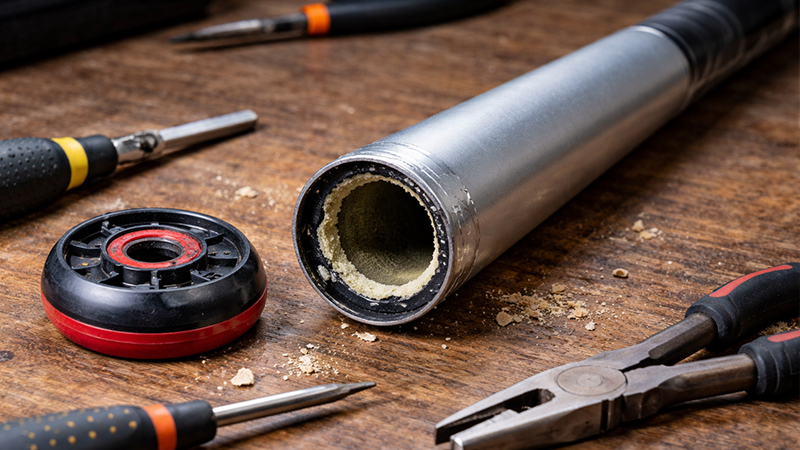
In the world of high-stakes tournament play, the term “Bat Doctor” is whispered with a mix of curiosity and caution. The primary reason for removing a bat’s end cap is to access the internal barrel.
Specialized “doctors” are known to have proprietary methods to shave the bat’s walls from the inside, potentially using techniques involving compressed air to achieve a thinner, more reactive surface.
However, for most players, the need to remove an end cap stems from structural failure. In high-impact scenarios—particularly for power hitters—the factory adhesive often fails, leading to end caps flying off during play.
Whether you are attempting a performance modification or a structural repair, the process is a high-stakes endeavor that requires industrial-grade materials and extreme precision.
The Structural Reality: Why “Over-the-Shelf” Solutions Fail
The most common mistake amateur players make when attempting to DIY a bat repair is underestimating the physics of a composite barrel. During a hit, the barrel undergoes intense flexing and vibration.
Through extensive testing of various products, it has been determined that there are zero commercial, over-the-shelf products strong enough to hold an end cap in place under these conditions.
Standard household glues or hardware store epoxies lack the specific properties required for sports equipment:
- Flexibility: The adhesive must be able to flex in both extreme heat and freezing cold in sync with the composite barrel.
- Bond Strength: It must withstand the centrifugal force and impact vibration of a 100mph+ swing.
- Visual Integrity: The finished bond must pass a visual inspection by tournament officials to ensure the player is not banned for suspected tampering.
The High Cost of Professional-Grade Modification
If you are committed to removing and replacing an end cap correctly, be prepared for a significant financial investment. Finding the correct adhesive often requires sourcing from companies that provide materials for industrial assembly lines and manufacturing.
The materials alone can cost over $100, which represents a significant portion of the cost of a new $250 composite bat. Furthermore, these specialized chemicals are not designed for long-term storage.
Once the chemicals are used and the containers are resealed, they typically dry out within approximately two months and must be discarded.
This creates a “maintenance window” where you must time your repairs to align with your tournament schedule to avoid wasting expensive supplies.
The Technical Process: A Step-by-Step Overview
Removing the end cap is only the first step in a “pain in the ass” process that becomes a grueling maintenance cycle. Doing it “the right way” involves a multi-step industrial process:
1. Precision Removal
While the exact mechanical tools used by “Bat Doctors” are often kept secret, the goal is to break the factory seal without scarring the composite rim of the barrel.
Any visible damage to the outer edge of the bat is a red flag for officials and can lead to immediate disqualification.
2. Chemical Preparation and Mixing
The restoration requires precise mixing of industrial-grade chemicals. This isn’t a simple “squeeze and go” application; the ratio must be perfect to ensure the adhesive retains its flexibility across different temperatures.
3. Managing Internal Debris
A critical part of the process is ensuring that no residue or adhesive fragments remain inside the barrel. If even a tiny piece of dried glue breaks off inside, it creates a “rattle”.
In most sanctioned associations, a bat with an internal rattle is automatically removed from play as it suggests internal tampering or structural failure.
4. Seating and Gas Management
When the end cap is reset, the chemical reaction of the industrial adhesive can create gas expansion. If left unchecked, this gas expansion can partially unseat the cap as it dries, leaving a gap that proves the cap has been opened.
To prevent this, the end cap must be taped down securely to maintain a vacuum-like seal during the initial setting phase.
5. The Curing Phase
Unlike standard glue that dries in minutes, professional bat modification requires a lengthy curing period. The bat must be set in direct sunlight and weighted down for several days until completely dry. This ensures the bond is deep and the chemicals have reacted fully with the composite material.
The “Bat Math”: Maintenance for the Elite Player
For those playing at a high volume—such as 300 games a year—bat maintenance becomes a statistical necessity. A high-level power hitter can go through 13 to 16 composite bats a year, not including those with repairable end plug issues.
Keeping a bag of 10 to 12 bats is common for players navigating different associations and dealing with frequent breakage.
When you factor in the $250 price tag per bat and the $100 recurring cost for specialized adhesives, the “Art of the Bat Doctor” becomes an expensive and time-consuming hobby.
The Ultimate Warning: “Be Careful What You Wish For”
The risks of DIY end cap removal often outweigh the rewards for the average player. The sources provide a stern warning: “Be careful what you wish for”. Once an end cap is removed, there is a very real possibility that it will never stay on properly again.
Beyond the mechanical failure, there is the professional risk. If you “botch” the repair—whether through a visible glue line, a slightly unseated cap, or an internal rattle—you face a permanent ban from your association.