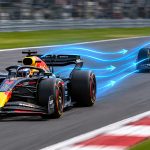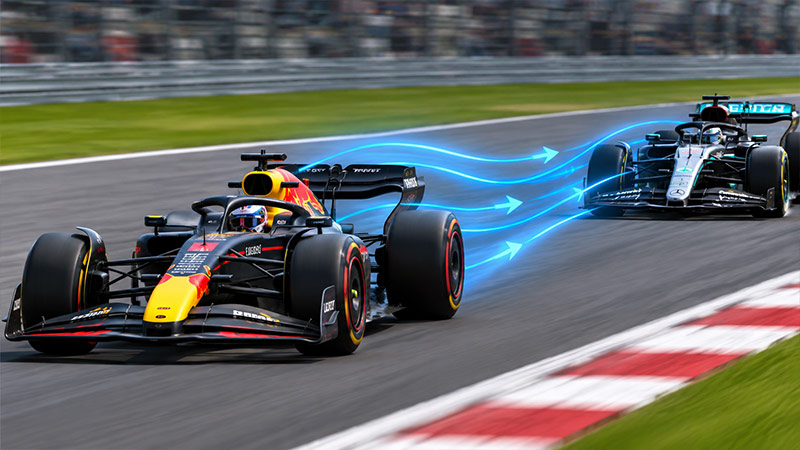
Picture two Formula 1 cars racing down a long straight at more than 300 km/h. The car behind is glued to the gearbox of the one in front.
Then, just before the braking zone, it darts out and blasts past. It needs no extra horsepower. It simply uses the air.
That move is powered by the slipstream, one of the oldest and most important tricks in motorsport.
A slipstream in F1 is the pocket of low-pressure, slower-moving air directly behind a car. A driver who tucks into it faces less drag, so their car gains speed on the car ahead.
Understanding the slipstream changes how you watch a race. It explains late lunges at Monza, tense qualifying tactics, and why drivers sometimes refuse to lead the pack. It also shows how F1’s 2026 rules are reshaping overtaking.
What Is a Slipstream in F1?
In Formula 1, a slipstream, also called a “tow” or a “draft”, is the reduced-drag zone created behind a moving car. The car ahead punches a hole through the air. The car behind travels through that hole with far less effort.
Think of cycling into a strong headwind. Ride alone, and you fight every gust. Tuck in behind a friend and the pedalling suddenly feels easier. F1 cars feel the same effect, only at speeds above 300 km/h, where air resistance is the biggest force holding a car back.
Key terms you will hear on a race broadcast:
- Slipstream: the low-drag wake behind a car.
- Tow: a slipstream given on purpose, often by a teammate in qualifying.
- Draft: the American term, common in NASCAR and IndyCar coverage.
- Slingshot: the overtake that follows, when the chasing car pulls out of the wake and uses its extra speed to pass.
The Physics Behind the Slipstream
Drag is the force that pushes back on a car as it moves through air. Engineers describe it with the standard drag equation:
Drag force (Fd) = ½ × ρ × v² × Cd × A
Here ρ is air density, v is the car’s speed relative to the air, Cd is the drag coefficient, and A is the frontal area. The key term is v squared. Double the speed and drag quadruples. The power needed to beat that drag rises even faster, with the cube of speed.
F1 cars carry large wings and shaped floors that create downforce for grip in corners. That downforce comes with a heavy drag penalty. So an F1 car fights far more air resistance than a road car of similar size.
As the lead car moves, it shoves air aside and leaves a turbulent, slower-moving wake behind it. Much of that air is already being dragged along in the same direction as the cars. The following car therefore meets air at a lower relative speed, and its drag falls.
Less drag means the same engine power pushes the car harder. The chasing car gains speed on the straight and closes the gap with every metre.
How big is the gain? It depends on the track, the car design and the gap, so treat these figures as approximate:
- A close tow on a long straight can add roughly 5 to 10 km/h of top speed.
- In qualifying at a low-downforce circuit such as Monza, a well-timed tow can be worth a few tenths of a second per lap.
- The effect is strongest within about half a second of the car ahead and fades as the gap grows past one second.
Slipstream vs DRS vs Dirty Air
These three terms often get mixed up. They are linked, but they are not the same thing.
| Feature | Slipstream | DRS (2011–2025) | Dirty air |
|---|---|---|---|
| What it is | Natural low-drag wake behind a car | Driver-operated rear-wing flap that sheds drag | Turbulent wake that disrupts the following car’s aerodynamics |
| Where it acts | Straights | Set DRS zones on straights | Corners |
| Who controls it | Physics; the driver chooses where to place the car | Race rules: within one second at a detection point | Nobody; a side effect of the car ahead |
| Effect on the chasing car | Higher top speed | Higher top speed, roughly 10 to 12 km/h (approximate) | Less downforce, less grip, more tyre sliding |
| Status in 2026 | Still present | Replaced by active aerodynamics and an overtake mode | Still present, but reduced by modern car design |
The slipstream and dirty air are two sides of the same wake. On a straight, that disturbed air is a gift. In a corner, it is a curse.
That trade-off is why following closely through fast bends is so hard. It is also why F1 redesigned its cars in 2022 around ground-effect floors, which make the wake far less damaging to the car behind.
How F1 Drivers Use the Tow
The slipstream is a tool, and the best drivers use it with precision. It shows up in three main ways.
Overtaking: the slingshot move
A classic slipstream pass follows four steps:
- Nail the corner exit. A strong exit onto the straight matters more than anything else.
- Sit in the wake. Stay directly behind the rival to cut drag and build speed.
- Pull out late. Move to the side just before the braking zone, so the car ahead has no time to react.
- Brake later and complete the pass. Use the extra speed to draw alongside and claim the corner.
Timing is everything. Pull out too early, and the speed advantage bleeds away before the corner. Pull out too late and there is no room to finish the move.
Qualifying: the art of the tow
In qualifying, drivers race the clock rather than each other. A tow on the straights can still trim valuable time from a lap. Teams sometimes plan it, with one teammate running ahead to give the other a tow.
At the 2021 Abu Dhabi Grand Prix, Sergio Pérez gave Red Bull teammate Max Verstappen a tow in Q3. Verstappen took pole position.
The tactic can also backfire. In Q3 at the 2019 Italian Grand Prix, most drivers crawled around their final out-lap, each waiting for someone else to lead. Most failed to start a final flying lap before the chequered flag.
Race strategy and teamwork
In the race, a tow is about more than one pass. Running in a rival’s wake cuts fuel and energy use on the straights. A driver can sit close, save energy and attack later in the stint.
Teammates can help each other too. A car ahead can offer a tow to pull a teammate clear of a pack or to help them defend.
The Hidden Costs of Following Closely
The slipstream is not free speed. Sitting in another car’s wake brings real costs:
- Overheating: Less clean air reaches the radiators and brakes. Temperatures climb, and engineers may ask the driver to drop back and cool the car.
- Lost downforce in corners: The same wake that helps on the straight starves the wings and floor of clean air in the bends. The car slides and feels unstable.
- Tyre wear: That extra sliding overheats the tyres, especially the fronts. Grip can suffer for several laps afterwards.
- Braking risk: With less drag and less downforce, the car slows less sharply under braking. Misjudge the braking point and a lock-up or a collision can follow.
- Poor visibility in the wet: Spray from the car ahead can cut a driver’s view to almost nothing.
The best drivers balance these costs. They close in on the straights, then back off slightly through fast corners to let the car breathe. Knowing when to attack and when to wait is a large part of elite racecraft.
Where the Slipstream Matters Most
The longer the flat-out section, the bigger the tow. These circuits are where the slipstream plays the starring role:
| Circuit | Key flat-out section | Why the tow matters |
|---|---|---|
| Monza, Italy | Main straight and the run through the chicanes | The lowest-downforce track on the calendar; a tow is vital in qualifying |
| Baku, Azerbaijan | Roughly 2 km flat-out run along the seafront | One of the longest full-throttle stretches in F1, ideal for late slingshot passes |
| Spa-Francorchamps, Belgium | Kemmel Straight after Eau Rouge | A classic place to slingshot past into Les Combes |
| Las Vegas, USA | The Strip straight, close to 2 km | Long straight and cool night air reward a well-timed tow |
| Mexico City, Mexico | Long run from the grid to Turn 1 | Thin air at altitude cuts drag overall, yet the start still produces huge tows |
On tight, twisty tracks such as Monaco, the slipstream barely matters. Straights are short, and dirty air makes following closely in the corners very difficult.
The Slipstream in the 2026 Era
The 2026 season brought F1’s biggest rule change in years. It reshapes how the slipstream fits into wheel-to-wheel racing.
- DRS is gone. Active aerodynamics replaced it. Every car can open movable elements on the front and rear wings on designated straights, whether it is following another car or not.
- A new overtake mode. A car running within about one second of the car ahead can use extra electrical energy to attack.
- Lighter, slipperier cars. The FIA targeted roughly 30% less downforce and around 55% less drag than the previous generation (approximate figures).
- More electric power. Electrical output now makes up close to half of the power unit’s total, so energy management on the straights matters more than ever.
What does this mean for the tow? The physics have not changed. A car in another’s wake still meets less drag.
The difference is how the tow interacts with energy. A driver who saves battery in a slipstream early on a straight may have more to deploy for an attack later in the lap.
The slipstream stays a core racecraft skill, working alongside the new tools rather than being replaced by them.
Conclusion
The slipstream is one of the simplest ideas in Formula 1, yet it shapes every race. A car in front punches a hole through the air, and the car behind uses that low-drag pocket to gain speed, close the gap and set up a pass.
Mastering it takes precise timing, a strong corner exit and judgement to manage heat, tyres and braking. From Monza’s straights to the new 2026 rules, the tow remains a core skill that separates good racecraft from great.