Picture the scene. It’s the closing stages of the 2021 Azerbaijan Grand Prix, the championship fight is on a knife-edge, and the race leader’s tyre has just failed on the main straight. Soon, every marshal post on the circuit is waving red.
The race is frozen, the pit lane fills with cars and mechanics, and strategists start doing the maths on what happens next.
That is the power of the red flag in F1. It is the only signal that stops a Grand Prix completely, and it can rewrite a result in the time it takes to change a set of tyres. Some drivers are rescued by it. Others watch a certain podium slip away.
In this guide, we break down everything you need to know: what a red flag means, why race control shows it, what happens in the pit lane during the stoppage, how restarts and points work, and the famous moments that turned red flags into F1 legend.
What Is a Red Flag in F1?
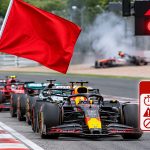
A red flag in F1 is the signal that a session has been suspended. It is the most serious flag in the sport’s signalling system, and it overrides every other instruction on track.
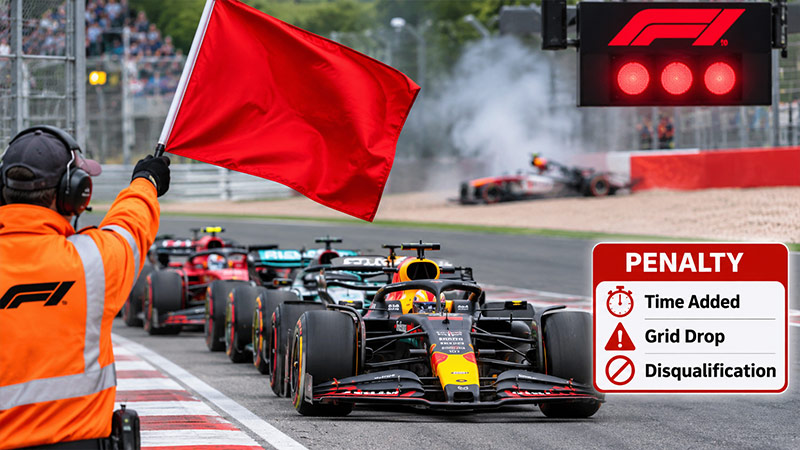
When race control decides to stop a session, red flags are waved at every marshal post around the circuit at the same time.
Red lights appear on the trackside light panels and at the start line, and “RED FLAG” flashes across the official timing screens and the teams’ pit wall systems. Drivers hear it on the radio within seconds.
The instructions to drivers are simple and absolute. Slow down immediately, do not overtake, be prepared to stop, and return to the pit lane at reduced speed.
Think of it as a full pause button. A safety car keeps the field circulating in formation, but a red flag halts competition entirely. Nothing restarts until the race director is satisfied the circuit is safe for full-speed racing again.
Why Race Control Shows a Red Flag
Every red flag comes down to one principle: the risk of continuing is greater than the cost of stopping. The race director makes the call, using dozens of camera feeds, live GPS tracking of every car and constant contact with marshals and the medical team.
The most common triggers are:
- Serious accidents. When a driver may be hurt, needs extraction, or a car is stranded in a dangerous spot, medical and recovery crews need a clear track to work safely.
- Barrier damage. Crash barriers, tyre walls and energy-absorbing barriers must be fully repaired before cars pass at speed again, and that work is impossible with traffic flowing.
- Heavy debris or fluids. Large pieces of carbon fibre, gravel spread across the racing line, or oil on the surface can turn a fast corner into a hazard.
- Extreme weather. Torrential rain, standing water and near-zero visibility create a real risk of aquaplaning, so racing stops until conditions improve.
- Track and infrastructure failures. A loose drain or valve cover can be catastrophic. At the 2023 Las Vegas Grand Prix, Carlos Sainz’s Ferrari struck a loose water valve cover just minutes into first practice, and the session was stopped.
- Fires and other hazards. A car fire, a person or animal on track, or any situation that puts marshals in danger can bring out the red flag.
A red flag is never a punishment. It is the sport’s way of protecting drivers, marshals and spectators when the usual tools, such as yellow flags or a safety car, are not enough.
What Happens After a Red Flag: Step by Step
The procedure that follows a red flag is tightly choreographed. Here is how it unfolds from the moment the flag appears to the moment racing resumes.
- The signal goes out. Red flags wave at every marshal post, red lights switch on, and timing screens and team radios confirm the suspension.
- Drivers slow down. Overtaking is banned, and drivers proceed carefully, ready to stop if marshals or vehicles are on track.
- Cars enter the pit lane. Each car drives into the pit lane and forms a single queue in the fast lane, in running order.
- The pit exit closes. No car can leave the pit lane until race control reopens it.
- Teams get to work. Mechanics can change tyres, swap a damaged front wing, clear debris from radiators and make permitted adjustments. Drivers often climb out, rehydrate and talk through tactics with their engineers.
- The track is cleared. Marshals recover stranded cars, sweep debris, and repair barriers, while the medical team attends to anyone involved.
- Race control sets the restart. Teams receive a resumption time with countdown warnings, the cars leave the pit lane behind the safety car, and the field lines up for the restart.
The race clock matters too. Time spent under a red flag does not count toward the two-hour limit for racing, but the whole event, stoppages included, must finish within a three-hour window.
Red Flag vs Safety Car vs Virtual Safety Car vs Yellow Flag
A red flag sits at the top of F1’s escalation ladder. Race control reaches for it only when slowing the field is not enough and the session must stop completely.
| Signal | What it means | Cars on track? | Overtaking | Pit stop cost |
|---|---|---|---|---|
| Yellow flag | Hazard nearby, slow down | Yes, at racing speed elsewhere | Banned in that zone | Normal |
| Double yellow flag | Serious hazard, be ready to stop | Yes, slowed through that zone | Banned in that zone | Normal |
| Virtual Safety Car | Every driver holds a set slower pace | Yes, at reduced speed | Banned | Reduced |
| Safety Car | Field bunched up behind the safety car | Yes, in formation | Banned | Greatly reduced |
| Red flag | Session suspended | No, all cars in the pit lane | Banned | Free tyre change |
The key difference is simple. Under every other signal, the race continues in some form. Under a red flag, it stops.
How a Race Restarts After a Red Flag
In most cases, an F1 race resumes with a standing start from the grid, just like the start of the Grand Prix. That single detail is why red flag restarts are among the most thrilling moments in the sport.
For several seasons, restarts happened behind the safety car, with the field released in a rolling start. The modern rules favour a standing restart, which gives every driver a fresh launch and a real chance to gain or lose positions into the first corner.
The restart follows a clear sequence:
- Grid order. Cars line up in the running order recorded at the time of the suspension, not the order in which they happened to queue in the pit lane.
- Formation behind the safety car. The field leaves the pit lane behind the safety car, completes a lap to bring tyres and brakes up to temperature, and then forms up on the grid.
- Lights out. The usual start light sequence runs, and racing resumes the moment the lights go out.
In very wet conditions, race control may choose a rolling restart behind the safety car instead. Laps completed before the stoppage still count toward the scheduled distance, so the race continues until the planned lap total or the time limit is reached, whichever comes first.
The restart is also a test of nerve. Tyres are cold, brakes may not be at their best, and drivers know a strong launch can win the race. That pressure has produced some of the most dramatic opening corners in recent memory.
Red Flags in Qualifying and Practice
Red flags are not limited to the race. In qualifying, they can decide pole position in an instant.
When a red flag appears during qualifying, the session clock stops and every driver must abandon the lap in progress.
Any lap not completed before the flag is lost. Once the track is clear, the clock restarts with the remaining time, which often creates a frantic scramble as the whole field tries to set a lap in the final minutes.
Timing is everything. A red flag late in the final segment can freeze the order and hand pole to whoever set the fastest lap before the stoppage. At the 2021 Monaco Grand Prix, Charles Leclerc crashed at the Swimming Pool section during the final runs of Q3.
The red flag ended the session, so nobody could improve, and Leclerc kept pole position. Cruelly, a driveshaft problem meant he could not start the race the next day.
Because a red flag can protect a provisional result, the stewards look closely at every qualifying stoppage. A driver judged to have stopped or crashed on purpose can lose lap times and face further penalties.
In practice sessions, a red flag simply costs running time, and that time is generally not added back. For teams testing new parts or race setups, a long stoppage can disrupt a carefully planned programme.
Strategy: The “Free Pit Stop” and Who Wins or Loses
A red flag can turn race strategy upside down, because teams are allowed to change tyres during the stoppage without losing any time.
A normal pit stop costs roughly 20 to 25 seconds once you include the drive through the pit lane. Under a red flag, that cost drops to zero.
Every driver gets fresh tyres, and in a dry race, switching to a different compound during the stoppage can satisfy the rule requiring two different tyre compounds. Many drivers simply fit the hardest available tyre and run to the flag without stopping again.
That creates clear winners and losers:
- Winners are drivers who had not yet pitted. They get a free stop and keep their track position.
- Losers are drivers who pitted shortly before the red flag. They paid the full time cost for a stop everyone else just received for free.
The 2023 Australian Grand Prix showed this perfectly. George Russell pitted under an early safety car, only for a red flag to follow moments later. Rivals who stayed out changed tyres for free, and Russell lost the positions his stop had cost him.
Repairs matter just as much. A driver carrying a damaged front wing would normally have to pit and drop down the order. During a red flag, that wing can be replaced at no cost, rescuing a race that looked lost.
The smartest strategists factor in the chance of a stoppage. At street circuits with tight walls, or when rain is approaching, teams sometimes delay a stop and gamble that a red flag will hand them a free one.
Famous Red Flag Moments in F1 History
Some of the most talked-about races of the modern era were shaped by a red flag. Each of these moments changed a result, a career or the rules themselves.
| Year | Grand Prix | What happened | Why it mattered |
|---|---|---|---|
| 2023 | Australian | Three red flags, including a chaotic late standing restart with several collisions | Sparked a wide debate about late-race restarts |
| 2022 | Japanese | Heavy rain stopped the race early; it resumed hours later over a shortened distance | Full points were awarded, Max Verstappen clinched the title, and the points rules were clarified |
| 2022 | British | Zhou Guanyu’s car flipped and slid into the barrier at Turn 1 on the opening lap | Zhou walked away, and the halo was widely credited with protecting him |
| 2021 | Belgian | Torrential rain meant only a few laps were run behind the safety car | Half points were awarded with no green-flag racing, which led to a rules overhaul |
| 2021 | Azerbaijan | A late tyre failure for Verstappen led to a two-lap sprint from a standing restart | Lewis Hamilton ran wide at Turn 1, and Sergio Pérez won |
| 2020 | Bahrain | Romain Grosjean’s car split in two and caught fire after hitting the barrier | He escaped in under 30 seconds, a landmark moment for F1 safety |
| 2020 | Italian | A heavy crash for Charles Leclerc stopped the race | Pierre Gasly went on to take a famous first win |
| 2014 | Japanese | The race was stopped after Jules Bianchi’s crash, which left him critically injured | His accident led directly to the creation of the Virtual Safety Car |
| 2011 | Canadian | Rain suspended the race for around two hours | Jenson Button won after more than four hours, the longest race in F1 history |
Together, these moments show the two faces of the red flag. It is the sport’s most important safety tool, and it is also one of the biggest wildcards in any Grand Prix.
What Happens If the Race Cannot Resume?
Sometimes the track cannot be made safe in time, or the weather never improves. In that case, the race ends under the red flag and the stewards declare a result based on the running order before the stoppage.
After the 2021 Belgian Grand Prix, where points were awarded without any real racing, F1 introduced a sliding scale. The share of points now depends on how much of the scheduled distance was completed under green-flag conditions.
| Race distance completed | Points awarded | Points for the winner |
|---|---|---|
| Fewer than 2 green-flag laps | No points | 0 |
| 2 laps up to 25% | Top 5 finishers | 6 |
| 25% up to 50% | Top 9 finishers | 13 |
| 50% up to 75% | Top 10 finishers | 19 |
| 75% or more | Full points | 25 |
Time limits apply as well. Racing cannot run for more than two hours, and the entire event, including any suspension, must finish within three hours. If the clock runs out before the scheduled lap total, the race ends early.
Formula 1 reviews its Sporting Regulations every season, and these details can change. For the final word on any rule, check the current FIA Formula One Sporting Regulations for the season you are following.
Conclusion
A red flag in F1 is far more than a pause. It is the sport’s ultimate safety tool, a moment when racing yields to the protection of drivers, marshals and fans. Yet it also reshapes Grands Prix in ways few other moments can.
A free tyre change can rescue a strategy, a standing restart can flip the podium, and a single stoppage can hand a driver a career-defining victory.
Understanding what triggers a red flag, how the pit lane procedure works and how restarts unfold turns confusion into insight.