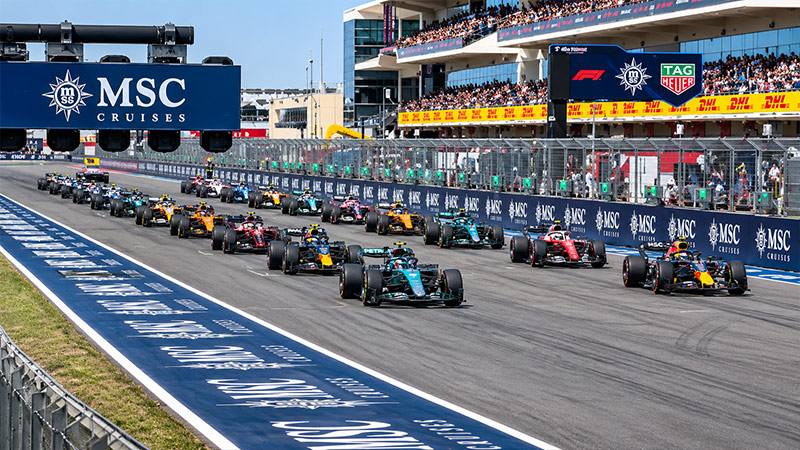
If you have ever tried to count the cars blasting toward Turn 1 when the lights go out, you are not alone. Here is the short answer: a Formula 1 race in 2026 has 22 cars on the grid, entered by 11 teams that each run two cars.
That figure is new. From 2017 through 2025, the grid held 20 cars from 10 teams. Cadillac’s arrival as the 11th team for 2026 added two more, giving fans the largest field since 2016.
The headline number is only the start. This guide covers the full 2026 grid, why every team runs exactly two cars, how many cars the rules allow, how grid sizes have shifted across more than seven decades, and how many cars actually finish and score.
At a glance
- Cars in a 2026 F1 race: 22
- Teams: 11, each with two race cars
- Maximum grid allowed under current rules: 26 cars
- Cars that score points in a Grand Prix: the top 10 finishers
The 2026 F1 grid, team by team
Eleven teams line up in 2026, and each one brings two race cars. Two of those teams are the story of the season: Audi, which took over the Sauber operation, and Cadillac, the first brand-new entry since Haas in 2016.
| Team | Power unit | 2026 status | Race cars |
|---|---|---|---|
| McLaren | Mercedes | Returning | 2 |
| Ferrari | Ferrari | Returning | 2 |
| Red Bull Racing | Red Bull Ford | Returning | 2 |
| Mercedes | Mercedes | Returning | 2 |
| Aston Martin | Honda | Returning | 2 |
| Alpine | Mercedes | Returning | 2 |
| Williams | Mercedes | Returning | 2 |
| Racing Bulls | Red Bull Ford | Returning | 2 |
| Haas | Ferrari | Returning | 2 |
| Audi | Audi | Rebranded from Sauber | 2 |
| Cadillac | Ferrari | New entry | 2 |
The math is simple: 11 teams multiplied by two cars equals 22 starters, as long as every car makes it to the grid. The 2026 season also brought all-new chassis and power unit rules, so every one of those 22 cars is a fresh design.
Why every team runs exactly two cars
Two cars per team is a rule, not a habit. Under the sporting regulations and the commercial agreement between the teams and the sport, every team must enter two cars in every championship event.
That structure shapes the whole sport in four ways:
- Constructors’ points. Both cars score for the team, so the second driver matters as much as the first in the fight for prize money.
- Strategy. Two cars let a team split its pit-stop plans and cover rivals who gamble on tyres or timing.
- Data. Engineers compare two sets of telemetry on the same track, which speeds up car development.
- Fairness. No team can flood the field with extra entries to block rivals or boost its points haul.
Things were looser in the past. Through the 1950s to the 1980s, big teams sometimes entered a third car for a guest or test driver. Garages also kept a spare race car, known as the T-car, until the late 2000s. Today teams build several chassis across a season for repairs and replacements, but only two can race.
If a regular driver is ill or injured, the team calls up its reserve driver. The car count stays the same; only the name on the car changes.
How many cars can be on an F1 grid?
The current regulations allow up to 26 cars, which means room for 13 teams. With 22 cars in 2026, the sport has space for two more teams on paper.
In practice, getting in is hard. A new team must pass an FIA selection process that tests its finances, technical plans and staffing.
It must also reach a deal with the sport’s commercial owners, which includes a large entry payment shared among the existing teams. Cadillac spent several years working through that process before its 2026 debut.
Circuit design adds a physical limit. Pit lanes, garages and grid slots at many tracks are built around a field of roughly 20 to 26 cars, so a much larger grid would need costly upgrades worldwide.
How F1 grid sizes have changed over time
The 22-car grid of 2026 sits in the middle of F1’s historical range. Field sizes have swung widely since the World Championship began in 1950, driven by costs, safety rules and the number of teams willing to compete.
| Era | Typical starting grid | What shaped it |
|---|---|---|
| 2026 | 22 cars | Cadillac joins as the 11th team |
| 2017–2025 | 20 cars | A stable field of 10 teams |
| 2010–2016 | 20 to 24 cars | Three new teams arrived in 2010, then several folded |
| Mid-1990s–2000s | 20 to 26 cars | Rising costs pushed smaller teams out |
| Late 1980s–early 1990s | 26 starters from up to about 40 entries | Pre-qualifying sessions cut the field before qualifying |
| 1960s–1970s | Roughly 20 to 26 cars | Circuit safety limits capped the grid |
| 1950s | Widely varied, sometimes 30+ | Privateers and one-off entries filled many races |
The late 1980s stand out. So many teams entered that the slowest ones had to survive an early-morning pre-qualifying session just to earn a place in qualifying. Some teams travelled to races and never turned a wheel on Sunday.
How many cars run in each part of a race weekend
All 22 cars take part across the weekend, but the number on track changes from session to session. Qualifying is where the count shrinks fastest.
| Session | Cars on track | What happens |
|---|---|---|
| Practice (FP1–FP3) | 22 | Teams test setups; rookies drive in some FP1 sessions |
| Qualifying Q1 | 22 | The slowest 6 are eliminated |
| Qualifying Q2 | 16 | The slowest 6 are eliminated |
| Qualifying Q3 | 10 | The top 10 fight for pole position |
| Sprint (selected weekends) | 22 | A shorter race; the top 8 score points |
| Grand Prix | Up to 22 | Roughly 305 km, the main event |
Two details are worth knowing. First, teams must hand some first-practice sessions to rookie drivers each season, so a familiar car may carry an unfamiliar name on Friday.
Second, the 107% rule means a driver who is far off the pace in Q1 can be refused a start, though stewards usually allow it when a problem was out of the driver’s control.
The cars you see that are not racing
Not every car on an F1 circuit is chasing points. Two official road cars play a vital role in every Grand Prix.
- The Safety Car leads the field at reduced speed after a crash or when debris covers the track. It keeps the 22 race cars bunched up and safe while marshals clear the circuit. Mercedes-AMG and Aston Martin currently share this duty across the calendar.
- The Medical Car carries the FIA’s doctor and a paramedic. It follows the field on the opening lap, when accidents are most likely, so help can arrive within seconds.
The Virtual Safety Car, often shown as VSC on TV graphics, is not a car at all. It is a system that tells every driver to slow to a set pace without a physical car on track.
A race weekend also hosts support series such as Formula 2 and Formula 3. These are separate championships with their own grids, so their cars never count toward the F1 total.
How many cars finish and score points
Starting with 22 cars does not mean 22 cars see the chequered flag. Crashes, mechanical failures and penalties trim the field in most races, though modern cars are far more reliable than those of past decades.
To be classified as a finisher, a driver must complete at least 90% of the winner’s race distance. Only the top 10 classified finishers score in a Grand Prix:
| Position | 1st | 2nd | 3rd | 4th | 5th | 6th | 7th | 8th | 9th | 10th |
|---|---|---|---|---|---|---|---|---|---|---|
| Points | 25 | 18 | 15 | 12 | 10 | 8 | 6 | 4 | 2 | 1 |
The bonus point for the fastest lap was dropped from 2025 onward. In sprint races, the top eight score from 8 points for the winner down to 1.
History offers two famous extremes. At the 1996 Monaco Grand Prix, only three cars were still running at the finish. At the 2005 United States Grand Prix, a tyre safety dispute meant just six cars started the race at all.
How F1 compares with other racing series
F1 runs one of the smaller fields in top-level motorsport. That is by design: each car costs a fortune to build and run, and the sport limits entries to protect quality and team finances.
| Series | Typical field | Why it is that size |
|---|---|---|
| NASCAR Cup Series | Around 40 cars | Many teams, often running several cars each |
| Indianapolis 500 | 33 cars | A tradition dating back decades |
| Formula 3 | 30 cars | Ten teams with three cars each |
| IndyCar (regular race) | Around 25 to 27 cars | A shared chassis keeps costs lower |
| Formula 1 | 22 cars | 11 teams with two cars each |
| Formula 2 | 22 cars | 11 teams with two cars each |
| MotoGP | 22 riders | 11 teams with two riders each |
A smaller field has real benefits for fans. It is easier to follow every team, rivalries are sharper, and each grid slot carries enormous value. Field sizes in other series can shift season to season, so treat those figures as typical rather than fixed.
Conclusion
How many cars are in an F1 race? In 2026, the answer is 22, with 11 teams each fielding two cars. That number reflects decades of change, from crowded grids of the 1950s and pre-qualifying chaos of the late 1980s to the tightly controlled field of today.
Strict entry rules, high costs and a cap of 26 cars keep Formula 1 exclusive, which makes every grid slot fiercely valuable.
Across a race weekend, qualifying trims the contenders, retirements thin the field, and only the top 10 finishers leave with points.
Whether you are a new fan or a seasoned follower, knowing how the grid works adds depth to every start. The next time the lights go out, count them: twenty-two.