There are 11 teams in Formula 1 in 2026, and each one runs two cars, which puts 22 drivers on the grid at every Grand Prix. That is one more team than F1 had for the whole of the last decade.
The new name is Cadillac. Backed by General Motors and TWG Motorsports, it is the first brand-new team to join the sport since Haas arrived in 2016. Its arrival lines up with the biggest rules reset in years: new chassis, new power units and new sporting regulations, all at once.
If you have just started watching F1, or you are coming back after a few seasons away, the grid can look confusing. Team names change with sponsors. Some teams buy engines from rivals. A few share owners. This guide clears all of that up in plain terms.
By the end, you will know every team on the 2026 grid, who drives for them, where they are based, why F1 keeps the number of teams so low, and what could change in the seasons ahead.
F1 2026 at a Glance
Here are the key numbers every fan should know about this season’s grid.
| Fact | 2026 figure |
|---|---|
| Teams on the grid | 11 |
| Drivers (two per team) | 22 |
| Cars starting each Grand Prix | 22 |
| Power unit makers | 5 (Mercedes, Ferrari, Red Bull Ford, Honda, Audi) |
| Newest team | Cadillac (first season: 2026) |
| Longest-serving team | Ferrari (every season since 1950) |
| Rookies on the season-opening grid | 1 (Arvid Lindblad, Racing Bulls) |
The last time F1 had 11 teams was 2016, when Haas made its debut alongside the now-closed Manor outfit. From 2017 to 2025, the grid held steady at 10 teams and 20 cars.
All 11 F1 Teams in 2026
The table below lists every team on the 2026 grid, in alphabetical order, with its main base, its power unit and its season-opening driver pairing (Formula 1).
| Team | Main base | Power unit | 2026 drivers |
|---|---|---|---|
| Alpine | Enstone, UK | Mercedes | Pierre Gasly, Franco Colapinto |
| Aston Martin | Silverstone, UK | Honda | Fernando Alonso, Lance Stroll |
| Audi | Hinwil, Switzerland | Audi | Nico Hülkenberg, Gabriel Bortoleto |
| Cadillac | Fishers, Indiana, US | Ferrari | Sergio Pérez, Valtteri Bottas |
| Ferrari | Maranello, Italy | Ferrari | Charles Leclerc, Lewis Hamilton |
| Haas | Kannapolis, North Carolina, US | Ferrari | Esteban Ocon, Oliver Bearman |
| McLaren | Woking, UK | Mercedes | Lando Norris, Oscar Piastri |
| Mercedes | Brackley, UK | Mercedes | George Russell, Kimi Antonelli |
| Racing Bulls | Faenza, Italy | Red Bull Ford | Liam Lawson, Arvid Lindblad |
| Red Bull Racing | Milton Keynes, UK | Red Bull Ford | Max Verstappen, Isack Hadjar |
| Williams | Grove, UK | Mercedes | Alex Albon, Carlos Sainz |
A quick word on each team
- McLaren started 2026 as the reigning Teams’ Champions, with Lando Norris defending his first Drivers’ title.
- Mercedes kept Russell and Antonelli together under Toto Wolff, who has led the team since 2013.
- Red Bull Racing paired Max Verstappen with Isack Hadjar, promoted from Racing Bulls, and now runs its own Red Bull Ford engine.
- Ferrari is the only team to have raced in every F1 season since 1950. Leclerc and Hamilton stayed together for a second year.
- Williams carried strong form from 2025, when it finished fifth and Carlos Sainz scored two podiums.
- Racing Bulls, Red Bull’s sister team, fields the grid’s only rookie, 18-year-old Arvid Lindblad.
- Aston Martin began a works partnership with Honda, with Adrian Newey stepping into the Team Principal role.
- Haas entered its 11th season and is one of two American teams on the grid.
- Audi replaced the Kick Sauber name after taking over the Swiss squad, and builds its own power unit.
- Alpine stopped making its own engines and now uses Mercedes power.
- Cadillac made its debut at the 2026 Australian Grand Prix, choosing two experienced Grand Prix winners as its drivers.
How the Grid Grew From 10 to 11 Teams
The jump to 11 teams came from one new entry, Cadillac. Audi’s arrival grabbed just as many headlines, but it did not add a team. It took over an existing one.
Cadillac: a three-year road to the grid
Cadillac’s story began as a bid led by Andretti Global. The FIA approved that bid in October 2023, but Formula One Management, the sport’s commercial arm, rejected it in January 2024. F1 said at the time that it did not believe the applicant would be competitive (Motor Sport Magazine).
The project then changed shape. Investment group TWG Global, led by Dan Towriss, took charge, and the team was rebranded as a General Motors works effort under the Cadillac name. In November 2024, F1 agreed to move the application forward, and final approval followed in March 2025.
Key details of the Cadillac entry:
- Debut: 2026 Australian Grand Prix, the first all-new team since Haas in 2016.
- Drivers: Sergio Pérez and Valtteri Bottas, both Grand Prix winners returning after a year away.
- Team Principal: Graeme Lowdon, formerly of the Marussia and Manor teams.
- Engine: Ferrari power units and gearboxes for now, with GM building its own power unit for later in the decade (Formula 1).
- Entry cost: a reported anti-dilution fee of about $450 million, more than double the $200 million figure set in the previous Concorde Agreement.
Audi: a new name, not a new team
Audi bought the Swiss Sauber squad and turned it into a full factory team for 2026, complete with its own power unit. Because Audi took over an existing entry, the team count stayed the same. Interestingly, the Sauber name still appears on the official FIA entry list, even though the cars race as Audis (Crash.net).
This is a common pattern in F1. Racing Bulls, for example, began life as Minardi and later raced as Toro Rosso, AlphaTauri and RB. A name change is not the same as a new team.
Why F1 Keeps the Number of Teams So Low
F1’s rules allow up to 12 teams and 24 cars, so one slot remains open even with Cadillac on board (PlanetF1). Filling it is hard on purpose. Three forces keep the grid small.
1. Prize money is shared: Teams split a fixed pot of commercial revenue. Every new team means a smaller slice for everyone else. That is why newcomers pay an anti-dilution fee, which is shared among the existing teams as compensation.
2. Teams are now worth a fortune: Leading F1 teams are valued at around $1 billion. Existing owners argued that a $200 million entry was too cheap for a seat at that table, which pushed the price higher.
3. Quality matters more than quantity: F1 wants teams that can compete and last. The three teams that joined in 2010 (Lotus Racing, Virgin and HRT) spent their F1 lives near the back, and all three had left the sport by the end of 2016.
F1 also pointed to the extra pressure that one more team puts on race promoters, garage space and paddock logistics.
How a new team gets onto the grid
Joining F1 is a two-door process. The FIA judges whether a team is fit to race, and F1’s commercial owner must agree to commercial terms.
- Expression of Interest. The FIA opens a window for applicants. In 2023, bids came from Andretti, Hitech, Rodin Carlin and LKY SUNZ.
- Assessment on merit. The FIA checks funding, technical know-how, experience, and facilities. For Andretti, this step took eight months.
- Commercial agreement. Every team must sign the Concorde Agreement, the contract that governs prize money and broadcast rights. This is where Andretti’s first bid stalled.
- Anti-dilution fee. The new team pays the agreed fee to the existing teams. Under the newest agreement, that figure is no longer fixed and moves with F1’s commercial health.
- Build and race. The team then has to design a car, sign drivers, and be ready for the first race of its debut season.
In practice, buying an existing team is often simpler than starting a new one. That is exactly what Audi did with Sauber.
How Many Teams F1 Has Had Over the Years
Eleven teams is a healthy grid by modern standards, but F1 has seen much bigger fields. In 1989, 20 teams entered 39 cars for just 26 starting spots.
The slowest entries had to survive a Friday-morning pre-qualifying session simply to earn a place in qualifying.
That era faded quickly as costs rose. Since 2010, the grid has never dropped below 10 teams or gone above 12.
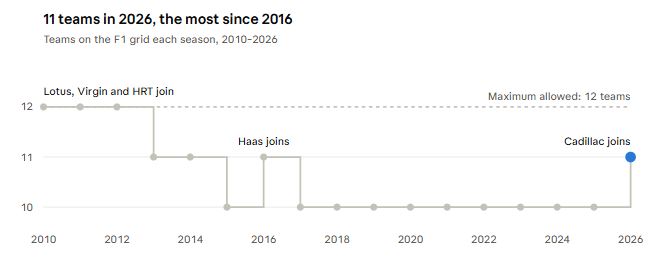
Three new teams arrived in 2010, but all had left by the end of 2016. The 2012 season was the last with 12 teams, and the grid then held at 10 from 2017 until Cadillac’s arrival made it 11 again. Through all of it, one name never missed a season: Ferrari, present since the very first championship in 1950.
Teams, Constructors and Engine Makers: What’s the Difference?
All 11 teams are constructors, meaning each one designs its own chassis. But only five companies build the power units that drive those cars. That is why you will often hear a car described with two names, such as “McLaren-Mercedes” or “Haas-Ferrari.”
| Power unit maker | Teams it supplies in 2026 |
|---|---|
| Mercedes | Mercedes, McLaren, Williams, Alpine |
| Ferrari | Ferrari, Haas, Cadillac |
| Red Bull Ford | Red Bull Racing, Racing Bulls |
| Honda | Aston Martin |
| Audi | Audi |
Two terms help make sense of this table:
- Works team: a team whose car and engine come from the same company or a close partner. In 2026 that means Mercedes, Ferrari, Red Bull Racing, Aston Martin with Honda, and Audi.
- Customer team: a team that buys its power unit from a rival. McLaren, Williams, Alpine, Haas, Cadillac and Racing Bulls all fit this group.
Being a customer is no barrier to success. McLaren won the Teams’ Championship in 2024 and 2025 with Mercedes engines.
One more detail trips up new fans: ownership. Red Bull owns two of the 11 teams, Red Bull Racing and Racing Bulls. They count as separate teams, with separate cars, garages and points, even though they share an owner.
What Comes Next: Could F1 Have 12 Teams?
Yes, it is possible, but nothing is planned yet. As of November 2026, no new entry process is open, and the grid is set to stay at 11 teams for the near future.
The main talking points:
- Chinese carmakers are interested: FIA president Mohammed Ben Sulayem has said he held talks with BYD and Geely about a possible F1 entry. He told BYD to come back with a serious proposal, and said BYD preferred to build its own team rather than buy an existing one (Grande Prêmio).
- The FIA wants the right team, not just any team: Ben Sulayem has stressed that the rules will not be rewritten to suit a newcomer, and that any bid must pass the same tests Cadillac did.
- F1’s commercial side is cautious: F1 leaders have argued that the paddock is close to its logistical limit, and only a bid of real significance would be considered.
- Other names keep circling: Former team boss Otmar Szafnauer has said he would seriously consider a 12th-team bid if F1 opens the door.
For fans, the short version is this: watch for an FIA announcement of a new Expression of Interest window. Until that happens, 11 teams and 22 drivers is the number to remember.
Where the 2026 season stands
The first season with 11 teams has already produced a historic result. Kimi Antonelli clinched the Drivers’ Championship at the Mexico City Grand Prix on 1 November, becoming the youngest world champion in F1 history at 20. Mercedes then sealed the Teams’ title at the São Paulo Grand Prix. Three rounds remain: Las Vegas, Qatar and Abu Dhabi.
Conclusion
Formula 1 in 2026 has 11 teams and 22 drivers, its biggest grid since 2016. Cadillac’s arrival brought a new American name to the starting line, while Audi’s takeover of Sauber and fresh partnerships with Honda, Ford and Mercedes reshaped the field without changing the count. Behind that simple number sits a careful system.
Shared prize money, rising team values and strict entry checks keep the grid small and the competition strong.
One slot on the grid is still open, and interest from carmakers such as BYD and Geely means the story may not end at 11. For now, though, you know every team, every driver pairing, every engine deal and exactly how this historic grid came together this season.