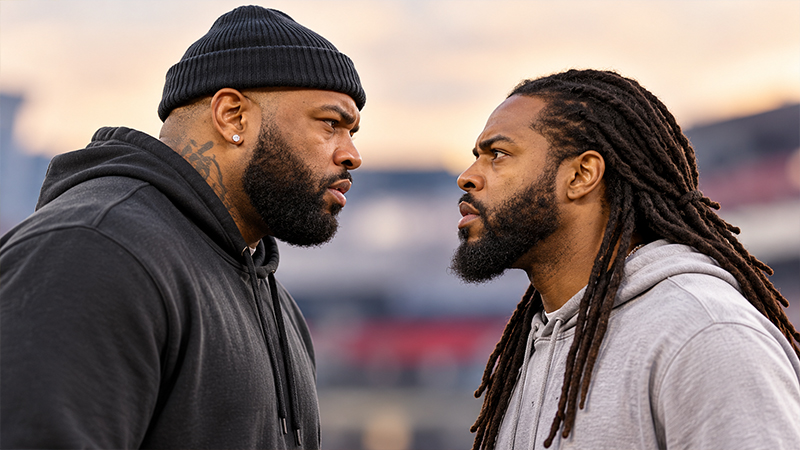
In the high-stakes theater of professional football, moments of physical confrontation often overshadow the technical brilliance on display.
However, few instances have remained as etched in the collective memory of fans as the 2013 encounter between then-Washington tackle Trent Williams and Seattle Seahawks cornerback Richard Sherman.
To understand this moment is to understand the peak of an era defined by defensive dominance, psychological warfare, and the razor-thin line between professional intensity and personal grievance.
The Era of the Legion of Boom
To contextualize the punch, one must first revisit the environment of the Seattle Seahawks during the early 2010s.
This period saw the rise of the “Legion of Boom,” a defensive unit that wasn’t just the best in the league but perhaps the most fascinating group in sports history.
They played with a flair for the dramatic that was virtually unrivaled, combining elite physical talent with a psychological edge that often unraveled their opponents.
At the center of this whirlwind was Richard Sherman. A Stanford graduate with a penchant for verbal sparring, Sherman was the most compelling character of the group.
He didn’t just play cornerback; he narrated the game as it happened, engaging in legendary feuds with the premier players of his generation.
His style was built on the premise that if you could win the mental battle, the physical battle would follow.
The Catalyst: More Than a Single Moment
The incident, which saw Williams strike Sherman in the face following a playoff game, did not occur in a vacuum.
While the “smack” itself became the viral clip that still lives in sports lore today, the foundations were laid throughout sixty minutes of high-tension football.
According to Sherman’s own recollection of the event, the game was characterized by constant “back and forths”.
This wasn’t merely a private dispute between two men; it involved a rotating cast of characters including Seattle’s Chris Clemons and several other players who were deeply immersed in the heat of the battle.
In the world of professional sports, “trash talk” is a standard currency, but on this particular day, the exchange reached a tipping point.
Williams, known for his incredible physical presence and standard-setting play at left tackle, apparently took exception to the verbal barbs being traded.
For an elite athlete, the pressure of a playoff atmosphere combined with persistent provocation can occasionally lead to a breakdown in traditional decorum.
The “rest is history,” as the confrontation transitioned from a verbal disagreement to a physical one immediately following the whistle.
The Psychology of the “Smack”
Why did a player of Trent Williams’ caliber reach that point? In professional football, the left tackle and the defensive backfield rarely interact directly on the field in a physical sense.
However, the emotional temperature of a sideline and the proximity of players during dead-ball periods create ample opportunity for friction.
The Seahawks’ culture at the time was designed to be abrasive. They wanted to be the team that got under your skin.
For Williams, who was then the cornerstone of the Washington offensive line, the frustration of the game’s outcome paired with the persistent “back and forths” created a perfect storm.
The physical reaction was a manifestation of an entire afternoon’s worth of suppressed intensity.
The Aftermath: A Lesson in Professionalism
If the story ended with the punch, it would be a mere footnote about a lack of discipline. Instead, the subsequent events offer a profound look at the “unwritten rules” of professional sportsmanship.
Despite the public nature of the altercation, the resolution happened behind closed doors, away from the cameras and the roar of the crowd.
In the immediate wake of the incident, “cooler minds prevailed”. Rather than allowing the feud to fester into a multi-year war, Williams and Sherman engaged in a series of direct communications.
These included both text messages and phone conversations where the two men addressed the tension of the game and the nature of their confrontation.
This dialogue transformed a moment of hostility into a foundation for mutual respect. Remarkably, the two have been friends ever since that day.
It serves as a reminder that the aggression required to perform at the highest level of the NFL is often a localized phenomenon—a “switch” that is flipped during competition and, for the most mature athletes, flipped back once the game concludes.
Divergent Paths and Continued Excellence
Since that afternoon in 2013, both men have gone on to cement their status as future Hall of Famers, though their paths have looked quite different.
Richard Sherman transitioned from the fiery centerpiece of the Legion of Boom to a veteran leader, eventually moving into a successful media career where he uses his podcast to provide historical context to his famous “beefs”.
Trent Williams, conversely, has defied the traditional aging curve for offensive linemen. Even a decade after the incident, he has remained one of the most dominant forces in the league.
His longevity is nearly unprecedented; after eleven years and nearly 150 games, he continues to perform at a level that leaves analysts in awe. In a recent season, he earned a staggering 97.8 overall grade from Pro Football Focus, a testament to his technical mastery and physical resilience.
It is a poetic irony of the sport that Williams eventually joined the San Francisco 49ers—the team Sherman also played for later in his career—further bridging the gap between their once-rivalrous identities.
Why This Story Still Matters
The reason this specific confrontation continues to be discussed in sports circles is that it represents the rawest form of the game.
We live in an era of highly curated athlete personas, where every movement is monitored, and every statement is vetted by public relations teams. The Williams-Sherman incident was unscripted, visceral, and real.
Furthermore, it highlights the evolution of the athlete. It shows that high-level competitors can move past physical altercations to find common ground. In a broader sense, it provides a template for conflict resolution:
- Acknowledge the heat of the moment: Both players recognized that the game’s intensity fueled their actions.
- Direct Communication: They didn’t use intermediaries; they spoke and texted directly.
- Mutual Respect: They focused on their shared status as elite professionals rather than their temporary roles as antagonists.
The Legacy of a Legend
The “clip still lives,” as Sherman says, because it captures a moment where the mask of professional sportsmanship slipped, revealing the intense passion underneath.
But the true story isn’t the punch; it’s the decade of friendship and mutual excellence that followed. It stands as a testament to the idea that in the NFL, your fiercest rival on Sunday can become your closest peer on Monday.
For fans and students of the game, the Williams-Sherman saga is a masterclass in the complexity of the human element in sports.
It reminds us that these athletes are not just avatars on a screen or statistics on a fantasy roster; they are individuals navigating an incredibly high-pressure environment where emotions run as hot as the talent.