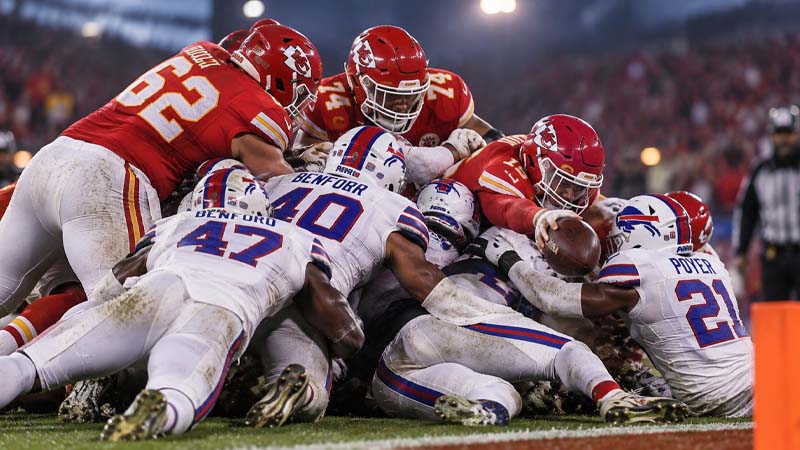
The traditional playbook of professional football is undergoing a silent but total restructuring. For decades, the fourth down was viewed through a singular, risk-averse lens: a signal to surrender possession in exchange for field position, or a cue to attempt a field goal.
Punting was the default defensive mechanism of the conservative coach, built on the assumption that minimizing immediate risk was the safest path to victory.
However, a fundamental shift has occurred across the football landscape. Today, offenses frequently remain on the field on fourth down, transforming what was once a desperate gamble into a standard, calculated strategy.
This transition is not driven by reckless impulse or a sudden preference for spectacle; rather, it is the result of rigorous data integration, advanced behavioral economics, and a deeper understanding of probability.
For corporate leaders, strategists, and sports enthusiasts alike, the evolution of the fourth-down decision offers a masterclass in how empirical analysis can dismantle decades of unchallenged organizational dogma.
This article analyzes the strategic, mathematical, and psychological frameworks driving this fourth-down shift, illustrating why the modern approach to football strategy has changed permanently.
1. The Analytical Framework: Win Probability and Expected Value
At the heart of the modern strategy is a shift from subjective decision-making to quantitative optimization.
Historically, coaches relied on intuition, experience, and the fear of public criticism to guide their fourth-down choices. Today, those decisions are governed by sophisticated computer models and comprehensive data analysis.
The Transition to Win Probability Integration
Traditional football strategy focused heavily on static metrics like field position. A punt was considered successful because it forced the opposing team to start their offensive drive further down the field. However, computer models look at a far more comprehensive metric: overall win probability.
Win probability models run simulations based on thousands of historical game situations, accounting for variables such as time remaining, score differential, field position, and team strength.
These models demonstrate that in many short-yardage situations, particularly in opponent territory, punting or kicking actually decreases a team’s statistical chance of winning the game.
By surrendering possession, a team gives up the opportunity to score, while only marginally reducing the opponent’s scoring probability. Keeping the offense on the field, conversely, maximizes the long-term probability of securing a victory.
Understanding Expected Point Value
Another foundational mathematical concept in modern decision-making is Expected Point Value (EPV). Every spot on the field has an associated expected point value for the possessing team.
For instance, having a first down at the opponent’s 40-yard line has a positive EPV, while punting the ball to the opponent’s 10-yard line yields a lower overall value when factoring in the likelihood of the opponent scoring.
Modern math and analytics show that keeping the offense on the field on fourth down yields a higher expected point value than punting or attempting a field goal in numerous scenarios.
These scenarios are not limited to late-game desperation; they frequently occur in early-quarter, short-yardage situations or when a team is positioned in opponent territory.
When a coach chooses to punt from the opponent’s 40-yard line, they are effectively trading a high-EPV possession for a marginal territorial advantage—a trade that data shows to be highly unfavorable over the course of a season.
2. The Baseline Probability: Analyzing Short-Yardage Success Rates
A common criticism of aggressive fourth-down decisions is that they represent an unnecessary gamble.
Critics argue that failing to convert a fourth down hands the opponent excellent field position. However, this perspective fails to account for the actual historical success rates of short-yardage conversions.
The 70% Threshold
The mathematical justification for going for it on fourth-and-short is rooted in empirical reality. Data reveals that converting a fourth-and-one or fourth-and-short situation occurs at a highly consistent historical rate, often around 70% or higher.
In any business or strategic environment, a course of action with a 70% probability of success and a high payoff is rarely classified as a gamble; it is recognized as a highly favorable investment.
In professional football, a 70% conversion rate means that the offensive unit is statistically highly likely to maintain possession and continue their drive.
When coaches look at the decision through this empirical lens, the choice to punt—which has a 100% probability of surrendering possession—becomes the riskier strategic move if the goal is to maximize offensive output and score points.
Risk Mitigation Through Statistical Realism
By understanding that the baseline probability of converting short yardage is exceptionally high, coaches can reframe their understanding of risk.
The traditional fear of failing on fourth down and giving the opponent a short field is statistically offset by the high likelihood of maintaining the drive and scoring.
Over a multi-game or multi-season horizon, consistently choosing the mathematically favorable option results in more points scored and, ultimately, more victories.
3. The Multi-Down Strategy: Expanding the Third-Down Playbook
The decision to go for it on fourth down is not an isolated choice made in a vacuum when the fourth-down play clock is running down. Instead, it is an integrated strategy that fundamentally alters play-calling on preceding downs.
Establishing “Four-Down Territory”
In the traditional era, a coaching staff approached third down with the explicit goal of gaining enough yardage to secure a first down.
If they faced a third-and-eight, they felt immense pressure to pick up all eight yards in a single play. If they failed, they would automatically punt on fourth down.
In the modern analytical era, coaches frequently identify specific zones of the field as “four-down territory” before the series even begins.
If a team knows they are playing with four downs instead of three, their tactical options on third down expand dramatically.
How Playbook Expansion Works in Practice
When a coach plans their third-down play-calling with the explicit knowledge that they have two total plays to pick up the required yardage, the playbook opens up.
For example, if a team faces a third-and-six in opponent territory, they do not have to attempt a risky, low-probability pass downfield to secure the first down. Instead, they can call a conservative run play or a short, high-completion pass designed to gain four yards.
While this play does not move the chains immediately, it sets up a highly manageable fourth-and-two.
Because the team has already committed to going for it on fourth down, and because they know fourth-and-short conversions succeed at a 70% rate, they can systematically dissect a defense across two plays rather than one.
This multi-down synergy forces defensive coordinators to defend the entire width and depth of the field, as they can no longer rely on the offense playing conservatively on third down.
4. The Psychology of Decision-Making: Confidence and Modern Leadership
While the math supporting fourth-down aggression is clear, football is played and coached by human beings.
Transitioning from traditional, conservative play-calling to an aggressive, data-driven strategy requires overcoming powerful psychological barriers and shifting organizational culture.
The Fear of Failure vs. The Power of Trust
In traditional football, the fear of making a visible mistake heavily influenced coaching decisions. If a coach punts and the opponent eventually scores, the coach is rarely blamed directly for the loss; the decision is viewed as standard procedure.
However, if a coach goes for it on fourth down and fails, they face immediate, intense scrutiny from fans, media, and traditionalists.
To execute a modern analytical strategy, coaches must replace this fear-based decision-making with offensive confidence and trust. This confidence is not blind optimism; it is grounded in the elite capabilities of their personnel.
Modern coaches explicitly trust their elite quarterbacks, dominant offensive lines, and highly skilled play-callers to execute under pressure and pick up a single yard, viewing this as a far safer bet than surrendering the ball.
Organizational Alignment and Shielding Decision-Makers
For a coach to consistently make mathematically sound, aggressive decisions, there must be complete alignment throughout the organization.
Leaders require the backing of the board and executive suite to take calculated risks that may occasionally fail in the short term but yield superior long-term results.
The same dynamics apply to professional sports. Forward-thinking front offices and ownership groups protect their coaching staffs by evaluating decisions based on the process rather than the outcome.
If a coach goes for it on fourth-and-one and the play is stuffed, the decision remains correct if the historical conversion probability was 70%. Over time, organizations that support this empirical approach build a culture of confidence, execution, and resilience.
5. Game Flow, Urgency, and Strategic Desperation
While mathematical models provide a consistent baseline for decision-making throughout a game, the specific flow of a contest can introduce variables that make aggressive choices absolutely mandatory.
The Cost of Conservative Play Late in the Game
When a team is trailing late in a game, the value of possession and time increases exponentially. In these scenarios, traditional risk-aversion is no longer just suboptimal—it is catastrophic.
Punting the ball when trailing late in a game essentially hands away precious time and possession to the opponent, drastically reducing any remaining chance of a comeback.
Even if a team faces a long distance on fourth down, the cost of giving the ball back to an opponent who can run out the clock is far greater than the risk of failing to convert.
Evaluating the Strategic Cost of Inaction
In business, the cost of inaction is often harder to quantify than the cost of an active mistake, yet it is frequently more damaging. In football, conservative late-game punting is the ultimate form of strategic inaction.
Modern coaches recognize that when trailing, they must accept immediate risk to avoid the certain defeat that comes with running out of time.
By aggressively attacking fourth downs under pressure, teams maximize their opportunities to score and force defensive errors, turning potential losses into highly competitive finishes.
Conclusion
The fourth-down revolution is not a temporary trend; it represents the permanent integration of empirical data into the core strategy of professional sports.
By replacing traditional risk-aversion with a disciplined adherence to expected value, win probability models, and offensive execution, modern coaches have fundamentally elevated the game.
For organizations of all kinds, the lesson of the fourth down is clear: when data consistently contradicts traditional practices, the organizations that adapt first and build a culture supporting calculated risks will inevitably dominate the competition.
The old playbook has been discarded, and those who refuse to play by the new rules will simply find themselves left behind on the sidelines.