During any given football weekend, television viewers are bound to hear the referee announce that a penalty has been declined.
For casual observers, this phrase can seem puzzling. Why would a team willingly turn down free yards or a chance to punish their opponent?
The reality of professional football is that declining an infraction is a core element of game strategy, not a mere ceremonial gesture.
If you have ever wondered whether NFL penalties can be declined, the short answer is yes. Under the sport’s official regulations, the team that was fouled has the right to reject the referee’s call and keep the play’s natural result instead.
Understanding how and why this happens reveals the deeper, chess-like strategy that coaches use on every single snap.
Understanding Rule 14: The Legal Framework of NFL Penalties
To understand how this mechanic works, we must look at the official rulebook. Rule 14 of the 2026 NFL Rulebook establishes the general principle that a team may decline a penalty unless another specific regulation expressly provides otherwise.
This rule grants coaches the flexibility to manage the outcome of a play based on what benefits their team the most.
When an infraction occurs on the field, the officiating crew flags the play. However, the penalty yardage and rules are not automatically forced upon the teams.
Instead, the referee identifies the foul and explains the enforcement options to the offended team. At this point, the team’s captain or head coach must communicate their final choice.
If a team decides to accept a penalty, the state of the play changes according to the rulebook. This change typically involves:
- Moving the football forward or backward by a set number of yards
- Repeating the down or, in some cases, losing a down
- Awarding an automatic first down to the offense
- A combination of these different outcomes
Conversely, when a team chooses to decline, the penalty’s enforcement is entirely bypassed. The yardage is not moved, the down is not replayed, and no automatic first down is awarded.
Instead, the actual result of the play stands exactly as it unfolded, subject only to other outstanding fouls or special enforcement rules.
Declining does not mean the officials pretend the foul never happened, but it does prevent the rules of that foul from altering the physical outcome of the play.
The Strategic Equation: Why Football Coaches Turn Down Free Yardage
One of the football world’s most fascinating strategic dimensions is realizing that coaches are not just looking at penalty yards.
They are comparing two complete, distinct pictures. On one side, they have the play as it naturally ended; on the other side, they have the play after the penalty is enforced.
To make the correct decision, a head coach must evaluate several critical factors:
- Down and Distance: What down will it be, and how many yards are needed for a first down under each scenario?
- Field Position: Where will the ball be spotted on the field?
- Possession: Does one option guarantee keeping or gaining possession of the ball?
- The Game Clock: How will each choice affect the remaining time in the quarter or half?
By analyzing these variables, coaches can make the optimal strategic move. Let’s explore the most common situations where this decision-making process occurs.
Offensive Playbook: Scenarios Where the Offense Declines a Penalty
An offense typically declines a defensive penalty when the actual play yielded a much better outcome than what the penalty yardage would provide.
1. Preserving a Touchdown
The most obvious scenario involves a touchdown. If an offensive player catches a touchdown pass or runs the ball into the end zone while a defensive player commits a foul—such as defensive holding or offside—the offense will immediately decline the penalty. Accepting the penalty would enforce the yards but wipe out the play, taking the points off the scoreboard. By declining, the offense ensures the touchdown stands.
2. Choosing Big Yardage Over Small Penalties
Another frequent situation occurs when a major play completes downfield despite a defensive infraction. For example, suppose the defense commits an offside violation, which is a five-yard penalty. On that same play, the offense completes a twenty-yard pass.
- If they accept: The offense moves forward five yards and must replay the down.
- If they decline: The offense keeps the twenty-yard completion.
Naturally, the offense declines the penalty because keeping the twenty-yard gain is far more advantageous than taking a five-yard advancement.
The same logic applies to defensive holding. While defensive holding normally awards five yards and an automatic first down, a twenty-five-yard completion on the play is vastly superior.
The offense declines the holding penalty to keep the twenty-five yards, which already secures the first down.
3. Handling Defensive Pass Interference
Defensive pass interference offers another layer of offensive strategy. If a defensive player interferes with a receiver but the receiver still manages to make the catch and run for significant yardage past the spot of the foul, the offense may choose to decline the penalty to keep the full catch and run.
However, if the pass falls incomplete, accepting the pass interference penalty is the standard move, as it awards the offense the ball at the spot of the foul with an automatic first down.
Defensive Leverage: When the Defense Rejects Offensive Penalties
Defenders are just as likely to decline penalties, particularly when the offense commits an infraction on a play that ended poorly for them.
1. Keeping the Sack
Suppose the offense commits a holding infraction, but the defensive line still manages to slip through and sack the quarterback for a twelve-yard loss.
- If the defense accepts: The offense is penalized ten yards, but they get to replay the down.
- If the defense declines: The defense rejects the penalty, meaning the twelve-yard sack and the lost down stand.
In this case, the defense declines the penalty to lock in the massive loss of yardage and force the offense to move to the next down. Replaying the down is a second chance the defense does not want to give the offense.
2. Forcing a Punt on Third Down
On third down, the defense’s ultimate goal is to stop the offense from converting. Imagine a third-down play where the offense throws an incomplete pass, failing to gain the first down, but commits a minor penalty during the play.
- Accepting the penalty would push the offense back but allow them to replay third down, giving them another opportunity to convert.
- Declining the penalty keeps the result of the play—an incomplete pass—meaning the offense has failed to convert. This forces a fourth down, forcing the offense to punt the ball away.
For the defense, declining the penalty is the most efficient way to end the opponent’s drive and get the ball back for their own offense.
High-Value Enforcements: When Accepting is the Only Logical Choice
While declining is a vital tool, coaches frequently accept penalties when the rules of enforcement provide critical strategic advantages that the play itself did not deliver.
1. Automatic First Downs as Drive Rescuers
On crucial third or fourth downs, certain penalties are too valuable to decline because they grant an automatic first down. A defensive foul that awards a new set of downs can rescue a stalled drive and keep possession of the football.
For example, roughing the passer is an extremely heavy infraction that combines a fifteen-yard penalty with an automatic first down. Even if the offense completed a short, modest pass on the play, accepting the fifteen yards and the automatic first down is usually far more valuable than keeping a small gain.
2. Roughing the Kicker Decisions
A similar situation arises with roughing the kicker, which also carries a fifteen-yard penalty and an automatic first down. If a team successfully kicks a field goal but the defense is flagged for roughing the kicker, the head coach must make a difficult comparison.
They can decline the penalty to keep the three points on the scoreboard, or they can accept the penalty, take the fifteen yards, and establish a brand-new offensive series.
Depending on the score and the time left in the game, a fresh set of downs close to the opponent’s end zone can be worth much more than a field goal.
Limits to the General Rule: Penalties That Cannot Be Declined
Although the general rule permits declining a penalty, not every play offers a simple yes-or-no choice. There are specific circumstances where the mechanics of the game restrict how penalties are handled.
1. Pre-Snap Whistles and Dead-Ball Fouls
A pre-snap false start is the best example of a play with no result to preserve. The moment an offensive player moves prematurely, the officials blow their whistles to signal a false start.
The ball is dead immediately, and no legal play can occur. Because there is no run, pass, or touchdown to keep, there is no alternative outcome to compare. The penalty must be administered.
2. Offsetting and Multiple Fouls
If both teams commit fouls during the same play, the infractions may offset. When penalties offset, the rules typically dictate that the down must be replayed, preventing either team from simply declining their opponent’s foul to keep a specific play result.
Other complex rules, such as those governing change of possession, multiple fouls by a single team, dead-ball administrations, and special timing regulations, can also dictate how a penalty must be resolved.
The Mechanics: Who Decides and How to Decode the Referee
When a flag is thrown, the entire stadium waits for the referee to make the final announcement. But how does that decision get communicated, and how can viewers understand it in real-time?
The Decision-Making Process
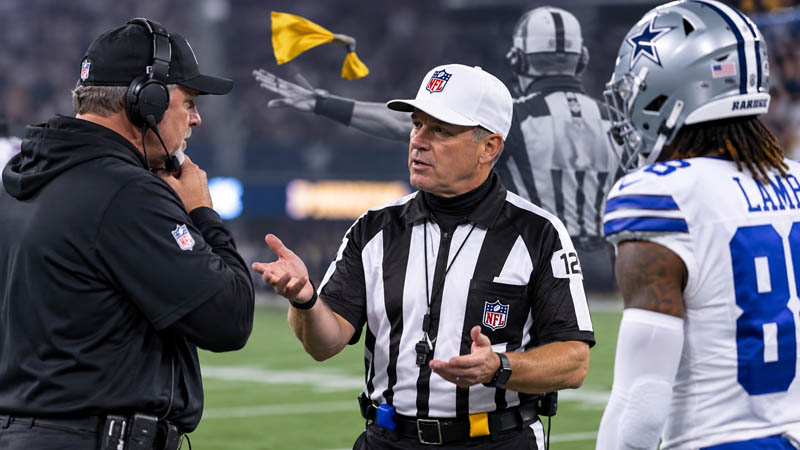
While the referee is the one who officially administers the rules, they do not make the strategic choice.
The referee presents the available enforcement options to the offended team. The final decision is communicated directly to the referee by the team’s head coach or designated captain.
In standard situations where one outcome is obviously superior, the decision is made almost instantly. However, if the situation involves complex clock management or field position issues, the head coach may take a moment to confer with their staff before delivering the choice to the officiating crew.
Deciphering the On-Field Announcement
Once the decision is made, the referee will turn on their microphone and announce the result to the stadium and television audience. To understand exactly what happened, viewers should listen for three crucial details:
- The Offending Team: Which team and player committed the foul.
- The Choice: Whether the penalty was accepted or declined.
- The Resulting Down: What down it will be for the next play.
Hearing these three pieces of information tells you exactly which outcome won the strategic comparison.
Conclusion: The On-Field Chess Match
Ultimately, the decision to decline an NFL penalty is a testament to the tactical depth of professional football.
It shows that the sport is not just about raw physical power or simple yardage accumulation. Instead, it is a game of leverage, down-and-distance management, and situational awareness