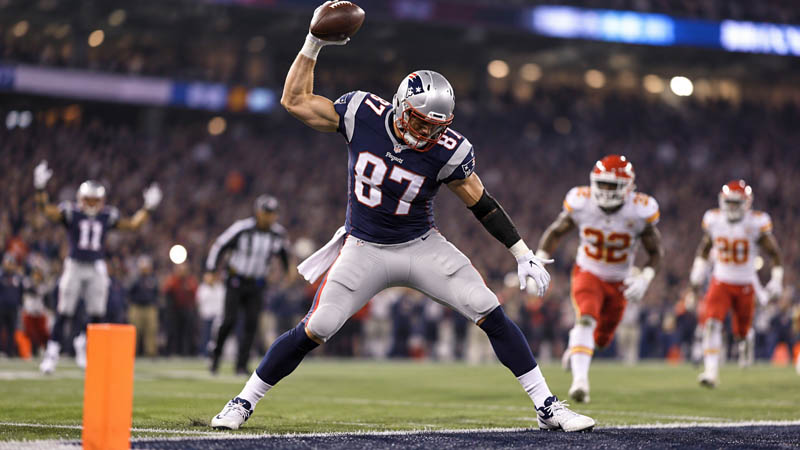
At first glance, few actions in professional sports appear as counterintuitive as the quarterback spike.
With tens of thousands of fans screaming, the game clock ticking down, and the pressure mounting, a quarterback receives the snap and immediately drives the football directly into the grass.
To a newcomer, this looks like an unforced error—a wasted play that yields zero yards, consumes a down, and stops the offense’s forward momentum.
Yet, this apparent waste is actually one of the most vital clock management strategies in football. It is a highly regulated, mathematically calculated tactical move designed to exchange a single down for the most precious resource on the field: time.
In late-game, high-stakes situations, managing the clock is just as critical as managing yardage. To fully understand why teams resort to this strategy, one must examine the fine balance between game situations, team assets, and the strict rules governing modern professional football.
Anatomical Breakdown: How the Spike Works
The spike begins like any normal scrimmage play, with the offense quickly forming at the line. The center snaps the ball directly to the quarterback, usually from under center to save time.
The quarterback immediately throws the ball downward into the ground. Because the ball moves forward, the play counts as an incomplete forward pass.
The clock stops, but the offense is charged with an incomplete pass, loses one down, gains no yards, and continues with the next play.
The Clock-versus-Down Exchange
The entire strategic foundation of the spike rests on a simple formula: trading downs for seconds. In football, teams have two primary limits when attempting a late-game comeback: their remaining downs (the four chances they have to gain ten yards) and the game clock (which continuously runs during active play).
When a team has no timeouts remaining—or when they are deliberately choosing to save their final timeouts for a later, more critical moment—the game clock becomes their absolute bottleneck.
If a player is tackled in the field of play, the clock continues to run, draining the remaining time and leaving the team unable to communicate, align, or call a structured play.
By executing a spike, the quarterback accepts a loss of one down to purchase a complete stoppage of the clock. This pause allows the entire coaching staff and roster to regroup, substitute players, and call a highly calculated play with the play clock reset.
To visualize the specific trade-offs of this play compared to other clock-stopping and time-management decisions, consider the following structural comparison:
| Play Choice | Impact on Game Clock | Down Cost | Yardage / Resource Cost | Strategic Advantage |
|---|---|---|---|---|
| Quarterback Spike | Stops instantly once the ball hits the ground | Costs exactly one down | Zero yards gained; counts as an incomplete pass | Saves remaining timeouts; allows immediate group regrouping and substitutions |
| Quarterback Kneel | Continues running unless stopped by a timeout or other rule | Costs exactly one down | Negligible loss of rushing yardage | Safely runs out the remaining clock when leading at the end of the half or game |
| Incomplete Sideline Pass | Stops instantly when the pass falls incomplete | Costs exactly one down | Zero yards gained; takes several seconds for receivers to run routes | Preserves time while attempting a high-risk deep pass, though carries sack and turnover risks |
| Team Timeout | Stops immediately upon the official’s whistle | No downs lost | Consumes one of three limited team timeouts per half | Maximum time preservation with zero down penalty; ideal when disorganized or low on time |
This matrix illustrates that no stoppage of play is truly “free.” Every method of halting the game clock requires the team to pay with an asset—either a timeout, a down, or the physical seconds consumed during the play’s execution.
The Legal Loophole of Rule 8, Section 2
A common question is why a quarterback’s spike is not penalized as intentional grounding. Normally, throwing the ball into the turf without an eligible receiver nearby can result in a ten-yard penalty and loss of down.
However, NFL Rule 8, Section 2 provides a specific exemption for an immediate spike after the snap. The quarterback must receive the ball and begin the throwing motion immediately and continuously.
If the quarterback takes a dropback step, hesitates, scans the field, fakes a handoff, or pump-fakes, the exemption no longer applies. In such cases, officials can call intentional grounding, potentially ending a late-game drive.
Strategic Scenarios: When to Choose the Spike
A head coach and quarterback must analyze several dynamic variables to determine whether a spike is the correct tactical choice in a split-second window. There are three classic scenarios where a spike is mathematically and strategically superior to using a timeout or attempting a normal play:
A quarterback and head coach must quickly weigh the game situation before deciding whether to spike the ball. Three common scenarios make a spike particularly valuable.
1. Preparing for a Field Goal
When a team completes a pass in bounds with no timeouts remaining, substituting the kicking unit while the clock runs can waste valuable seconds. A quick spike stops the clock, giving the offense time to bring on the kicker and holder.
2. Saving Timeouts
Timeouts are valuable because they stop the clock without costing a down. If a team has timeouts available, it may still choose to spike after a long in-bounds completion, preserving those timeouts for more critical moments later.
3. Stopping the Clock After a Deep Completion
During a two-minute drill, defenses often force receivers toward the middle. If a player is tackled in bounds, a spike can immediately stop the clock, allowing the offense to regroup and plan its next play.
Operational Mistakes: The Fatal Errors of Spiking
Although spiking the ball looks simple, executing it under intense pressure requires precise coordination. One mistake can cause a turnover, a costly penalty, or allow the clock to expire before the offense can run another play.
The Fourth-Down Catastrophe
One of the most damaging mistakes a quarterback can make is spiking the ball on fourth down. Because a spike is officially treated as an incomplete forward pass, it counts as a down.
If the offense is facing fourth down, a spike results in a turnover on downs, immediately giving possession to the opponent. In a chaotic late-game situation, losing track of the down can therefore end a team’s comeback attempt instantly.
Presnap Penalties
Rushing to the line can also create confusion. Offensive players must be properly set before the snap. A false start or illegal shift can result in a five-yard penalty, while certain late-game penalties may also trigger a ten-second runoff, potentially ending the game.
The Substitution Trap
Late substitutions can create another problem. Officials may delay the snap to allow the defense to match the personnel. Those precious seconds can continue running off the clock, leaving the offense unable to spike before time expires.
The Fake Spike: Deception on the Edge
Because the defensive unit is fully aware of when a spike is highly likely, offensive coordinators can occasionally weaponize this predictability through a high-risk, high-reward trick play: the fake spike.
In a fake spike scenario, the quarterback will rush to the line of scrimmage, loudly shouting “Spike! Spike!” to mimic the exact body language of a team trying to stop the clock. The offensive linemen line up quickly, and the center snaps the ball.
However, instead of driving the ball into the turf, the quarterback pauses, drops back, and attempts to throw a pass to a wide receiver who has sprinted past the relaxed, unsuspecting defensive secondary.
While the fake spike has produced some of the most iconic, game-winning plays in history, it carries massive structural risks:
- Loss of Intentional Grounding Protection: The moment the quarterback hesitates, fakes, or delays the downward throw, they immediately lose the special rule exemption that allows a spike. If the secondary coverages are not fooled and the receivers are covered, the quarterback cannot simply throw the ball away into the ground. Doing so will result in an immediate intentional grounding penalty.
- Severe Pass Rush Vulnerability: Defenders are taught to play until the whistle blows, meaning they are fully entitled to rush the passer during a spike attempt. If the quarterback fakes the spike, they remain a live runner in the pocket, exposing themselves to being sacked, hit, or stripped of the ball by an aggressive defensive line.
The Final Verdict: Mastering Gridiron Time Management
The quarterback spike represents the ultimate distillation of professional football’s chess-match nature. It is a play where physical athletic prowess is secondary to strict mental discipline, precise rulebook knowledge, and situational awareness.
When you watch the final minutes of a close game, pay close attention to how the offense manages these late-game situations.
Watch the stadium clock as the offense scrambles to the line of scrimmage, verify that all eleven players come to a complete stop before the snap, and observe the immediate transition to the next down.
The ability to execute a clean clock-stopping spike—and the strategic wisdom to know when to trade a down for time—is often the microscopic difference between a historic game-winning drive and a devastating defeat.