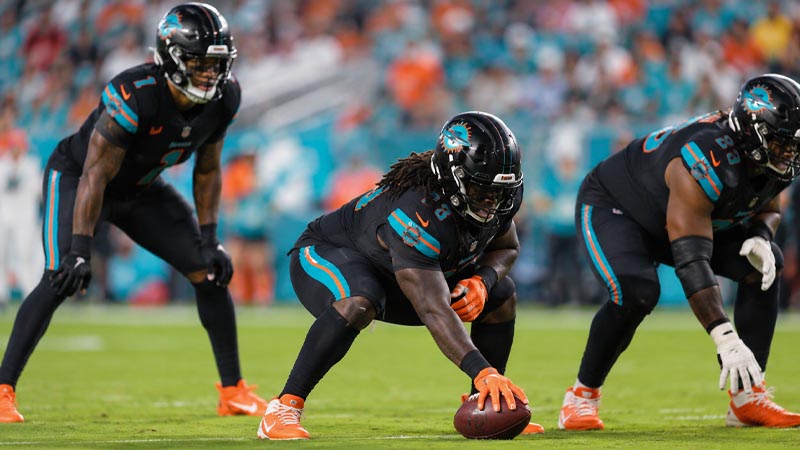
The offensive line operates as a single coordinated unit, and at its center sits the player responsible for connecting all five blockers. The center starts every offensive play by snapping the football to the quarterback, but his responsibilities extend far beyond simply delivering the ball.
The center is often the communication hub of the offensive line. Before the snap, he studies the defensive alignment, identifies potential pressure, and helps establish blocking assignments.
After the snap, he must combine strength, balance, technique, and awareness to protect the quarterback or create running lanes.
This makes the center one of the most mentally demanding positions on the offensive side of the football. He is involved in a constant battle of recognition and reaction: diagnose the defense before the snap, communicate the plan, and then execute that plan in a matter of seconds.
1. The Snap: How Every Play Begins
Every offensive play begins with the center’s snap. Although it may appear routine, the snap requires exceptional consistency and timing.
In an under-center formation, the center delivers the football directly into the quarterback’s hands. In shotgun formations, the ball must travel several yards backward with enough speed and accuracy for the quarterback to receive it cleanly.
The center must perform this action while preparing to immediately engage a defender. A poor snap can disrupt the timing of the entire offense, forcing the quarterback or running back to adjust and potentially turning a well-designed play into a broken one.
A high, low, sideways, or poorly timed snap can create serious problems. For that reason, snap accuracy is one of the fundamental skills every NFL center must master.
2. Reading the Defense Before the Snap
The center’s mental responsibilities become especially important once the offense reaches the line of scrimmage.
Before the ball is snapped, the center studies the defensive front and looks for information that could affect the blocking scheme. This includes identifying:
- Defensive line alignments
- Linebacker positioning
- Potential blitzers
- Defensive shifts
- Gaps that could be attacked
- Possible pressure combinations
Defensive linemen may line up directly over the center, shade toward one side, or position themselves in the gaps between offensive linemen. These alignments can influence how the offensive line must respond.
Linebackers also create additional uncertainty because they can either rush the passer or drop into coverage. A linebacker moving toward the line of scrimmage may signal potential pressure, requiring the offensive line to adjust its protection.
The center must process all of this information quickly and determine what represents the greatest immediate threat.
3. The Communication Hub of the Offensive Line
Recognizing a defensive threat is only useful if the offensive line knows how to respond. This is where the center’s communication skills become critical.
The center frequently makes protection or blocking calls that help coordinate the guards and tackles. These calls establish who is responsible for specific defenders and how the line should react to potential pressure.
Defenses frequently disguise their intentions. A defense may show one alignment before shifting into another moments before the snap. When that happens, the center must recognize the change and communicate the necessary adjustment.
For example, if an additional linebacker threatens to blitz from one side, the center may change the protection call so the appropriate guard or tackle is prepared to account for him.
The goal is simple: prevent an unblocked defender from reaching the quarterback.
This communication transforms five individual offensive linemen into one coordinated protection unit.
4. Pass Protection: Protecting the Quarterback From the Inside
Once the ball is snapped, the center immediately transitions from diagnosing the defense to executing his blocking assignment.
In pass protection, the center’s primary responsibility is to help keep pressure away from the quarterback by controlling interior defensive linemen and responding to blitzes.
Interior defenders can be particularly difficult to handle because they often combine tremendous size and strength with powerful pass-rushing techniques. The center must maintain balance, use proper hand placement, and generate leverage without losing his position.
At the same time, he must remain aware of what is happening around him. If a linebacker enters his protection area or defensive linemen exchange responsibilities, the center may need to adjust quickly.
Interior pass protection is therefore not simply about strength. It requires awareness, footwork, communication, and the ability to react instantly when the defensive plan changes.
5. Run Blocking: Creating Space for the Running Game
The center also plays a major role in establishing the running game.
Unlike pass protection, where the objective is generally to maintain a stable pocket, run blocking is about creating movement and opening space for the ball carrier.
The center may block a defender directly in front of him or work with a guard on a combination block. In a double-team situation, two offensive linemen work together to control an interior defender before one blocker eventually moves to the second level to engage a linebacker.
Timing is critical.
If the center leaves the double-team too early, the defensive lineman may escape and disrupt the play. If he stays too long, a linebacker may reach the running lane untouched.
Successful run blocking therefore depends on precise coordination between the center and the surrounding offensive linemen.
6. Recognizing Defensive Stunts and Twists
Defensive stunts and twists are designed to create confusion along the offensive line.
Instead of rushing straight ahead, defenders may cross paths or exchange gaps. One defensive lineman might rush outside to attract an offensive blocker while another loops behind him and attacks the vacated gap. The center must recognize these movements quickly.
When a defensive lineman crosses into another blocker’s responsibility, the center may need to pass off his original assignment and pick up the new threat. This requires excellent awareness and communication with the guards.
A successful offensive line does not simply block the defender directly in front of each player. It must recognize how defenders move together and adjust accordingly. The center is often at the heart of these adjustments.
7. The Physical and Mental Demands of the Position
The modern NFL center must combine considerable physical ability with advanced football intelligence.
Physically, a center needs the strength to anchor against powerful defensive tackles while maintaining enough mobility to move laterally in pass protection.
In the running game, he may also need the athleticism to reach blocks, pull, or climb to the second level against linebackers. Mentally, the position is equally demanding.
The center must recognize defensive formations, identify potential pressure, communicate blocking assignments, and react to changes—all within seconds and often in front of tens of thousands of loud spectators.
This combination of strength, technique, awareness, and communication makes the center one of the most demanding positions on the offensive line.
Conclusion: The Strategic Heart of the Offensive Line
The center may not receive the same attention as the quarterback, running back, or wide receiver, but his influence on offensive success is enormous.
He begins every play with the snap, helps diagnose the defense, communicates protection adjustments, and battles powerful interior defenders.
In the running game, he helps establish the blocking structure that creates opportunities for the ball carrier. In pass protection, he helps prevent pressure from reaching the quarterback.
The position demands far more than size and strength. An elite center must think quickly, communicate clearly, move efficiently, and execute under extreme physical pressure.
That combination of tactical leadership and physical execution makes the center the strategic core of the offensive line—and one of the most important unsung contributors to a successful NFL offense.