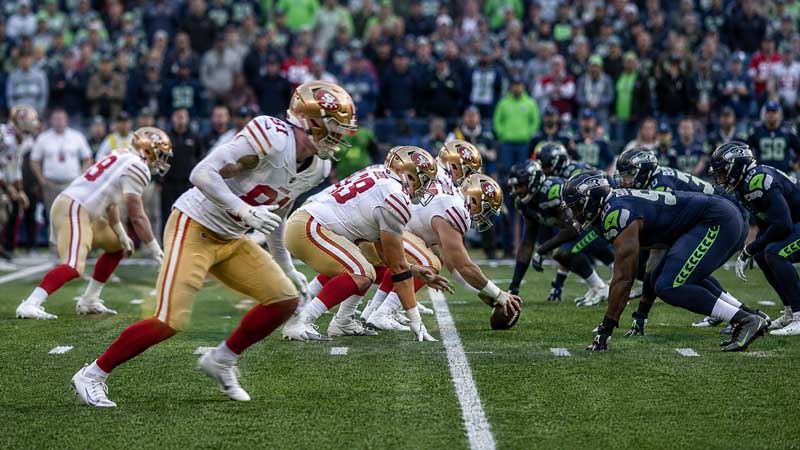
In American football, few moments are as frustrating for fans, players, and fantasy managers as when a spectacular, game-changing play is wiped off the board by a yellow penalty flag thrown before the action even gets underway.
Pre-snap penalties often seem like administrative technicalities, yet they govern the very balance of power between the offense and the defense. Among these infractions, the illegal motion penalty is one of the most frequently called—and least understood.
Unlike more fluid sports where players can move continuously without restriction, American football is built on a framework of structured plays, functioning almost like a turn-based strategic game. To maintain competitive fairness, the rules mandate a period of offensive stillness before a play begins.
This comprehensive guide breaks down the mechanics of the pre-snap motion rules, details how to distinguish illegal motion from similar infractions, debunks common football myths, and explains the tactical reasons why these regulations exist in the modern game.
The Core Philosophy: Why Pre-Snap Stillness Matters
To understand why the rules restrict movement before the play, one must look at the structural relationship between the offensive and defensive units.
Because the offense knows the exact moment the ball will be snapped and where the play is designed to go, they possess an inherent informational advantage.
If offensive players were allowed to run freely, build momentum, and sprint toward the line of scrimmage before the snap, the defense would have virtually no chance to react or adjust.
The Balance of Power
The requirement for offensive players to come to a complete stop before the play begins serves several critical functions:
- Defensive Alignment: It gives the defensive unit a fair opportunity to recognize the offensive formation and adjust their coverage, leverage, and blitz assignments accordingly.
- Preventing Unfair Head Starts: It prevents wide receivers and running backs from gaining forward momentum before the ball is in play, which would otherwise make pass coverage and run defense nearly impossible.
- Tactical Complexity: By enforcing a brief pause, the game elevates pre-snap adjustments into a high-stakes chess match, where quarterbacks and defensive captains read and counter each other’s alignments in real time.
The Three Golden Rules of Legal Pre-Snap Motion
While offensive stillness is the baseline expectation, the rulebook provides a specific, highly regulated exception known as motion.
Motion allows the offense to move a player to gather information about the defense or create a leverage advantage before the snap. However, for this movement to remain legal, the offense must execute it under strict parameters.
To ensure a play is executed legally, the offensive unit must adhere to three fundamental rules at the moment of the snap:
Rule 1: Only One Player May Be in Motion
After all 11 offensive players have lined up and come to a complete, simultaneous stop for at least one full second, the offense may put a single player in motion.
This player must have lined up in a legal backfield position (such as a running back, fullback, or a receiver positioned behind the line of scrimmage).
Rule 2: The Direction of Movement Must Be Lateral or Backward
At the exact moment the center snaps the ball to the quarterback, the single player in motion must be running parallel to or away from the line of scrimmage.
Under no circumstances is the moving player permitted to turn upfield or angle forward toward the opponent’s goal line before the snap has occurred.
Rule 3: The Other Ten Players Must Remain Completely Stationary
While that single backfield player is legally in motion, the remaining ten offensive players must remain completely motionless in their set positions. If any other player flinches, shifts, or moves without resetting, the play becomes illegal.
The Pre-Snap Penalty Matrix: How to Tell Infractions Apart
During a live broadcast, referees will throw a yellow flag before or at the snap, and commentators will quickly call out infractions that sound nearly identical to the casual viewer.
Terms like “illegal motion,” “illegal shift,” “false start,” and “illegal formation” are often used interchangeably in casual conversation, but they represent entirely different physical actions and officiating decisions.
The table below outlines the precise distinctions between these pre-snap situations:
| Official Call | What Officials Are Judging | Play Whistled Dead Immediately? | Play-by-Play Penalty |
|---|---|---|---|
| Legal Motion | A single eligible backfield player moving parallel to or away from the line of scrimmage at the snap. | No (The play continues naturally). | None (Legal play). |
| Illegal Motion | A backfield player moving in an unauthorized direction (e.g., forward) or an ineligible player moving at the snap. | No (A live-ball foul; the play runs to completion). | 5 Yards from the previous spot; replay the down. |
| Illegal Shift | Multiple players moving simultaneously before the snap without coming to a complete, one-second pause before the snap or before a single player begins legal motion. | No (Typically a live-ball foul). | 5 Yards from the previous spot; replay the down. |
| False Start | An offensive player making an abrupt, sudden movement that simulates the start of the play or flinching out of a set stance. | Yes (Whistle blows immediately to kill the play). | 5 Yards from the previous spot; replay the down. |
| Illegal Formation | The offensive line failing to align correctly at the snap (e.g., having fewer than seven players positioned on the line of scrimmage). | No (A live-ball alignment foul). | 5 Yards from the previous spot; replay the down. |
Key Officiating Distinctions
Live-Ball vs. Dead-Ball Enforcement
A major operational difference lies in whether the play is allowed to happen. A false start is a dead-ball foul. Because a player made an abrupt movement that simulated the snap, the officials blow their whistles immediately to prevent collisions and protect players who might react unsafely.
Conversely, illegal motion is a live-ball foul. Because the infraction is defined by the player’s movement at the exact moment of the snap, the officials drop their flags but allow the quarterback to run the play. If the play results in a touchdown or a long completion, it is wiped away after the whistle blows.
Motion vs. Shift
An illegal shift focuses on the actions of multiple offensive players before the snap. If an offense wants to shift three players from a left-side bunch formation to the right side, they are legally allowed to do so.
However, all three players (along with the rest of the offense) must come to a complete, stationary stop for at least one full second.
Once they have reset for a full second, the offense can then put a single player into motion.
If the ball is snapped before that full-second reset occurs, or if two players continue moving through the snap, the infraction is an illegal shift. Illegal motion almost always zooms in on the behavior, direction, or eligibility of the single player who was moving when the center snapped the ball.
Anatomy of an Illegal Motion Penalty: A Practical Case Study
To see how these rules translate to a real-world game scenario, let us examine a typical play-by-play sequence.
The Setup
An offense breaks the huddle and aligns in a shotgun formation. A wide receiver is positioned several yards behind the line of scrimmage on the far right side of the field. The quarterback stands in the backfield, checks the defensive alignment, and begins calling out the pre-snap cadence.
The Action
- The Shift: The quarterback barks a signal, and the wide receiver begins running laterally across the formation toward the left side of the field.
- The Error: As the receiver approaches the left side, they anticipate the snap and turn their body upward, angling toward the defense to gain an extra burst of speed.
- The Snap: The center snaps the ball while the receiver is actively moving forward at a diagonal angle toward the line of scrimmage.
- The Result: The quarterback catches the snap and completes a quick pass to a tight end for a nine-yard gain.
The Enforcement
Because the receiver was moving toward the line of scrimmage at the snap, an official throws a yellow flag at the moment of the snap.
The play is allowed to finish. Once the play is dead, the referee announces an illegal motion penalty against the offense (official foul code: ILM).
The nine-yard gain is completely erased from the stat sheet. The ball is walked back five yards from the original spot, and the offense must replay the down (e.g., turning a 1st-and-10 into a 1st-and-15).
Niche Rulebook Scenarios That Catch Offenses Off Guard
While lateral receiver motion is standard, the rulebook contains specific, lesser-known articles designed to cover unique offensive positions and legacy formations.
These technicalities often catch players off guard, leading to critical penalties during key moments.
The Line-of-Scrimmage Receiver Rule
If an eligible receiver lines up directly on the line of scrimmage (acting as the end of the line) and wishes to go into motion, they cannot simply run laterally.
Because they started on the line, they must first move backward into a backfield position, come to a complete stop for at least one full second to establish themselves as a backfield player, and only then go into motion.
If they attempt to sweep directly off the line of scrimmage into motion without stopping, they will be flagged for illegal motion.
The T-Formation Quarterback Rule
In rare packages or classic offenses utilizing a T-Formation, the quarterback may go into motion.
However, unlike standard backfield players who can remain in motion through the snap, a T-formation quarterback who goes in motion is required by rule to come to a complete stop for at least one full second before the ball can be snapped. If they are still moving when the ball is snapped, it is penalized as illegal motion.
Strategic Summary: The Pre-Snap Chess Match
Pre-snap motion is one of the most powerful tools in a modern offensive coordinator’s playbook. By moving a receiver or running back across the field, the quarterback can force the defense to reveal its coverage scheme.
If a cornerback follows the motion player across the formation, the defense is likely playing man-to-man coverage; if the secondary shifts their zones instead, the quarterback knows they are facing a zone defense.
Additionally, motion can be used to outflank defenders, create mismatches against slower linebackers, or help speed-oriented players avoid physical press coverage at the line of scrimmage. However, executing these sophisticated concepts requires flawless synchronization.
The quarterback’s verbal cadence and the motion player’s running path must be perfectly timed. A single fraction of a second of mistiming—or an early turn upfield—can transform a brilliant tactical design into a self-inflicted five-yard penalty.
Understanding these strict mechanics allows fans to look past the chaos of pre-snap movement and appreciate the razor-thin margins of error that define elite football execution.