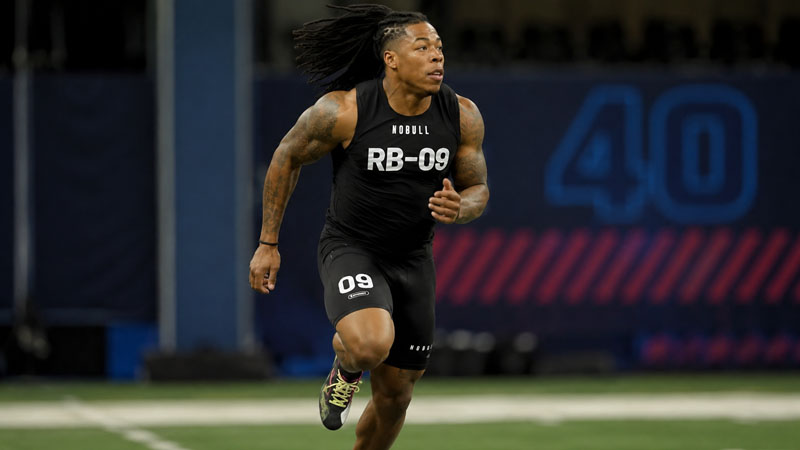
In professional football, raw linear velocity remains the ultimate equalizer. When evaluators, coaches, and sports science analysts look for elite playmakers, they search for athletes who can instantly alter defensive structures.
Among the current generation of professional players, Detroit Lions running back Jahmyr Gibbs stands out as a prime exemplar of this elite athletic profile.
Widely recognized by his fitting nickname, “Sonic,” Gibbs has quickly established himself as one of the most explosive offensive weapons in the modern era.
While casual observers often focus purely on a player’s final time over a standard straight-line run, professional personnel departments dig much deeper.
They analyze acceleration curves, initial explosive bursts, and the transition of track-based metrics into functional game performance.
By examining the precise mechanical metrics of Gibbs’ professional entry evaluations, we can uncover the physical traits that make him a recurring threat to score from anywhere on the field.
This detailed analysis breaks down his physical milestones, explains the biomechanics of his burst, and explores how his physical profile shapes modern offensive strategy.
The Draft Evaluation and the Raw Numbers
To understand the baseline of Gibbs’ elite velocity, we must first examine his official measurements recorded during the 2023 professional scouting combine.
Entering the testing cycle with significant expectations, the running back had already developed a reputation as an elite open-field threat during his collegiate career at Alabama.
The standard testing benchmark for professional football prospects is the 40-yard dash. However, the evaluation process is designed to test consistency, stamina, and recovery under pressure.
Prospects are given multiple attempts to record their fastest times. During his first attempt, Gibbs registered an impressive time of 4.40 seconds.
While a 4.40-second mark is already in the upper echelon of professional ball-carriers, his second attempt truly solidified his place in the record books. On his second run, Gibbs stopped the clock at an official 4.36 seconds.
To provide a clear picture of these performance metrics, the progression of his runs is outlined in the table below:
Scouting Combine Run Progression and Splits
| Performance Phase | Recorded Time (Seconds) | Tactical Significance |
|---|---|---|
| First Run (Initial Baseline) | 4.40 seconds | Establishes the floor of his elite physical capability under testing conditions. |
| Second Run (Official Time) | 4.36 seconds | Confirms his peak physical ceiling and secures his place among elite historic prospects. |
| 10-Yard Split (Initial Burst) | 1.52 seconds | Measures initial explosive power, critical for clearing the line of scrimmage. |
| 20-Yard Split (Mid-Phase Acceleration) | 2.52 seconds | Measures transitional velocity as the runner uprights his posture. |
This official 4.36-second performance placed Gibbs at the very top of his position group.
In an exceptionally competitive draft class filled with diverse athletic talents, his time made him the second-fastest running back overall, finishing only a fraction of a second behind De’Von Achane’s remarkable 4.32-second run.
This historical standing immediately signaled to front offices that Gibbs possessed the rare, game-changing speed that justifies a premium draft selection.
Deconstructing the Split Times: The Biomechanics of Burst
While the final 4.36-second mark captures the headlines, the real story of Gibbs’ athletic profile is found in the individual split times. In professional football, running backs rarely get to run 40 yards in a completely unobstructed straight line.
Instead, their success is determined in the first five to twenty yards of a play, where they must navigate congested defensive fronts, avoid initial tacklers, and burst through narrow running lanes.
Therefore, sports scientists and offensive coordinators pay close attention to the 10-yard and 20-yard splits. These sub-metrics isolate specific phases of the sprint:
- The 10-Yard Split (First Phase – Start & Drive): Clocked at an astonishing 1.52 seconds, this metric demonstrates Gibbs’ explosive start. A 1.52-second split indicates that he can go from a complete standstill to peak acceleration almost instantly. This is the exact distance needed to clear the defensive line of scrimmage or bounce a run to the outside edge before linebacker flow can close the running lane.
- The 20-Yard Split (Second Phase – Transition): Clocked at 2.52 seconds, this split shows his capacity to maintain acceleration as he transitions into his upright running form. It represents the phase where a running back blows past secondary defenders who are attempting to angle over to make a tackle.
By achieving these specific times, Gibbs proved that his speed is not merely a product of long-stride build-up. Instead, it is rooted in rapid force production against the ground, allowing him to hit his top gear faster than almost anyone else on the field.
Translating Track Times to Live Game Velocity
One of the most persistent challenges in professional player evaluation is distinguishing between “track speed” and “football speed.”
Some athletes excel in track spikes and light training gear on a synthetic surface but struggle to replicate that performance when wearing full pads, helmets, and navigating live defenders.
Gibbs, however, has proven that his track-level metrics translate directly to live-action situations.
His transition to the Detroit Lions has featured numerous examples of functional, padded velocity that matches or even exceeds his combine testing profile.
According to advanced tracking metrics from NFL Next Gen Stats, Gibbs has reached top-tier speeds during competitive gameplay that validate his athletic reputation. On a notable 70-yard touchdown run, he was clocked traveling at a blistering 22.03 miles per hour.
To put this on-field performance into perspective, consider how game-day velocity differs from standardized testing:
- Padded Resistance: Sprinting in professional protective gear adds significant weight and restricts natural aerodynamic movement. Reaching over 22 mph under these conditions requires immense lower-body power and physical conditioning.
- Angled Pursuits: Unlike a straight track lane, football runs require lateral cuts, adjustments, and reading the movements of block structures. Gibbs’ ability to maintain a 22.03 mph velocity while navigating a live field demonstrates exceptional body control and balance.
- Stamina Retention: Achieving peak game speed late in a play—such as during a 70-yard breakaway—shows that his speed is backed by the cardiovascular endurance required to sustain long-distance sprints without decelerating.
Strategic Advantages of Elite Running Back Speed
The presence of a player who possesses both a 4.36-second baseline and 22+ mph game-day velocity fundamentally changes how an offense is designed and how defenses must respond. In the modern professional landscape, speed is used as a tactical chess piece.
- Defensive Spacing and Alignment: When Gibbs is on the field, opposing defensive coordinators cannot afford to play single-high safety coverage or leave their linebackers in isolated space. Safeties must play deeper to prevent home-run plays, which naturally opens up the middle of the field for intermediate passing routes and interior runs.
- Horizontal Stretch: His 1.52-second ten-yard burst means he can reach the sideline faster than edge defenders can contain him. This makes outside stretch runs, tosses, and quick screen passes highly effective, forcing the defense to run laterally and creating natural cutback lanes.
- Mismatches in the Passing Game: Linebackers are typically heavier and slower than defensive backs. When an offensive scheme matches Gibbs against a linebacker in pass coverage, his acceleration splits allow him to create immediate separation on angle routes, wheel routes, and check-downs.
- Explosive Efficiency: Offenses that rely on slow, methodical drives must execute 10 to 12 plays flawlessly to score. An explosive playmaker like Gibbs can erase mistakes, penalties, or negative plays by turning a simple handoff into a 70-yard scoring drive in a single play.
Physical Performance Attributes
To summarize the key findings of this speed analysis, the following list highlights the primary components of his athletic profile:
- Official Baseline: An elite 4.36-second run that ranks among the fastest historical marks for the running back position.
- Explosive Launch: A 1.52-second first-phase split that guarantees immediate separation from the line of scrimmage.
- Sustained Momentum: A 2.52-second second-phase split showing rapid transition into open-field velocity.
- True Game Utility: Verified real-world game tracking of 22.03 miles per hour during a long-distance scoring play.
- Position Dominance: Establishing a benchmark as the second-fastest running back in his professional entry class.
Conclusion: The Future of High-Velocity Offenses
As professional football continues to prioritize space, speed, and explosive playmaking, athletes who possess the unique combination of track-level metrics and physical resilience will remain highly valued.
Jahmyr Gibbs’ 4.36-second combine performance was not an anomaly; it was a highly accurate preview of his professional trajectory.
By combining elite starting burst, sustained acceleration, and documented game-day speed of over 22 mph, he has redefined what coaches expect from the modern running back position.
For the Detroit Lions, “Sonic” is more than just a clever nickname—he is the engine of a dynamic offense that forces defenses to defend every square inch of the field.
As his career progresses, his speed will continue to serve as the benchmark against which future generations of backfield playmakers are measured.