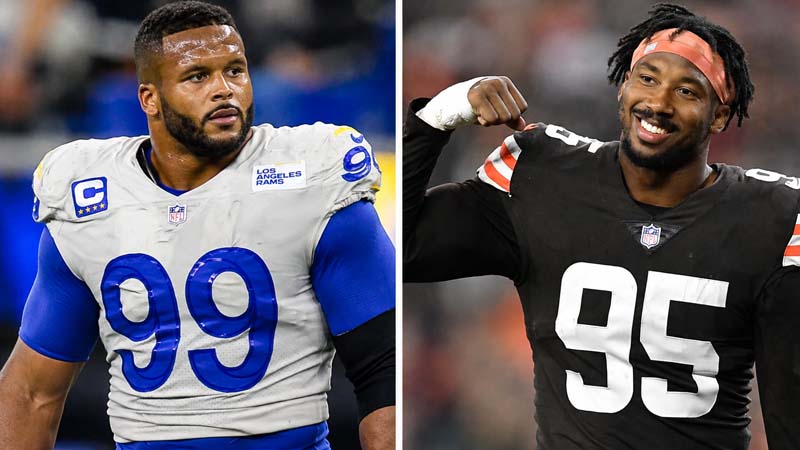
Which player is the most dominant defender of the modern era is more than a simple comparison of statistics; it represents a fundamental clash of football philosophies.
On one side stands Aaron Donald, an interior defender who broke the traditional rules of what a defensive tackle could achieve. On the other stands Myles Garrett, a physical marvel playing the premier edge position.
Both players have redefined how offensive coordinators design game plans and how front offices value defensive line talent.
To determine who truly holds the crown of defensive supremacy, we must analyze their career metrics, positional difficulties, athletic profiles, and tactical impacts.
The Legacy Framework: Career Accolades and Impact
When evaluating historic greatness, individual accolades and championship milestones serve as the primary baseline. Both players have built resumes that place them among the all-time legends of the sport, but their paths to glory feature distinct achievements.
- Aaron Donald’s Accolade Dominance: Donald’s career is defined by historic peak performance. He is one of the rare players in league history to win three Defensive Player of the Year awards. Over his ten-year career, he was named a First-Team All-Pro eight times. His dominance culminated on the game’s biggest stage, where he delivered the iconic final pressure on the quarterback to secure a Super Bowl championship for the Los Angeles Rams.
- Myles Garrett’s Ascendancy: Garrett has established himself as the premier edge defender of his generation. He has earned his own Defensive Player of the Year honors and has maintained an elite standard of play that rivals legendary defenders like Donald and J.J. Watt. Garrett’s consistency has allowed him to compile astonishing career sack numbers while serving as the focal point of his team’s defensive scheme.
The Statistical Tale of the Tape
To understand the day-to-day productivity of these two generational talents, we must examine their career numbers.
The table below presents a comprehensive side-by-side comparison of their career production, highlighting the sheer volume of plays they have made.
| Defensive Metric | Aaron Donald | Myles Garrett |
|---|---|---|
| Games Played | 154 | 134 |
| Total Sacks | 111.0 | 125.5 |
| Sack Yards Lost | 813.0 | 827.5 |
| Solo Tackles | 340 | 293 |
| Assisted Tackles | 203 | 119 |
| Combined Tackles | 543 | 412 |
| Forced Fumbles | 24 | 23 |
| Fumble Recoveries | 7 | 6 |
| Defensive Touchdowns | 0 | 1 |
Key Statistical Takeaways:
- Sack Efficiency: Myles Garrett has accumulated 125.5 sacks in 134 games, averaging approximately 0.94 sacks per game. In contrast, Aaron Donald recorded 111.0 sacks in 154 games, averaging 0.72 sacks per game. While Garrett holds the edge in raw sack volume, Donald’s interior production is historically unmatched for a defensive tackle.
- Run Defense and Tackle Volume: Donald’s position in the middle of the defense naturally put him in a position to make more tackles. He racked up 543 combined tackles compared to Garrett’s 412. Donald’s ability to shed interior blocks and stop the run while simultaneously rushing the passer is what made him a complete defensive weapon.
- Game-Changing Plays: Both players excel at creating turnovers. Donald forced 24 fumbles over his career, while Garrett has forced 23. Garrett also has one defensive touchdown to his name, highlighting his ability to transform a strip-sack into immediate points.
Tactical Deep Dive: Interior Disruption vs. Edge Dominance
The most critical factor in this comparison is the positional value of an interior defensive tackle versus an edge defender.
   OFFENSIVE LINE ALIGNMENT & DEFENSIVE ROLES

   [Left Tackle]  [Left Guard]  [Center]  [Right Guard]  [Right Tackle]
         |             |           |            |              |
         |             |           |            |              |
   (Myles Garrett)           (Aaron Donald)
    Edge Rusher                3-Technique DT
   Rushes the C-gap           Disrupts A & B gaps
   Speed, Bend, Power         Instant Pocket Collapse
The Case for Aaron Donald: The Interior Anomaly
- The 3-Technique Revolution: Donald played primarily as a 3-technique defensive tackle, lining up on the outside shoulder of the offensive guard. In professional football, generating a high-volume pass rush from the interior is significantly harder than doing so from the edge. Interior rushers operate in highly congested spaces, where they are closer to the quarterback but face immediate contact from multiple blockers.
- Shorter Path to the Quarterback: Because an interior defender is aligned closer to the center of the offensive formation, any quick win by a player like Donald results in an immediate collapse of the pocket. Donald’s rapid hand-fighting and lower-body power allowed him to penetrate the A and B gaps instantly, forcing quarterbacks to throw before their receivers could develop routes.
- Historical Rarity: While the league regularly produces elite double-digit sack artists off the edge, finding an interior tackle who can rack up 111.0 career sacks—including a historic 20.5-sack season in 2018—is incredibly rare. Donald’s ability to dominate games from the inside changed how offenses designed protection schemes, as they could no longer rely on simple one-on-one matchups for their interior offensive linemen.
The Case for Myles Garrett: The Ultimate Edge Weapon
- The Premier Pass-Rushing Role: As an edge defender, Garrett plays the most coveted position on defense. Edge rushers are tasked with defeating offensive tackles in space, utilizing speed, agility, and power to bend around the pocket. Garrett’s size and speed make him a constant threat to strip the ball from the quarterback’s blind side.
- Unyielding Attention from Blockers: Garrett’s dominance is reflected in the extreme measures opposing teams take to slow him down. He consistently leads the league in double-team rate from the defensive end position.
- Extreme Blocking Schemes: Opposing offenses frequently resort to historic blocking configurations to survive Garrett. During a game, Garrett noted that he looked around and saw a guard, the center, and the opposite guard all shifting to block him on a single play. Facing a triple-team of interior blockers as an edge player highlights the sheer terror he instills in offensive play-callers.
- High-End Consistency: Garrett’s pass-rush win rate remains at the top of the league despite these blocking schemes. His elite play has carried his team’s defense, culminating in a league-leading 23.0-sack season in 2025.
The Draft Profiles: The “Undersized” Icon vs. The Perfect Specimen
The origin stories of these two defenders show the different expectations they faced entering professional football.
- Aaron Donald’s Underdog Ascent: Coming out of college, Donald was widely considered “undersized” for a traditional defensive tackle. Critics questioned whether his frame could withstand the physical toll of competing against massive interior offensive linemen at the professional level. He fell to the 13th overall pick in the 2014 draft, using that perceived limitation as fuel to build a legendary career defined by leverage, strength, and unmatched work ethic.
- Myles Garrett’s Blue-Chip Pedigree: Garrett was the exact opposite of an underdog. He entered the draft as the consensus “perfect prospect”. Analysts frequently compared him to premier physical marvels like Jadeveon Clowney and Von Miller. Garrett possessed a rare combination of height, reach, and speed that made his selection as the #1 overall pick in the 2017 draft an absolute certainty. He has fully lived up to that billing, translating his elite physical gifts into continuous defensive dominance.
The Blockbuster Trade and the Ultimate “What If”
A fascinating chapter in this defensive rivalry occurred in June 2025, when the Los Angeles Rams acquired Myles Garrett in a massive trade. This transaction united the reigning Defensive Player of the Year with the infrastructure of Donald’s former team.
The trade sent shockwaves through the league and immediately sparked rumors of an incredible defensive pairing:
- Donald Flirts with a Return: Following the trade, speculation began that Aaron Donald might come out of retirement to team up with Garrett in Los Angeles.
- The Competitive Fire: Donald admitted that the acquisition of Garrett “got him thinking” and had him actively flirting with the idea of a return to the field. He noted that if he could find his competitive fire, a return to play alongside Garrett was a real possibility.
- The Strategic Impact: A defensive line featuring both Aaron Donald rushing from the 3-technique and Myles Garrett coming off the edge would have been practically unblockable. Offensive lines would have been forced to choose which player to double-team, leaving the other in a one-on-one matchup. While the pairing did not ultimately materialize on the field, the mere thought of these two icons sharing a defensive front remains one of the greatest “what ifs” in football history.
Strategic Breakdown: How Coordinators Defended Each Star
The ultimate testament to a player’s greatness is the schematic adjustment they force an opponent to make.
Both Donald and Garrett broke traditional defensive boundaries, forcing offensive coordinators to abandon standard drop-back passing concepts.
Countering Aaron Donald:
- Guards Sliding Help: Teams rarely left an offensive guard alone with Donald. Most schemes featured a “sliding” protection where the center immediately helped the guard, effectively creating a wall in the middle of the pocket.
- Quick Game Passing: To minimize Donald’s interior push, offenses utilized quick three-step drops, throwing screens and short slants to get the ball out of the quarterback’s hands before Donald could penetrate the backfield.
- Heavy Run Formations: Teams attempted to run directly at Donald using double-teams from a guard and a tackle to wear down his lower-body leverage over four quarters.
Countering Myles Garrett:
- Chipping with Tight Ends and Running Backs: Offenses rarely allow Garrett a clean run at the offensive tackle. They consistently position a tight end or a running back on his side to “chip” him at the snap, disrupting his pass-rush track and slowing his initial burst.
- Unbalanced Lines: Teams often run away from Garrett’s side of the field or use heavy formations with extra tackles to neutralise his speed off the edge.
- Triple-Team Protections: In extreme passing situations, teams will slide an entire side of the offensive line toward Garrett, utilizing a tackle, guard, and center to prevent him from collapsing the edge.
The Verdict: The Interior Icon Wins the Historic Crown
Comparing these two defensive giants requires choosing between two forms of dominance.
Myles Garrett is the ultimate prototype of an edge rusher. His speed, athleticism, and consistency have allowed him to compile career sack numbers at a faster pace than almost any defender in history. He is a future Hall of Famer who continues to dominate the league, as shown by his league-leading 23.0 sacks in 2025.
However, Aaron Donald represents an unparalleled positional anomaly. Dominating from the interior of the defensive line is historically more difficult and far rarer than dominating from the edge.
Donald did not just lead his position; he produced sack numbers that rivaled the greatest edge rushers while playing in the congested middle of the line.
With three Defensive Player of the Year awards, eight First-Team All-Pro selections, and a Super Bowl ring secured by his own championship-winning pressure, Donald maintains a slight edge in the race for historical supremacy.