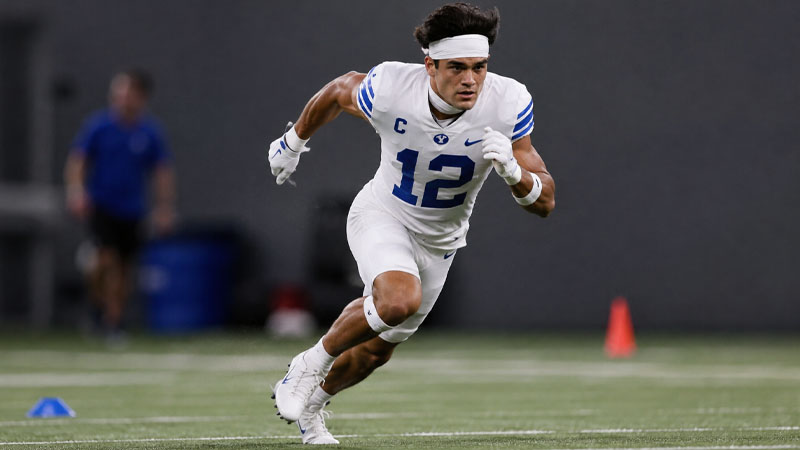
For decades, professional football talent evaluators have remained tethered to a singular, standardized metric for determining a wide receiver’s big-play potential: the 40-yard dash.
This straight-line sprint, run in compression shorts on artificial turf, has made and broken draft stocks since the inception of modern scouting. However, every few years, an outlier emerges who completely shatters this conventional paradigm.
When Makea “Puka” Nacua entered the professional ranks, his physical testing metrics triggered standard warning lights across front-office databases.
Registering an official 40-yard dash time of 4.57 seconds, he was immediately categorized as a below-average athlete relative to his positional peers. Traditional evaluators assumed his ceiling was severely limited by a lack of elite separation speed.
What followed was one of the most astonishing rookie campaigns in professional football history.
Far from struggling to separate, Nacua established himself as an elite offensive weapon, utilizing a masterclass in functional game speed, body control, and physical intelligence to dominate defensive secondaries.
His success has forced a complete re-evaluation of how organizations measure, conceptualize, and value speed in the modern era.
The Tale of the Tape: Puka Nacua’s Complete Athletic Profile
To understand why traditional evaluation models failed to project Nacua’s immediate dominance, we must first look at his comprehensive pre-draft physical and athletic measurements.
While his straight-line sprint did not turn heads, his broader athletic footprint painted a much more complex picture.
The following table outlines the exact physical metrics recorded during his pre-draft evaluation:
Physical Dimensions
| Metric | Measurement (Imperial) | Measurement (Metric) |
|---|---|---|
| Height | 6 feet 2 inches | 188 cm |
| Weight | 212 pounds | 96 kg |
| Age (As of Sept 2024) | 23 years old (May 29, 2001) | 23 years old (May 29, 2001) |
| Arm Length | 31.5 inches | 80 cm |
| Hand Span | 9.5 inches | 24 cm |
The physical profile of a 6-foot-2, 212-pound receiver provides a sturdy foundation. Nacua does not possess the slight, aerodynamic frame of a pure track-style speedster; instead, he has the build of a physical, modern boundary threat who can absorb contact and play through the physical demands of intermediate routes.
His athletic testing performance tells a parallel story, showing standard numbers alongside solid indicators of explosive power:
Athletic Performance Testing
| Drill | Performance Score | Scouting Context |
|---|---|---|
| 40-Yard Dash | 4.57 seconds | Below average for modern wide receivers |
| 10-Yard Split | 1.62 seconds | Standard introductory burst indicator |
| 20-Yard Split | 2.64 seconds | Intermediate acceleration checkpoint |
| 20-Yard Shuttle | 4.36 seconds | Lateral agility and short-area redirection |
| Three-Cone Drill | 7.32 seconds | Change-of-direction stability metric |
| Vertical Jump | 33.0 inches | Vertical explosion and catch-radius baseline |
| Broad Jump | 10 feet 1 inch (3.07 m) | Horizontal power and lower-body drive |
| Bench Press | 15 reps | Upper-body strength and press-coverage resistance |
While the 4.57-second 40-yard dash is the number that dominated pre-draft discussions, his 1.62-second 10-yard split and 2.64-second 20-yard split showed a highly respectable burst off the line of scrimmage.
His broad jump of over 10 feet and vertical leap of 33 inches demonstrated that his lower-body power was more than adequate for high-point situations.
The Utah Roots and Collegiate Evolution
Nacua’s journey to professional prominence began long before his name was called in the draft. Born on May 29, 2001, in Provo, Utah, he established himself as a legendary figure in Utah high school sports history.
Attending Orem High School, Nacua put together a career that completely rewrote the state’s record books:
- Career Receptions: 260 catches
- Career Receiving Yards: 5,226 yards
- Career Touchdowns: 58 receiving touchdowns
These record-shattering numbers caught the attention of major college programs nationwide. Nacua ultimately chose the University of Washington to begin his collegiate career.
He played in the first eight games of his freshman season, displaying flashes of the playmaking ability that would later define his game.
Seeking a transition, Nacua entered the collegiate transfer portal and returned to his home state, committing to Brigham Young University (BYU) for the 2021 season.
His impact at BYU was immediate and highly efficient. During his first season with the Cougars, he hauled in 43 passes for 805 receiving yards and 6 touchdowns, averaging an exceptional 18.7 yards per reception.
His collegiate film was littered with explosive plays, but lingering injuries during his college tenure meant he was still working his way back to peak physical condition during his pre-draft evaluation window.
This physical context helps explain why his timed speed did not match his true on-field capability during the draft cycle.
Game Speed vs. Track Speed: The Biomechanics of Functional Velocity
To understand how Nacua bypassed the limitations of his 4.57-second 40-yard dash, one must examine the distinction between track speed and functional game speed.
Track speed is an artificial construct: a runner starting in a specialized stance, moving in a straight line with no physical obstacles, reacting purely to a starter’s pistol.
In contrast, functional game speed requires a player to process real-time variables while running. This includes:
- Reading the leverage of a defensive back.
- Anticipating safety help over the top.
- Tracking a ball over the shoulder while maintaining stride.
- Absorbing physical contact along the route stem.
When the pads go on, track speed often decreases due to the cognitive load of playing football. However, players with elite functional speed maintain their velocity because their movement mechanics are highly optimized for the sport.
The Next Gen Data Reality
During his historic rookie season, the tracking technology embedded in players’ pads began to tell a story that the stopwatch missed.
According to Next Gen Stats, Nacua reached a peak velocity of 21.35 mph during a dramatic 70-yard touchdown reception.
To put this in perspective:
- A speed of 21.35 mph is an elite velocity for an active player in pads during live gameplay.
- Many wide receivers who run sub-4.40 40-yard dashes in compression shorts never reach 21 mph in an actual game because they lack the physical strength to sustain speed under the weight of protective equipment and defensive resistance.
- Nacua’s ability to hit over 21 mph in game conditions proves that his top-end velocity is highly functional and elite when contextualized within actual play.
Momentum and the Physics of YAC
Because Nacua carries a sturdy 212-pound frame, his high top-end speed creates immense kinetic energy. The physics of football are simple: momentum equals mass multiplied by velocity.
When a defender attempts to tackle a 212-pound receiver moving at over 21 mph, the force required to halt that momentum is substantial.
This physical reality underpins Nacua’s elite yards-after-catch (YAC) capability, allowing him to bounce off arm tackles and pick up significant yardage after making a reception.
Agility in the Gauntlet: What the Tracking Data Saw
The warning signs that Nacua was a much faster football player than a sprinter were present during his pre-draft showcase, if one knew where to look.
While traditional scouts focused on the linear track, high-tech tracking chips were capturing detailed performance data during positional workouts.
During these positional drills—most notably the gauntlet, which requires a receiver to run laterally across the field while catching a rapid succession of passes—the tracking data painted a picture of elite movement efficiency.
- Elite Acceleration Out of Breaks: The tracking metrics clocked Nacua with elite quickness and explosive burst when entering and exiting his cuts.
- Deceleration Control: His start-stop abilities allowed him to drop his hips instantly, halt his momentum, and change directions without losing balance.
- Ball-Tracking Fluidity: The tracking systems registered that Nacua did not slow down to catch the football. His stride remained perfectly consistent, demonstrating exceptional hand-eye coordination and body control.
By showing elite quickness in positional drills, Nacua proved that his body mechanics were highly optimized for the exact movements required on a football field, even if his 40-yard sprint did not jump off the page.
The Four Pillars of Functional Speed
How does a receiver with a 4.57-second 40-yard dash consistently beat defensive backs who run in the 4.40s? Nacua’s success is built upon four specific pillars of play speed:
I. Elite Route Running and Timing
Speed is irrelevant if a receiver cannot get open. Nacua uses advanced footwork and route stems to manipulate the leverage of defenders. By threatening defenders vertically, he forces them to turn their hips early.
Once the defender’s weight is displaced, Nacua uses his elite start-stop ability to break off his route, creating yards of separation without needing to run past the defender in a straight line.
His routes are executed with perfect timing, ensuring he arrives at the quarterback’s target window exactly when the ball does.
II. Exceptional Spatial Balance and Body Control
A major limiting factor for many track-style receivers is their inability to maintain balance when changing direction. Nacua exhibits outstanding balance, whether he is tight-roping the sideline or transitioning between his route breaks.
Standing 6-foot-2, he possesses a rare ability to bend his knees, lower his center of gravity, and maintain total balance through sharp angles. This body control allows him to make difficult receptions in high-traffic areas over the center of the field.
III. Physicality and Play Strength
Football is a contact sport, and pure speed is often neutralized by physical defenders. Nacua embraces the physical aspect of the position.
He uses his hands effectively to beat press coverage at the line of scrimmage, preventing defenders from disrupting his route timing.
During the route, he can lean into defenders, using his 212-pound frame to shield them from the ball. This physicality ensures that his play speed is never compromised by contact.
IV. Yards-After-Catch (YAC) Mentality
Shattering rookie records requires a receiver to turn short passes into long gains. Nacua does not run to the sideline to avoid contact; instead, he transitions from receiver to ball carrier instantly.
His combination of dependable hands, start-stop agility, and physical toughness makes him a nightmare to bring down in space. He runs with a physical urgency that forces missed tackles and maximizes every yard after the catch.
The Economics of the Draft: How the Rams Capitalized
The discrepancy between Nacua’s timed speed and his functional game performance created a massive market inefficiency—one that the Los Angeles Rams capitalized on beautifully during the 2023 draft cycle.
Because Nacua’s 40-yard dash time was below average, and because he had battled injuries during his collegiate career, many franchises took him off their draft boards or pushed him down their rankings.
The Rams, focusing on tracking metrics, route efficiency, and physical play style, recognized his hidden value.
They selected Nacua in the fifth round with the 177th overall pick. This draft position allowed them to secure a premier offensive contributor on a highly cost-effective contract structure.
The table below outlines the financial details of his rookie agreement:
Contract Value Analysis
| Contract Element | Value (USD) |
|---|---|
| Total Contract Value | $4,000,000 |
| Contract Duration | 4 Years |
| Signing Bonus | $244,976 |
| Total Guaranteed Money | $244,976 |
| Average Annual Salary | $1,000,000 |
By finding an elite, record-shattering receiver in the fifth round, the Rams secured premium, top-tier production at a fraction of the cost of a typical high-end veteran wide receiver.
This draft masterclass highlights the massive competitive advantage that can be gained by looking past raw testing times and focusing on functional play speed.
The Evolving Paradigm of Scouting
The success of Puka Nacua represents a pivotal moment in the evolution of player evaluation. It serves as a stark reminder that football is not played in a straight line on a track, but is instead a dynamic, physical sport played in pads under constant cognitive load.
When analyzing an athlete’s potential, scouts must look beyond simple stopwatch numbers and focus on the holistic components of functional on-field speed:
- Dynamic Acceleration: How fast can a player accelerate within the first 10 yards of their route to create immediate separation?
- Redirection Stability: Can the player decelerate, change direction, and maintain balance without losing their momentum?
- Physical Power: Does the athlete possess the play strength to maintain their running speed while fighting off physical coverage?
- Cognitive Efficiency: How quickly can the player read defensive coverage and adjust their route while running at full speed?
Nacua excels in every single one of these functional categories. By combining elite route running, exceptional body control, physical play strength, and dynamic ball tracking, he has proven that a 4.57-second receiver can play like a sub-4.40 flyer on any given Sunday.
As professional organizations continue to integrate high-tech tracking telemetry into their evaluation processes, players like Nacua will no longer be viewed as draft-day surprises. Instead, they will be recognized as the gold standard of modern football performance.