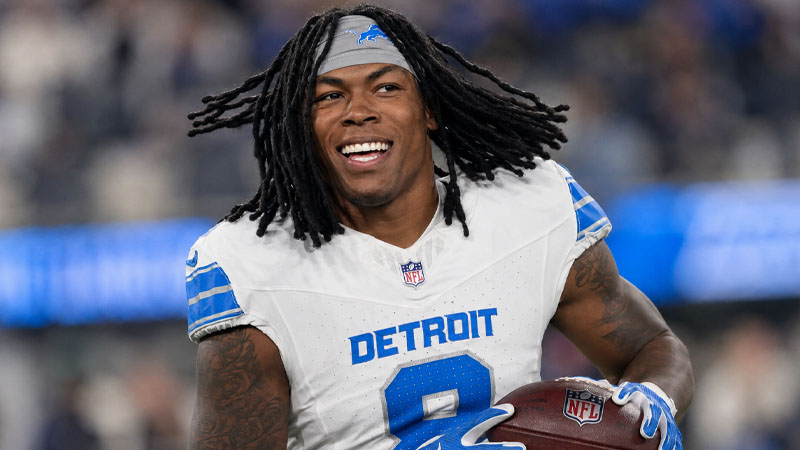
When the Detroit Lions selected running back Jahmyr Gibbs with the 12th overall pick in the first round of the 2023 NFL Draft, the move was met with immediate, widespread debate. Traditional football analysis long maintained that taking a running back high in the first round was a sub-optimal allocation of draft capital.
However, Detroit’s offensive design team recognized that Gibbs was not a traditional running back. Out of the University of Alabama, Gibbs possessed a rare, elite combination of pure rushing speed and refined, wide-receiver-caliber route running.
Over his first three professional seasons, Gibbs has completely vindicated Detroit’s draft strategy. By wearing the #0 jersey, he signaled a new era of positionless offensive versatility.
Measuring 5’9″ and weighing 202 pounds, his compact build, low center of gravity, and explosive change of direction make him uniquely suited for the modern game.
Rather than serving as a simple handoff merchant, Gibbs has operated as a foundational offensive chess piece. He forces opposing defensive coordinators into agonizing matchup dilemmas: put a linebacker on him, and he wins with pure speed; put a defensive back on him, and Detroit exploits the numbers advantage in the run game.
Year-by-Year Rushing Breakdown: High-Efficiency Ground Dominance
To truly appreciate the ground game that Gibbs brings to the field, one must look at the remarkable efficiency he has maintained over three consecutive seasons.
Running backs who carry a heavy load often experience a sharp decline in yards per carry (AVG). Gibbs, however, has consistently bucked this trend, maintaining a career rushing average of 5.3 yards per carry over 675 attempts.
In his rookie year (2023), Gibbs rushed for 945 yards and 10 touchdowns in just 15 games, establishing his big-play ability with a 5.2 yards-per-carry average.
In 2024, his rushing workload increased to 250 carries, resulting in a career-high 1,412 yards and 16 touchdowns. Despite the heavier load, his efficiency actually increased to an astonishing 5.6 yards per carry, demonstrating his superb conditioning and vision.
In 2025, Gibbs continued his dominant stretch, carrying the ball 243 times for 1,223 yards and 13 touchdowns.
While his average settled at 5.0 yards per carry, he ranked 7th in the NFL in rushing yards and tied for 4th in rushing touchdowns. This sustained level of production proves that his sophomore season was no aberration.
The table below provides a comprehensive breakdown of his regular-season rushing metrics:
| Season | Team | Games Played (GP) | Rushing Carries (CAR) | Rushing Yards (YDS) | Average Yards/Carry (AVG) | Rushing Touchdowns (TD) | Longest Run (LNG) | Rushing First Downs (FD) |
|---|---|---|---|---|---|---|---|---|
| 2023 | DET | 15 | 182 | 945 | 5.2 | 10 | 36 | 42 |
| 2024 | DET | 17 | 250 | 1,412 | 5.6 | 16 | 70 | 70 |
| 2025 | DET | 17 | 243 | 1,223 | 5.0 | 13 | 78 | 56 |
| Career | DET | 49 | 675 | 3,580 | 5.3 | 39 | 78 | 168 |
Analysis of the Rushing Data:
- Volumetric Consistency: Over his 49-game career, Gibbs has accumulated 3,580 rushing yards, averaging 73.1 yards per game on the ground alone.
- The Big-Play Factor: His ability to split defenses is evidenced by his career-long run progression: from a 36-yard run as a rookie, to a 70-yard burst in 2024, and finally a career-best 78-yard touchdown run in 2025.
- Chains Mover: Running back effectiveness is often measured by the ability to sustain drives. Gibbs has picked up 168 rushing first downs, averaging a first down on 24.8% of his career rushes.
The Passing Game Expansion: A True Multi-Dimensional Threat
While his rushing numbers are those of an elite back, Gibbs’ work in the passing game is what elevates him into the rarest tier of offensive playmakers.
Modern offenses require running backs who can act as functional receivers, running actual routes downfield rather than just catching desperate check-downs.
Over his first two seasons, Gibbs caught exactly 52 passes each year, showing steady progress in his yards-per-reception efficiency, which jumped from 6.1 in 2023 to 9.9 in 2024. However, the real schematic shift occurred during the 2025 regular season.
Detroit’s coaching staff consciously adjusted his role to capitalize on his unmatched matchup advantages, resulting in a career-high 94 targets. Gibbs caught 77 of those targets for 616 yards and 5 touchdowns.
This represented an elite catching rate of 81.9%, providing quarterback Jared Goff with an incredibly reliable, low-risk, high-reward target in the short-to-intermediate passing game.
| Season | Team | Games Played (GP) | Receptions (REC) | Targets (TGTS) | Receiving Yards (YDS) | Average Yards/Catch (AVG) | Receiving Touchdowns (TD) | Longest Catch (LNG) | Receiving First Downs (FD) |
|---|---|---|---|---|---|---|---|---|---|
| 2023 | DET | 15 | 52 | 71 | 316 | 6.1 | 1 | 24 | 20 |
| 2024 | DET | 17 | 52 | 63 | 517 | 9.9 | 4 | 54 | 26 |
| 2025 | DET | 17 | 77 | 94 | 616 | 8.0 | 5 | 42 | 28 |
| Career | DET | 49 | 181 | 228 | 1,449 | 8.0 | 10 | 54 | 74 |
Analysis of the Receiving Data:
- Target Efficiency: Gibbs has converted 181 of his 228 career targets into completions. This is an overall career catch rate of 79.4%, which is remarkable for an offensive weapon moving across different alignments.
- Explosive Output: In 2024, Gibbs averaged nearly double-digit yards per reception (9.9), highlighted by a career-long 54-yard reception.
- Third-Down Conversion Power: Gibbs has secured 74 receiving first downs over his three seasons. Combining this with his rushing first downs, he has personally kept the chains moving 242 times for Detroit.
Scoring Efficiency & Scoring Output: Maximizing Point Production
Ultimately, the goal of any NFL offense is to put points on the board. A premier player must be able to convert yardage into touchdowns, especially when the field shrinks in the red zone. Gibbs has established himself as one of the most prolific and dependable scorers in the league.
Through 49 career regular-season games, Gibbs has scored exactly 49 touchdowns. This average of 1.00 touchdown per game places him in historic company. In his rookie campaign, he notched 11 total touchdowns.
In 2024, he crossed the goal line 20 times, contributing 120 points to Detroit’s high-octane offense. In 2025, he followed up with 18 total touchdowns (13 rushing and 5 receiving), contributing another 108 points.
The following table details his scoring output:
| Season | Team | Games Played (GP) | Rushing Touchdowns | Receiving Touchdowns | Return Touchdowns | Total Touchdowns (TD) | Two-Point Conversions | Total Points Scored (PTS) |
|---|---|---|---|---|---|---|---|---|
| 2023 | DET | 15 | 10 | 1 | 0 | 11 | 0 | 66 |
| 2024 | DET | 17 | 16 | 4 | 0 | 20 | 0 | 120 |
| 2025 | DET | 17 | 13 | 5 | 0 | 18 | 0 | 108 |
| Career | DET | 49 | 39 | 10 | 0 | 49 | 0 | 294 |
Analysis of the Scoring Data:
- Red Zone Lethality: Gibbs’ 39 career rushing touchdowns in 49 games showcase his capability to run through contact near the goal line, despite not being a traditional heavy “power” back.
- The 300-Point Threshold: With 294 career points scored entirely through non-kicking touchdowns, Gibbs is on pace to cross the 300-point mark in his very next regular-season game.
- Consistent Year-Over-Year Scoring: Scoring 20 touchdowns in 2024 and following up with 18 in 2025 highlights a level of multi-year scoring stability that very few active offensive players can match.
Ball Security & Operational Dependability: Minimizing Costly Mistakes
In the modern NFL, winning the turnover battle is the single highest predictor of victory. A running back can compile thousands of yards, but if they put the ball on the turf in critical moments, they become a liability. Coaches place an immense premium on ball security.
For a player with Gibbs’ volume of touches, his ball security metrics are nothing short of elite. Over three seasons, Gibbs has accumulated 675 rushing carries and 181 receptions, for a total of 856 career touches. On those 856 touches, he has fumbled only 5 times, losing just 2 of them to the opposing defense.
| Season | Team | Total Touches (Carries + Catches) | Total Fumbles (FUM) | Fumbles Lost (LST) | Touch-to-Fumble Ratio | Touch-to-Lost-Fumble Ratio |
|---|---|---|---|---|---|---|
| 2023 | DET | 234 | 2 | 1 | 117.0 touches/fumble | 234.0 touches / lost fumble |
| 2024 | DET | 302 | 1 | 1 | 302.0 touches/fumble | 302.0 touches / lost fumble |
| 2025 | DET | 320 | 2 | 1 | 160.0 touches/fumble | 320.0 touches / lost fumble |
| Career | DET | 856 | 5 | 3 | 171.2 touches/fumble | 285.3 touches / lost fumble |
Key Ball Security Takeaways:
- Incredible Reliability: Gibbs averages an outstanding 171.2 touches between fumbles of any kind.
- Securing the Ball: When it comes to fumbles that are actually recovered by the opponent, his ratio climbs to a stellar 285.3 touches per lost fumble.
- Trustworthiness: This level of security is why Detroit’s coaching staff has no hesitation in putting the ball in his hands during late-game, high-pressure situations.
The Elite Comparison: Gibbs vs. Bijan Robinson
Since entering the league in the same draft class, Jahmyr Gibbs and Atlanta Falcons running back Bijan Robinson have been locked in a career-long statistical and stylistic comparison. Robinson was selected 8th overall, while Gibbs went 12th.
Analysts and fantasy managers have debated endlessly over which player holds the crown as the premier young dual-threat weapon in the NFL.
Prominent analysts, including Mike Clay and Daniel Dopp, have publicly stated their preference for Gibbs, ranking him as the overall RB1 over Robinson. The analytical reasoning for this preference is rooted in several critical factors:
- Red Zone Efficiency: Gibbs’ touchdown production is remarkably concentrated and efficient. Scoring 49 touchdowns in 49 games gives him a scoring density that few running backs in the modern era can match.
- Passing Game Involvement: Gibbs’ massive target volume in 2025 (94 targets, 77 receptions) demonstrates that his ceiling as a pass-catcher is higher in Detroit’s offense than Robinson’s in Atlanta.
- Elite Surrounding Cast: Operating behind Detroit’s dominant offensive line allows Gibbs to maximize his yards-per-carry average (5.3 career AVG) far more consistently than Robinson can behind a shifting Atlanta front.
The table below contrasts the primary arguments from leading NFL analysts regarding this positional debate:
| Analyst | Core Position | Key Supporting Factor | Analytical Rationale |
|---|---|---|---|
| Mike Clay | Takes Gibbs over Robinson | Systemic Touchdown Opportunity | Detroit’s high-efficiency offense consistently generates red-zone trips, maximizing Gibbs’ elite scoring rate (39 rushing, 10 receiving TDs). |
| Daniel Dopp | Ranks Gibbs as RB1 overall | Target Volume & PPR Ceiling | The dramatic jump to 94 targets and 77 catches in 2025 provides Gibbs with an unmatched floor and ceiling in modern fantasy formats. |
| Opposing Consensus | Prefers Robinson | Volumetric Workload | Traditional views favor Robinson’s projection as a pure “workhorse” back with a higher share of his team’s total rushing attempts. |
Strategic Executive Summary: The Ultimate Core Asset
In an era of football where versatility, efficiency, and ball security dictate championship success, Jahmyr Gibbs has emerged as the definitive model for the modern running back.
He has transformed Detroit’s offense into an unpredictable, high-tempo machine capable of attacking defenses from any alignment.
For franchise decision-makers, sports analysts, and football enthusiasts alike, Gibbs represents the gold standard of offensive productivity.
His career statistics are not merely impressive—they are a testament to what is possible when elite physical talent meets world-class offensive coaching. As Detroit continues its championship pursuit, #0 will remain at the very center of their success.