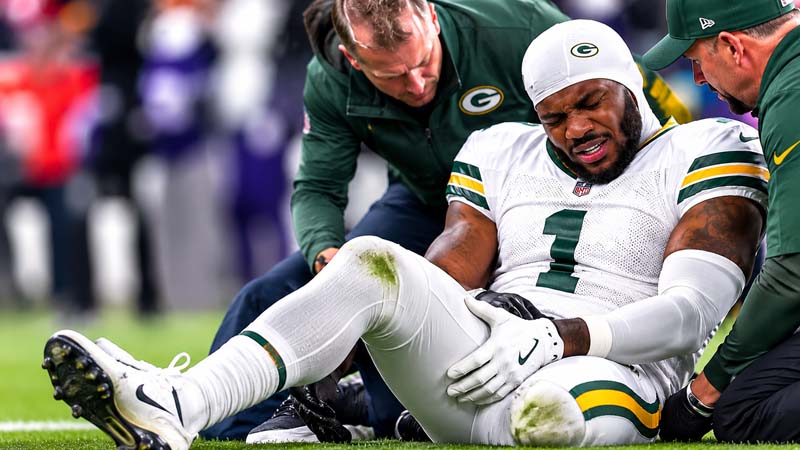
The intersection of elite athletic performance and orthopaedic medicine is nowhere more apparent than when a franchise player suffers a major knee injury.
For the Green Bay Packers, the defensive strategy underwent a profound structural shift on December 14, 2025, when star edge rusher Micah Parsons suffered a non-contact knee injury during a highly competitive game against the Denver Broncos.
When a premier defensive weapon is sidelined, the ramifications extend far beyond the immediate loss on the scoreboard. It alters defensive schemes, impacts salary cap dynamics, reshapes divisional races, and tests the depth of the roster.
An analysis of the clinical realities of Parsons’ anterior cruciate ligament (ACL) reconstruction, the physiological milestones of his ongoing rehabilitation, and the administrative roster choices facing the Green Bay front office reveals the complex path back to the field.
The Biomechanics of the Injury: What Occurred on December 14?
The injury occurred in the third quarter of the December 14, 2025, matchup as Parsons was actively pursuing Broncos quarterback Bo Nix. This specific play featured a classic non-contact deceleration mechanism.
In professional football, edge rushers must routinely generate immense lateral force, transitioning from a full sprint to a sharp cut in milliseconds.
When chasing a mobile quarterback, an edge rusher plants their foot to change direction. If the foot remains anchored to the turf while the upper body’s momentum continues to rotate, it creates a combination of valgus stress (the knee collapsing inward) and internal rotation of the tibia relative to the femur.
This mechanical overload exceeds the ultimate tensile strength of the ACL. The ACL serves as the primary stabilizer against anterior tibial translation and rotatory laxity. When these forces exceed the ligament’s threshold, a rupture occurs.
An MRI conducted on December 15, 2025, officially confirmed a clean tear of his left ACL. In clinical orthopaedics, a “clean tear” indicates that the ligamentous disruption is isolated. While any ACL tear is severe, an isolated tear is the most favorable diagnostic outcome. It means there is no major concomitant pathology, such as:
- A torn medial collateral ligament (MCL), often referred to as part of the “unhappy triad.”
- Severe damage to the lateral or medial meniscus, which would require separate suturing and significantly delay early weight-bearing protocols.
- Deep bone bruising of the lateral femoral condyle, which can complicate early rehabilitation due to persistent pain.
Because the diagnostic imaging showed no secondary structural failures, the surgical team was presented with a straightforward path for structural reconstruction.
Surgical Intervention: Dr. Neal ElAttrache’s Reconstruction
On December 29, 2025, fifteen days after the initial injury, Parsons underwent successful reconstructive surgery in Los Angeles. The procedure was performed by Dr. Neal ElAttrache, an orthopaedic surgeon renowned for treating elite professional athletes.
Injury Date: December 14, 2025
  │
  └── 15-Day Inflammatory Reduction Window
        │
        └── Surgery Date: December 29, 2025 (Dr. Neal ElAttrache)
The two-week delay between the injury and the surgical procedure is standard practice in modern sports medicine.
Operating immediately after a tear—while the knee is in an acute inflammatory state with limited range of motion—drastically increases the risk of arthrofibrosis (excessive scar tissue formation that restricts joint mobility).
Allowing the acute swelling to subside and restoring basic range of motion beforehand ensures a much better post-surgical outcome.
During ACL reconstruction, the torn native ligament is removed and replaced with a graft. While the specific graft selection for Parsons was not disclosed, elite athletes typically receive one of three primary options:
| Graft Type | Description | Key Benefits for Edge Rushers | Potential Recovery Challenges |
|---|---|---|---|
| Bone-Patellar Tendon-Bone (BTB) Autograft | Uses the middle third of the patient’s own patellar tendon with bone plugs from the kneecap and tibia. | High initial stability; excellent bone-to-bone healing; long considered the gold standard for high-demand cutting athletes. | Higher incidence of anterior knee pain; discomfort when kneeling during three-point stances. |
| Quadriceps Tendon Autograft | Harvests a strip of the patient’s quadriceps tendon from just above the kneecap. | Offers a thick, robust graft with a high collagen density; excellent tensile strength comparable to BTB. | Requires intensive early focus on restoring active quadriceps activation and extension. |
| Hamstring Tendon Autograft | Utilizes the semitendinosus and gracilis tendons to form a multi-stranded graft. | Less immediate post-operative anterior knee pain; smaller incision sites. | Can lead to minor, long-term deficits in hamstring strength, which is vital for explosive acceleration. |
Dr. ElAttrache’s successful execution of the reconstructive surgery marked the completion of the acute phase of care, transitioning Parsons’ roadmap into a multi-phased rehabilitation program.
The Multi-Phased Rehabilitation Process
Parsons is currently completing his rehabilitation and recovery process at the Green Bay Packers’ training facility. This localized, team-supervised environment provides access to specialized sports science personnel, anti-gravity treadmills, advanced diagnostic tools, and daily monitoring.
A standard professional ACL rehabilitation program is structured around objective functional milestones rather than strict timelines:
Joint Protection and Swelling Management (Weeks 1–6)
The primary goals immediately following the December 29 surgery were to protect the healing graft, eliminate joint effusion (swelling), and restore full passive extension. Achieving symmetrical hyperextension early is critical to preventing permanent gait alterations. During this period, therapy focuses heavily on:
- Neuromuscular electrical stimulation (NMES) to prevent severe quadriceps atrophy.
- Passive and active-assisted range-of-motion exercises.
- Gradual progression to full weight-bearing as tolerated, ensuring the patient can walk without an antalgic (limping) gait.
Progressive Strength and Hypertrophy (Weeks 7–18)
Once the joint is quiet and basic mobility is restored, the focus shifts to rebuilding the muscle volume lost during the acute phase.
This involves closed-kinetic-chain exercises like squats, leg presses, and step-ups, alongside targeted hamstring and gluteal strengthening.
- Therapists utilize Blood Flow Restriction (BFR) training, which allows the athlete to build muscle hypertrophy using lighter loads, protecting the healing graft from premature mechanical stress.
- Single-leg strength balance is prioritized to minimize the bilateral deficit between the reconstructed left knee and the healthy right leg.
Linear Running and Neuromuscular Re-education (Weeks 19–28)
Before an athlete can run, they must demonstrate sufficient quadriceps strength (typically at least 80% of the uninjured limb on an isokinetic dynamometer).
Linear running on specialized surfaces, such as AlterG (anti-gravity) treadmills, begins before progressing to solid ground.
This phase re-introduces the central nervous system to the demands of repetitive impact and teaches proper landing mechanics.
Sport-Specific Agility and Rotational Force (Weeks 29+)
For an edge rusher, linear speed is only a small fraction of the job. This phase introduces lateral shuffling, deceleration drills, change-of-direction patterns, and eventually, simulated pass-rush maneuvers around arcs.
The graft undergoes its final stages of ligamentization—the biological process where the tendon graft gradually transforms into a functional ligament, reaching its peak structural integrity between 9 and 12 months post-surgery.
Understanding the PUP List and Roster Management
As the 2026 NFL regular season approaches, Parsons remains sidelined and is expected to start the season on the physically unable to perform (PUP) list. This roster designation is a strategic necessity for the Green Bay front office.
The PUP list is divided into two distinct categories: Active/PUP (used during training camp) and Reserve/PUP (used once the regular season roster is finalized).
Training Camp (Active/PUP) ──> Final Roster Cuts ──> Regular Season (Reserve/PUP)
                                                     │
                                                     └── Sidelined for minimum 4 games
By placing Parsons on the Reserve/PUP list at the start of the regular season, the Packers secure several administrative and roster advantages:
- Roster Spot Exemption: A player on the Reserve/PUP list does not count against the active 53-man roster. This allows the team to carry an extra healthy defensive lineman or depth player during the opening weeks of the season.
- Mandatory Recovery Window: Under league rules, a player designated as Reserve/PUP must sit out a minimum of the first four games of the regular season. Given that Parsons’ surgery took place in late December 2025, this four-week window matches the physical timeline required to avoid premature contact.
- Gradual Practice Re-entry: Once the mandatory four-week period expires, a five-week window opens during which the team can allow the player to begin practicing. From the day the player begins practicing, the team has 21 days to either activate them to the 53-man roster or place them on Season-Ending Injured Reserve. This provides the coaching staff with a flexible three-week evaluation period to assess Parsons’ game speed, joint stability, and conditioning.
The Tactical Impact on the Defense
Losing an elite edge rusher requires a complete re-evaluation of defensive deployment. Players of Parsons’ caliber cannot be replaced by a single backup; instead, the defense must adapt through scheme changes and collective execution.
                  ┌─── More Defensive Line Rotations
                  │
Without Parsons ──┼─── Increased Blitz Frequency (Creepers/Simulated)
                  │
                  └─── Structural Shift in Front-Seven Formations
The Loss of Independent Pressure
An elite pass rusher’s greatest asset is their ability to generate pressure on the quarterback without help. When a defender can consistently win one-on-one matchups on the edge, the defensive coordinator can drop seven or eight players into coverage.
Without that dominant individual presence, the defense must dedicate more players to the rush, utilizing simulated pressures and zone blitzes to confuse the offensive line. This naturally exposes the secondary to more one-on-one matchups downfield.
Impact on Run Defense and Edge Setting
Modern edge rushers are not just pass-rush specialists; they are responsible for setting a hard edge against external run concepts like sweeps, stretches, and zone-read options.
The physical strength required to anchor against offensive tackles and prevent running backs from bouncing outside is immense.
The Packers’ defensive staff must rely on heavier, run-stopping defensive ends on early downs, sacrificing some speed in exchange for gap discipline.
Rotational Fatigue
When a star plays 80% of defensive snaps, the rotation behind them remains fresh. Without that anchor, the remaining edge players must play more snaps, increasing their fatigue levels late in games.
The coaching staff must manage these snaps carefully, rotating multiple players to preserve defensive pressure in the fourth quarter.
Historical Precedents: Returning to Elite Performance
While an ACL tear was once a career-altering diagnosis, advances in surgical technique and sports science have dramatically improved the return-to-sport rate for professional athletes. Several elite pass rushers have successfully returned from late-season ACL tears to perform at an All-Pro level:
- Von Miller (2013 Tear): Tore his ACL in late December 2013. He returned for the 2014 season, recording 14.0 sacks and demonstrating that elite edge bend and explosiveness can be fully recovered.
- Nick Bosa (2020 Tear): Suffered a torn ACL in Week 2 of the 2020 season. He returned in 2021 to register 15.5 sacks, ultimately winning the Defensive Player of the Year award in 2022.
- Matthew Judon (Career Trajectory): Successfully managed early-career ligament challenges to remain one of the most consistent edge threats in the league.
These historical precedents demonstrate that with modern surgical reconstruction and a disciplined rehabilitation program, elite athletes can recover their lateral agility, acceleration, and power.
The Strategic Road Ahead
The recovery process for an ACL injury is as much psychological as it is physical. For an elite edge rusher, the final barrier to entry is not running in a straight line or lifting heavy weights; it is developing the confidence to plant the reconstructed left foot, absorb contact from a 320-pound offensive tackle, and bend around the edge without hesitation.
By placing Parsons on the PUP list and aiming for a mid-season return, the Packers are prioritizing his long-term health and career durability.
This patience ensures that when Parsons does step back onto the field, he will do so with a fully reconstructed, stable knee joint, ready to anchor the defensive front for years to come.