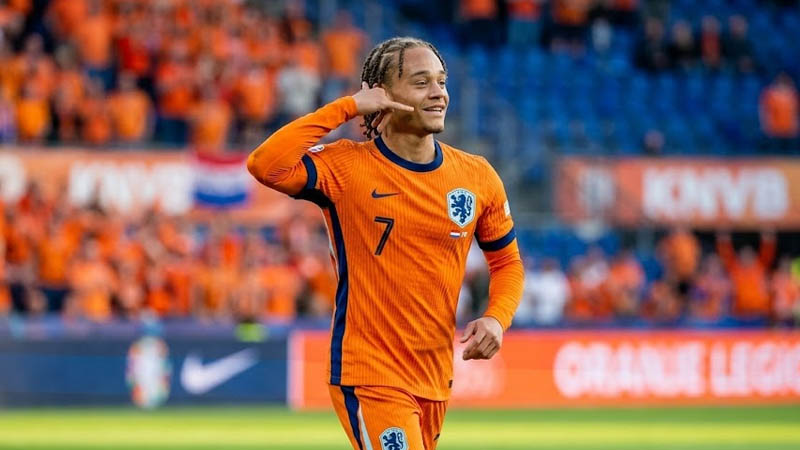
Xavi Simons has evolved from a social media phenom into one of Europe’s most technically gifted and tactically fluid playmakers.
His £51.8 million move to Tottenham Hotspur in August 2025 signaled his arrival as a top-tier talent ready to conquer the Premier League.
While his journey through PSV and RB Leipzig showcased his creative spark, his time in North London has provided a rigorous test of his consistency and physical durability.
This analysis dissects his statistical output, tactical positioning, and unique playing style to determine exactly where he sits in the hierarchy of modern midfielders.
The £51.8 Million Strategic Arrival at Tottenham
Tottenham Hotspur’s decision to secure Xavi Simons for a landmark fee was a calculated move to inject creative volatility into their attacking ranks.
Under the guidance of Thomas Frank, Simons was expected to be the centerpiece of a high-energy squad that prioritizes collective work rate and technical precision.
His integration was swift, with the player immediately immersing himself in the club’s culture and forming a strong bond with the supporters through both his on-pitch performances and off-pitch community engagement.
Thomas Frank’s Vision for the Dutchman
Thomas Frank emphasized that Simons was joining a “team that is working hard for each other,” suggesting that his defensive contributions would be just as vital as his creative flair.
This philosophy helped Simons transition into a more complete player, balancing his natural urge to attack with the pressing triggers required in the English top flight.
Fans and analysts alike viewed him as the “future” and a vital building block for the club’s long-term aspirations.
A Statement of Intent in North London
The transfer wasn’t merely about adding another body to the midfield; it was about securing one of the most dynamic young talents in world football.
Before his arrival, Simons had already proven his worth in the Bundesliga, where his ability to carry the ball and create chances in tight spaces was second to none.
By bringing him to Spurs, the club signaled that they were ready to compete for the highest honors, leveraging Simons’ elite ball-carrying and aggressive tactical fluidity.
Tactical Versatility: Defining His Optimal Role
One of the most persistent debates among tactical observers is whether Simons is best suited as a central attacking midfielder or a winger.
His ability to shift seamlessly across the front line makes him a “manager’s dream,” providing tactical flexibility that can alter the course of a match without requiring personnel changes.
However, defining his “best” position requires an understanding of how his specific skill set interacts with the surrounding tactical structure.
The Case for the Number 10
There is a compelling argument that Simons should be deployed exclusively as a “10” rather than on the wing. In a central role, he acts as a relentless catalyst, finding pockets of space between the opposition’s midfield and defensive lines to drive play forward.
His low center of gravity and sharp turning ability are maximized in congested central areas, where he can win fouls and release runners with disguise.
Impact from the Left Flank
Despite the preference for a central role, Simons has demonstrated high efficacy when cutting inside from the left wing.
From this position, he can utilize his rapid initial acceleration to beat full-backs before entering the “half-spaces” to deliver a final ball or take a shot.
This versatility allows Thomas Frank to adapt his attacking shape based on the opponent’s weaknesses, sometimes stretching defenses on the right or overloading the central corridor.
Experimental Formations and the 4-2-2-2
Tactical analysts have suggested that a “RB Leipzig-esque” 4-2-2-2 formation could be the key to unlocking his full potential alongside other high-caliber talents.
In this setup, Simons would operate as one of two attacking midfielders, potentially alongside Mohammed Kudus, supported by a robust defensive pairing like Sarr and Palhinha.
This structure leverages his pressing game and allows him to drift horizontally to find the most effective areas for creation.
Data-Driven Performance: A Statistical Overview
The metrics behind Simons’ game reveal a player who is not merely a highlight-reel talent but a high-volume producer across multiple elite leagues.
During his tenure in the Bundesliga, he established himself as a statistical anomaly, being the only player to achieve a “triple-triple” of 100+ chances created, 100+ fouls won, and 100+ successful take-ons within a two-season span.
This volume of contribution highlights his importance to the offensive rhythm of his teams.
| Competition / Season | Appearances (Subs) | Goals | Assists | Key Performance Indicator |
|---|---|---|---|---|
| Premier League (2025–26) | 19 (9) | 2 | 5 | Created 29 major chances |
| UEFA Champions League (25–26) | 6 (4) | 3 | 1 | 9.5 rating vs. Atletico Madrid |
| Bundesliga (2024–25) | 25 (0) | 10 | 6 | 86% passing accuracy |
| Bundesliga (2023–24) | 32 (0) | 8 | 10 | 45 total shots on target |
The Bruno Fernandes Comparison: High-Risk Playmaking
Simons possesses a playing style that draws frequent comparisons to Manchester United’s Bruno Fernandes. This comparison is rooted in a shared willingness to attempt “risky progressive passes” that many other players would shy away from.
While this approach does not always equate to raw efficiency, it is the primary engine behind his ability to break down stubborn, low-block defenses that require unconventional solutions.
Volatility vs. Game-Changing Creative Output
Because of his ambitious passing and high volume of dribbles, Simons can occasionally lose possession more frequently than a more conservative midfielder.
This volatility is often a point of frustration for fans during matches where his high-risk maneuvers do not connect, such as the infamous “Rabona” pass that wasted a scoring opportunity.
However, analysts argue that this risk is a necessary byproduct of his role as a primary creator who must constantly test the opposition’s structural integrity.
Emotional Investment and Leadership
Much like Fernandes, Simons is a player who wears his heart on his sleeve, demonstrating a “no excuses” mentality even in the face of disappointment.
After winning Man of the Match against Atletico Madrid but still being eliminated from the Champions League, his visible frustration underscored his drive to win.
This mental fortitude is a trait that Tottenham fans have found particularly endearing, seeing him as a leader who demands excellence from himself and his teammates.
Technical Profile: Mastery and Minor Flaws
A deep dive into Simons’ technical abilities reveals a player with a unique physical and skill-based profile. Standing at 5’10”, he challenges the traditional mold of a slight playmaker by displaying unexpected strengths in physical duels and aerial situations.
His game is built on a foundation of elite ball-carrying and close control, which allows him to navigate high-pressure environments with relative ease.
Elite Dribbling and Acceleration
Simons excels at turning sharply in tight spaces and driving the ball transitionally into dangerous zones. His initial acceleration is described as “incredibly rapid,” allowing him to bypass the first line of a press almost instantly.
This explosiveness makes him a nightmare for defenders in 1v1 situations, as he can change direction without losing momentum, often forcing opponents into committing fouls.
Surprising Aerial Ability and Shooting Range
One of the more nuanced “spikes” in his performance data is his prowess in the air. Despite not being the tallest on the pitch, he is “surprisingly good on headers,” often timing his jumps to beat larger markers in the box.
This aerial threat is complemented by his ability as a scorer from outside the box, where he utilizes a varied shot technique to catch goalkeepers off guard.
Identified Areas for Refinement
Despite his many strengths, there are clear areas where Simons can still improve. Tactical breakdowns suggest that he is “not great on crossing,” which may explain why a central role is often preferred over a wide one.
Furthermore, while his initial burst is elite, his raw top-speed over long distances can occasionally allow recovery defenders to catch him in wide channels. Refining these aspects could elevate him from an elite talent to a truly world-class, undeniable force.
The Human Element: Resilience and Community
Beyond the statistics and tactical diagrams, Simons’ character has played a significant role in his standing at Tottenham.
He has demonstrated a deep emotional intelligence, notably through his work raising awareness for the Alzheimer’s Society, a cause inspired by his grandmother’s personal journey with the disease.
This humanity has made him a beloved figure, but it also made the events of April 2026 even more difficult for the Spurs community to process.
Dealing with the April 2026 Setback
In late April 2026, Simons suffered a severe injury that sidelined him for the remainder of the season and forced him to miss the 2026 FIFA World Cup with the Netherlands.
This was a “massive blow” to both his club and his national team, as he was one of the few players capable of single-handedly changing the course of a major tournament.
Despite the disappointment, his mindset remains focused on recovery, viewing this period as a “building block” for a stronger return.
Building a Connection with Fans
The outpouring of support following his injury highlighted the “gutted” reaction of the fanbase, who recognized him as a player who truly tried to “immerse himself with the club”.
In his messages to the fans, he has prioritized his commitment to Spurs over individual accolades or national team duties, reinforcing his status as a cornerstone of the project in North London.
As he begins his rehabilitation, the consensus remains that he is “The Future” of the club.
Conclusion: Is Xavi Simons Truly World Class?
The evidence suggests that Xavi Simons is an elite, multi-dimensional talent whose value extends far beyond simple goal and assist totals.
His combination of chance creation, tactical flexibility, and surprising physical traits makes him one of the most unique profiles in modern football.
While his high-risk style leads to occasional inefficiency, the sheer volume of major chances he creates makes him an indispensable asset for a team with Premier League title or Champions League ambitions.
As he works toward his recovery for the 2026–27 campaign, the footballing world waits to see the next stage in the evolution of this extraordinary playmaker.
Frequently Asked Questions
What is Xavi Simons’ best position?
While he is versatile, many analysts believe his best role is as a central attacking midfielder (10) where he can influence the game centrally.
How does he compare to Bruno Fernandes?
Both players share a high-risk, high-reward passing style and are relentless in their search for progressive, line-breaking opportunities.
Why did he miss the 2026 World Cup?
A severe injury sustained in late April 2026 ruled him out of both the domestic season finale and the international tournament.
Is he effective in the air?
Surprisingly, yes. Despite being 5’10”, he spikes in performance metrics related to headed duels and aerial timing.
What was his biggest performance for Spurs?
Many point to his Champions League Man of the Match performance against Atletico Madrid as the pinnacle of his debut season.