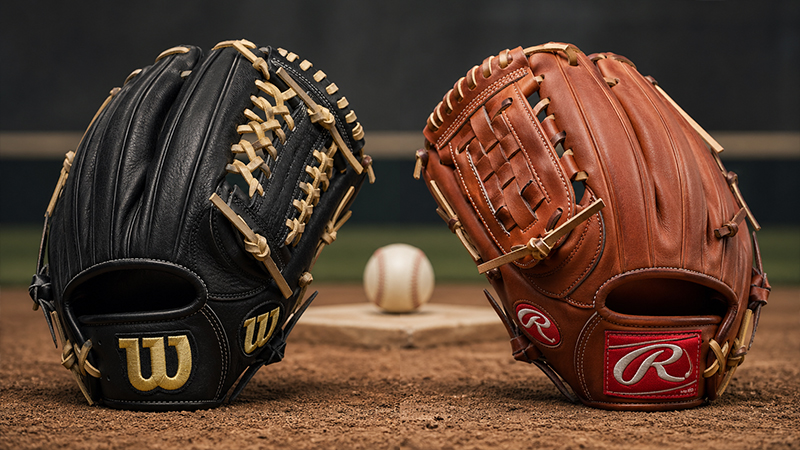
In the competitive landscape of professional baseball, the choice of a glove is less of a purchase and more of a professional partnership. For decades, the industry has been defined by two titans: Rawlings and Wilson.
This rivalry, often compared to the “Coke vs. Pepsi” or “Ford vs. Chevy” of the sporting world, represents the pinnacle of craftsmanship and performance.
For the elite player or the discerning parent investing $300 to $500 in a “forever” glove, the decision-making process requires a deep dive into leather science, ergonomic fit, and position-specific mechanics.
The Foundation: Engineering the Professional Grade
The primary differentiator between a “big box store” glove and a professional model lies in the quality of the hide and the tanning process. Both brands offer tiered systems designed to cater to different levels of play and tactile preferences.
The Rawlings Portfolio: Heart of the Hide & Pro Preferred
Rawlings’ reputation is built on two legendary leather families:
- Heart of the Hide (HoH): Constructed from the top 5% of available steerhides, HoH is known for being firm yet thinner than its counterparts. It utilizes less padding because the leather itself is resilient enough to hold its shape.
- Pro Preferred (PP): This represents the “luxury” tier, utilizing fine Kip leather. Kip leather is typically thicker but possesses a “buttery” softness that offers an immediate premium feel. To maintain longevity despite the softer hide, Pro Preferred gloves feature additional padding.
The Wilson Portfolio: A2000 & A2K
Wilson counters with a focus on structural consistency and ruggedness:
- A2000: The industry standard for over 50 years, the A2000 uses Pro Stock American Steerhide. It is celebrated for its durability and its ability to withstand the rigors of a long season while maintaining a consistent pocket.
- A2K: The premium iteration of the Wilson line. A2K leather (Pro Stock Select) is sorted three times by master technicians to ensure only the most flawless hides are used. This results in a glove that is exceptionally consistent in thickness and feel.
The Break-In Battle: Performance Velocity vs. Longevity
One of the most frequent points of contention among players is the time required to make a glove “game-ready.”
The Rawlings Edge: Responsive Out-of-the-Box
Rawlings is widely regarded as having a faster break-in period. Particularly in the Pro Preferred line, the softer Kip leather allows the player to shape the pocket with relatively minimal effort. For players who need a replacement mid-season, Rawlings offers a “responsiveness” that is hard to match.
However, some veteran users have noted that modern Rawlings models, particularly the R2G (Ready-to-Go) series, can become “floppy” more quickly than models from previous decades.
The Wilson Philosophy: The Stiff Standard
Wilson gloves, conversely, are notorious for their initial stiffness. An A2000 or A2K often requires significant manual labor—mallet work, oiling, and thousands of catches—before it is ready for competition.
The trade-off is structural integrity; a Wilson glove is generally praised for holding its shape for multiple seasons without losing the “snap” required for elite fielding.
Innovative Materials: Tech on the Diamond
While leather remains the core, both brands have introduced synthetic and composite materials to reduce weight and improve performance.
- Wilson SuperSkin: This micro-fiber material is a revolutionary inclusion in the A2000 and A2K lines. SuperSkin is half the weight of traditional leather, twice as durable, and provides superior moisture resistance (ideal for humid climates or sweaty hands).
- Rawlings Mesh: To compete with weight reduction, Rawlings offers Mesh backs on many models. This provides a lighter feel and better breathability, though some purists argue it lacks the long-term shape retention of a full-leather shell.
Position-by-Position Analysis: Finding Your Fit
Search intent often revolves around position-specific needs. Data shows that professional preferences often split along the infield/outfield divide.
Middle Infield (SS/2B): The Wilson Dominance
Middle infielders require small gloves (11.25″ to 11.75″) for lightning-fast transitions. Wilson is the preferred choice here for many, as their gloves tend to have a snugger fit and a hand stall that offers better “feel” for the ball.
- Pro Model Spotlight: Jose Altuve utilizes the Wilson A2000 JA27, featuring a unique chevron cross-web for maximum control. Carlos Correa relies on the A2000 1785.
Outfield and Catcher: The Rawlings Stronghold
Outfielders and catchers prioritize deep, wide pockets to secure fly balls and high-velocity pitches.
- Outfield: Rawlings’ Trap-Eze and H-Web patterns are legendary. Mike Trout uses a custom PROSMT27 with a Fastback design for ultimate security.
- Catcher: Rawlings dominates the catching market. The PROYM4 (Yadi Molina) and PROSCM43 (Buster Posey) are gold standards for their padding and deep-pocket design.
- First Base: The Rawlings PROSDCT is perhaps the most popular first base mitt in the MLB, used by stars like Paul Goldschmidt.
Ergonomics and User Experience: The “Sausage Finger” Factor
A critical gap in traditional reviews is the actual “feel” of the hand stall. User data from community forums highlights a significant ergonomic divide:
Hand Stall Sizing
Wilson gloves generally cater to a “youth” or “snug” market, offering a tighter fit that many players prefer for control. However, players with larger hands (colloquially referred to as having “sausage fingers”) often find Wilson gloves too restrictive.
Rawlings’ Roomier Build
Rawlings Pro Preferred and HoH models are often noted for having larger finger stalls, making them more comfortable for adult-sized hands. However, this can lead to “loose” finger stalls for players with thinner hands.
The Unboxing Experience
For the “gear head,” the presentation matters. Users have noted that a Custom Rawlings arrives in a premium “Custom Shop” box that elevates the purchase. In contrast, Wilson customs often arrive in a standard brown box, which some feel lacks the “special” touch for a $400+ investment.
Strategic Comparison Table
| Feature | Rawlings (HoH / Pro Preferred) | Wilson (A2000 / A2K) |
|---|---|---|
| Leather Feel | “Soft and Buttery” / Responsive | Firm / Rugged / Stiff |
| Break-in Time | Fast to Medium | Slow / Labor-Intensive |
| Shape Retention | May soften over time | Exceptional Longevity |
| Hand Fit | Roomier / Better for large hands | Snug / Secure / Tighter stall |
| Key Innovation | Mesh Backs / Kip Leather | SuperSkin / Triple-Sorted Leather |
| Position Stronghold | Catcher, First Base, Outfield | Middle Infield (SS/2B) |
Enhanced FAQ: Expert Answers to Common Queries
Q: Is the Wilson A2K worth the extra money over the A2000?
A: If you prioritize consistency, yes. The A2K’s triple-sorting process ensures there are no thin spots or imperfections in the hide. It is essentially a “perfected” A2000.
Q: Why do some pros choose Heart of the Hide over the more expensive Pro Preferred?
A: It comes down to “firmness.” Pro Preferred uses softer Kip leather, but many pros prefer the stiffer, thinner feel of Steerhide (HoH) because it allows them to feel the ball better in the pocket.
Q: Does SuperSkin actually make a difference?
A: Yes. Beyond the weight reduction, it is significantly easier to clean and does not absorb moisture like leather. For outfielders tracking balls in damp grass, it prevents the glove from becoming heavy during a game.
Q: Which brand is better for a left-handed player?
A: Both brands have historically been criticized for limited “off-the-shelf” offerings for lefties outside of pitcher or outfield models. If you are a left-handed player seeking a specific infield pattern, you will likely need to go the Custom route for both brands.
Final Verdict: The Decision Matrix
Choose Rawlings if:
- You prefer a softer, buttery feel and want to be game-ready within a week.
- You have larger hands or prefer a roomier hand stall.
- You play Catcher, First Base, or Outfield and value a deep, secure pocket.
- You value a high-end custom presentation and unboxing experience.
Choose Wilson if:
- You want a glove that will hold its stiff shape for multiple seasons.
- You prefer a tight, snug fit for maximum glove-to-hand connectivity.
- You are a Middle Infielder who needs a light, responsive glove for quick turns.
- You play in inclement weather and want the moisture-resistant benefits of SuperSkin.
Elevate Your Game
The choice between Rawlings and Wilson isn’t about which glove is “better”—it’s about which tool matches your defensive philosophy.
Are you the player who wants the immediate feedback of Kip leather, or the technician who wants a stiff, Pro Stock shell that will age with your career?
Regardless of your choice, both brands represent the Diamond Standard of the sport.
Would you like me to help you design a custom glove specification for a specific position, such as a Shortstop or a Catcher?