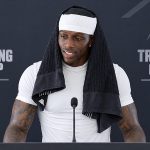
Few pitchers have arrived in Major League Baseball with more hype than Stephen Strasburg.
The first overall pick in the 2009 draft struck out 14 Pittsburgh Pirates in his debut on June 8, 2010, and “Strasmas” became a Washington tradition overnight.
Nearly a decade later, he was World Series MVP after carrying the Nationals to the franchise’s first championship.
Then his body gave out. Nerve damage, thoracic outlet syndrome and a string of setbacks limited him to eight starts after 2019, and he officially retired in April 2024.
So, will Stephen Strasburg be a Hall of Famer? He last pitched on June 9, 2022, which puts him on track for his first Hall of Fame ballot in 2028.
Here is a full look at his Cooperstown case: the dominant peak, the October heroics, the missing longevity and how voters are likely to judge it.
Stephen Strasburg’s Career Stats at a Glance
Strasburg spent all 13 of his big-league seasons with the Washington Nationals, and his rate stats read like an ace’s.
| Stat | Career total |
|---|---|
| Win-loss record | 113-62 |
| ERA | 3.24 |
| WHIP | 1.10 |
| Strikeouts | 1,723 |
| Innings pitched | 1,470 |
| Games started | 247 |
| All-Star selections | 3 (2012, 2016, 2017) |
| Baseball-Reference WAR | 32.3 |
| Postseason record and ERA | 6-2, 1.46 |
He also won a Silver Slugger Award and remains the only player ever drafted first overall who went on to win World Series MVP.
He holds the franchise record for strikeouts and ranks second in wins. He also clears the Hall’s basic eligibility rules, which require 10 MLB seasons and five full years away from the game.
The Case For Strasburg: An Elite Peak
At his best, Strasburg was as overpowering as any pitcher of his generation. His fastball touched triple digits early in his career, and a sharp curveball and fading changeup left hitters few places to hide.
His 2017 season was a gem: a 15-4 record, a 2.52 ERA and a third-place finish in National League Cy Young voting. In 2014 he led the NL with 242 strikeouts. In 2019 he topped the league with 18 wins and 209 innings while striking out 251 batters.
Supporters will point first to his rate stats. A career mark of more than 10.5 strikeouts per nine innings, a 1.10 WHIP and a 3.24 ERA compare well with many enshrined starters.
His 4.4 WAR per 162 games sits just below the 4.5 of the average Hall of Fame starting pitcher, so on a per-inning basis he pitched like a Hall of Famer.
The October Résumé: 2019 World Series MVP
If Strasburg’s Hall of Fame case has a centerpiece, it is the 2019 postseason. He went 5-0 that October, becoming the first pitcher to post a 5-0 record in a single postseason. He even came out of the bullpen to throw three scoreless innings in the Wild Card Game.
Against the Houston Astros in the World Series, he won Game 2 and then saved the season in Game 6. Facing elimination, he worked 8 1/3 innings to force a Game 7, and Washington won the title the next night. He was named World Series MVP.
Across his career, Strasburg went 6-2 with a 1.46 ERA, a 0.94 WHIP and 71 strikeouts in 55 1/3 postseason innings. Few starters in history have a cleaner playoff record. Voters do remember October: Jack Morris leaned heavily on his postseason legend and eventually reached Cooperstown through an era committee.
The Case Against: Longevity and Injuries
The biggest obstacle is simple: Strasburg did not pitch enough. His 1,470 innings would be among the lowest totals for any starting pitcher in Cooperstown.
The few enshrined starters below 1,800 innings, such as Satchel Paige, are special cases whose recorded innings were limited by segregation.
Injuries shadowed him from the beginning. He needed Tommy John surgery just months after his 2010 debut. In 2012, Washington famously shut him down after 159 1/3 innings to protect his arm, even as the team headed to the playoffs.
The decline after 2019 was even harder to watch. He signed a seven-year, $245 million contract that December, then battled carpal tunnel neuritis, neck and shoulder trouble, and thoracic outlet syndrome. He threw only 528 major league pitches after signing that deal.
The advanced metrics tell the same story. His 32.3 career WAR is less than half the 73.0 of the average Hall of Fame starter, and his JAWS score of 30.4 sits far below the 61.4 standard. His 113 wins would also be historically low for a modern Hall of Fame starter.
How Strasburg Compares to Other Short-Career Aces
Hall of Fame voters have honored brief brilliance before, but usually only when the peak was historic.
Sandy Koufax retired at 30, yet he won three Cy Young Awards and an MVP and threw four no-hitters. Dizzy Dean also won an MVP and reached 150 wins before arm trouble cut his prime short.
Strasburg’s peak, while excellent, never produced a Cy Young Award. He was often overshadowed by contemporaries such as Clayton Kershaw, Justin Verlander and Zack Greinke, and even by his own teammate Max Scherzer.
The closest modern comparison may be Johan Santana. Santana won two Cy Young Awards and compiled 51.7 WAR, yet he fell off the ballot after one year in 2018.
Felix Hernandez, a Cy Young winner with roughly 50 WAR, has drawn only modest support. If those résumés fell short, Strasburg faces an even steeper climb.
What Happens When Strasburg Reaches the Ballot
Strasburg is expected to appear on the Baseball Writers’ Association of America (BBWAA) ballot for the first time in 2028. A player needs 75 percent of the vote for election and at least 5 percent to stay on the ballot, for up to 10 years.
Realistically, his biggest test may be clearing that 5 percent bar. Many voters weigh longevity heavily, and ballots are often crowded with more accomplished candidates. Some writers may check his name to honor the 2019 run, but that support is unlikely to be broad.
If the writers pass on him, his case could later reach an era committee. Those smaller panels revisit players the writers may have undervalued. Even there, though, his short career would remain the central hurdle.
Final Verdict: Will Stephen Strasburg Make the Hall of Fame?
Probably not. Stephen Strasburg had Hall of Fame talent, a Hall of Fame peak on a rate basis and one of the finest single-postseason runs in baseball history. What he lacked was time on the mound, and Cooperstown has rarely forgiven that.
His career will instead be remembered as one of baseball’s great what-ifs. Had he stayed healthy into his early 30s, he might have pushed toward 175 wins and 2,500 strikeouts, numbers that would have made his case far more serious.
That does not shrink his legacy. He remains a Nationals icon, the franchise’s all-time strikeout leader and the ace who delivered its only World Series title.
A plaque in Cooperstown looks unlikely, but his place in Washington baseball history is secure.
For fans who remember Strasmas and October 2019, that may be enough. Strasburg’s story is a reminder that in baseball, greatness and durability do not always arrive together.