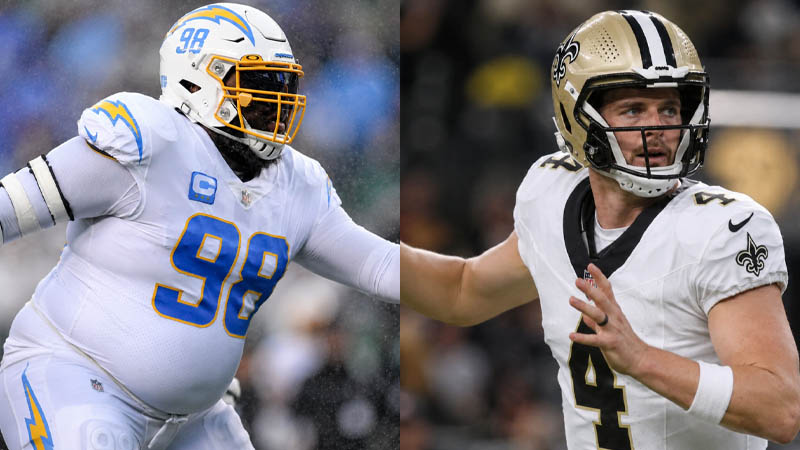
The NFL did not fine Linval Joseph because subsequent league reviews determined his high-impact collision on Derek Carr was a legal, continuous football move driven by natural physical momentum.
During the 2015 matchup, defensive end Danielle Hunter initiated the contact by tripping Carr, legally ruling the quarterback down before Joseph arrived.
Because Carr was already stumbling and Joseph was moving at full speed to finish the play, the league ruled the hit was an unavoidable cleanup effort rather than an intentional personal foul.
Consequently, Joseph avoided retroactive fines, while Hunter was officially awarded the sack.
Why Wasn’t Linval Joseph Fined for the Hit on Derek Carr?
To understand why this specific collision bypassed retrospective league fines, we must deconstruct the rapid sequence of physical events and analyze the official game film review under modern player safety guidelines.
The Immediate On-Field Action and Broadcast Interpretation
During the third quarter of the 2015 game, Derek Carr dropped back on a second-and-ten play. Broadcast replays immediately sparked outcry among analysts and fans, who believed they saw a clear helmet-to-helmet personal foul.
However, the on-field officiating crew threw no flags, initially interpreting the tackle as a legal collision occurring in real-time.
Danielle Hunter Initiates the Contact and Tripped the Quarterback
The crucial factor in the league’s retrospective analysis was how the play commenced. Minnesota Vikings defensive end Danielle Hunter successfully broke through the offensive line, diving directly at Carr’s feet and tripping him.
This initial physical action was ruled the definitive point where the tackle began, fundamentally changing how the follow-up hit was reviewed.
The Post-Game Stat Review and Sacks Breakdown
Because Hunter established the initial tackle, the league’s post-game officiating department officially awarded him the sack. Consequently, Joseph’s defensive statistics were adjusted downward upon further review.
This stat modification legally confirmed that Carr was already down, turning Joseph’s subsequent high-impact collision into a late cleanup play rather than an active quarterback sack.
Defining a Defenseless Player in This Action
In evaluating potential player fines, the league analyzes whether a defender targeted a defenseless player. Because Carr was actively stumbling and falling forward from Hunter’s trip, his body level dropped rapidly.
This sudden change in the quarterback’s posture made it impossible for the approaching defender to avoid impact or adjust his tackling zone.
The Official Rulebook Review of Player Momentum
Analyzing the league’s complex fine determination process requires a deep dive into how rulebook definitions of continuous motion and natural physical momentum dictate disciplinary decisions after high-impact game collisions.
Reviewing Unflagged Hits and Retrospective Action
The league’s player safety committee regularly audits unflagged hits to maintain strict safety standards. When reviewing these plays, officials do not simply look at the severity of the hit.
Instead, they investigate the defender’s physical intent and determine whether there was a deliberate attempt to strike the opponent’s head or neck area.
The Role of Velocity and Continuous Motion
The league ruled that Joseph was running at full speed and could not physically halt his forward progress. Because football is played at extreme velocity, defenders cannot instantly freeze their bodies when a quarterback begins to fall.
The contact was deemed a natural, continuous football move to finish the play, sparing Joseph from retrospective penalties.
Player Health Enforcement and Intentional Violations
Retroactive fines are designed to punish players who intentionally bypass safety rules to deliver punishing blows. In this specific matchup, the league concluded that the collision lacked malicious intent.
The lack of a distinct, personal foul confirmed that the action was a product of high-speed game dynamics rather than an illegal hit.
Comparative Career Disciplinary History of Linval Joseph
To put the league’s leniency on the Derek Carr collision into proper perspective, we must examine other notable incidents where Joseph did face substantial retrospective financial penalties from the league.
The Disciplinary Fine From the 2012 Giants Stomping Incident
While playing for the New York Giants in 2012, Joseph was involved in a highly publicized post-fumble skirmish against Washington center Will Montgomery.
After Montgomery pulled his leg, Joseph responded by trying to stomp and kick him. The league took a harsh stance on this non-football action, issuing a retroactive fine of $7,875.
The Disciplinary Fine From the 2017 Vikings Quarterback Hit
Five years later, while playing as a defensive tackle for the Minnesota Vikings in 2017, Joseph was penalized for roughing the passer. The hit was delivered to Washington quarterback Kirk Cousins during a regular-season game.
Because this hit directly violated quarterback protection protocols, the league penalized him with a substantial fine of $18,231.
Professional Officiating Challenges in High-Speed Matchups
Evaluating the split-second nature of professional football tackles helps explain why real-time rulings on the field sometimes differ from subsequent administrative reviews conducted by league officiating executives.
Real-Time Decisions vs. Post-Game Video Audits
On-field referees must make split-second safety rulings without the benefit of multi-angle slow-motion replays. During the Vikings and Raiders game, the speed of Joseph’s impact made it look like an illegal helmet-to-helmet strike.
Only administrative video reviews allowed the league to analyze the exact point of contact and separate intent from momentum.
The Impact of Fall and Stumble Physics on Tackling
When a ball-carrier is tripped, his trajectory becomes completely unpredictable. In this play, Carr’s sudden stumble meant that he was no longer upright when Joseph arrived.
Since defenders cannot defy the physical laws of inertia, the league acknowledges that some massive collisions are simply unavoidable results of field physics rather than rules infractions.
Frequently Asked Questions
What was the exact date of the game when Linval Joseph hit Derek Carr?
The high-impact collision between Linval Joseph and Derek Carr occurred on November 15, 2015, during a regular-season game between the Minnesota Vikings and the Oakland Raiders.
The play took place in the third quarter of the matchup on a second-and-ten play, which eventually led to an official review and downward adjustment of Joseph’s defensive statistics.
Why was Danielle Hunter awarded the sack instead of Linval Joseph?
Upon retrospective video review, league officials determined that defensive end Danielle Hunter initiated the contact that legally brought Carr down.
Hunter dove at Carr’s feet and tripped him, which legally ended the active play at that moment. As a result, Hunter was awarded the official sack, while Joseph’s statistics were revised downward.
What specific career fines has Linval Joseph received from the league?
While Joseph was not fined for the hit on Carr, he was fined on other career occasions. In 2012, while playing for the Giants, he was fined $7,875 for trying to stomp and kick Washington center Will Montgomery during a post-fumble skirmish.
In 2017, as a Viking, he was fined $18,231 for roughing Washington quarterback Kirk Cousins.
How does the league evaluate momentum when reviewing unflagged hits?
The league’s player safety and officiating departments examine whether a defender had the physical ability to avoid a collision.
If a quarterback is already stumbling or falling due to a prior tackle, a defender running at full speed is often granted leniency. In Joseph’s case, the league ruled his contact was an unavoidable, continuous football move.
5. Did the referees throw a flag on the field during the controversial hit?
No, the on-field officiating crew did not throw a penalty flag during the live action.
Although television viewers and broadcast commentators believed the hit involved illegal helmet-to-helmet contact, the referees on the field deemed it a legal, continuous play.
This decision was subsequently upheld during the league’s post-game review.
Conclusion: Balancing Player Safety and Field Physics
The league’s ruling on the Linval Joseph hit provides a masterclass in how football rules must balance aggressive physical play with modern safety standards.
By distinguishing between a deliberate personal foul and natural physical momentum, the league established a critical precedent for future defensive reviews.
It underscores the fact that field physics and velocity are given weight when analyzing high-speed collisions, ensuring that defenders are not unfairly penalized for unavoidable contact when a ball-carrier is already falling.
Ultimately, this incident demonstrates why post-game video analysis remains indispensable to the integrity of the game.
While live broadcasts can create immediate outrage among fans and analysts, detailed frame-by-frame reviews provide the clarity needed to make fair disciplinary decisions.
For players like Joseph, whose careers are defined by high-intensity trench warfare, these nuanced distinctions are the only thing separating a legal, hard-nosed football play from a costly retroactive penalty.