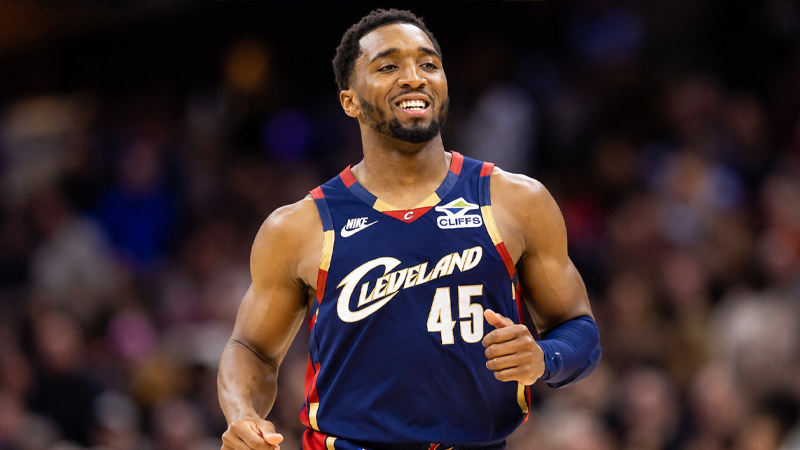
Donovan Mitchell was selected 13th overall in the 2017 NBA Draft because he was primarily viewed as an undersized shooting guard with inconsistent offensive efficiency during his two seasons at Louisville.
Despite possessing an elite 6’10” wingspan and world-class athleticism, scouts were hesitant to project him as a primary scorer in a draft class dominated by highly touted “one-and-done” freshmen.
Most scouting departments saw his professional ceiling as a high-energy defensive specialist or a rotational sixth man. These systemic evaluations, combined with his status as a college sophomore, allowed the Utah Jazz to orchestrate a legendary trade-day steal.
The Scouting Reports That Defined the 13th Selection
At the time of the draft, the consensus among professional evaluators was that Mitchell was a high-floor, low-ceiling prospect. His physical profile was a paradox that left many front offices uncertain about his best positional fit.
While his explosive vertical leap was undeniable, his height created significant friction in traditional scouting models.
The Challenge of “Tweener” Size and Positional Uncertainty
Standing at exactly 6’3″, Mitchell was classified as a “tweener”—a player caught between two positions without a clear home. For a shooting guard, he was considered significantly undersized by league standards of the time, which favored taller, more rangy wings.
Conversely, because he did not play as a traditional point guard at Louisville, teams were skeptical about his ability to manage an offense at the professional level. This lack of a defined position led to fears that he might struggle to survive against larger perimeter players.
Inconsistent Metrics and Offensive Efficiency Concerns
Scouts were deeply concerned with Mitchell’s shooting numbers, which showed flashes of brilliance but lacked sustained consistency. As a sophomore, he shot a modest 40.8% from the field and just 32.9% from three-point range.
His scoring was often described as inefficient, with a 53.4% true shooting percentage that failed to scream “franchise cornerstone” to lottery-bound teams.
Furthermore, averaging only 2.7 assists per game signaled to many that his court vision was underdeveloped, reinforcing the idea that he was a role player rather than a playmaker.
The Competitive Landscape of the 2017 NBA Draft
To understand why Mitchell fell to the end of the lottery, one must examine the unique pressure of the 2017 draft cycle. This particular year was defined by “one-and-done” fever, where teams were obsessed with the perceived “limitless” potential of 19-year-old freshmen.
Mitchell, having spent two years in college, was unfairly labeled as a “finished product” with less room for growth.
| Pick | Player | Team | Scouting Consensus at the Time |
|---|---|---|---|
| 1 | Markelle Fultz | 76ers | Viewed as the perfect modern three-level scoring guard. |
| 2 | Lonzo Ball | Lakers | Praised for generational passing and basketball IQ. |
| 3 | Jayson Tatum | Celtics | Noted for polished footwork and iso-scoring potential. |
| 4 | Josh Jackson | Suns | Evaluated as an elite two-way wing with high motor. |
| 5 | De’Aaron Fox | Kings | Considered the fastest player in the draft with elite handles. |
| 12 | Luke Kennard | Pistons | Preferred for his specialized, elite floor-spacing ability. |
| 13 | Donovan Mitchell | Nuggets (to Jazz) | Projected as a high-energy defensive specialist. |
The teams drafting in the top ten were swinging for the fences, prioritizing younger prospects like Jonathan Isaac or Frank Ntilikina over a sophomore whose offensive game was still being questioned by the mainstream media.
How Systemic Limitations Masked His True Potential
A major factor in Mitchell’s lower draft position was the environment in which he played at the collegiate level.
Many analysts now point to the specific coaching style and offensive structure at Louisville as a primary reason why his full offensive arsenal remained hidden from the public eye until he reached the professional level.
The Defensive-First Philosophy of Rick Pitino
Under Coach Rick Pitino, the Louisville system prioritized a suffocating defensive press that often limited individual offensive freedom. Pitino himself later admitted that the team’s system did not properly highlight Mitchell’s capabilities as a primary creator.
Because Mitchell was tasked with being a defensive anchor, he often entered the professional draft with the reputation of a “perimeter defender” first and a scorer second.
This defensive focus made him appear as a “safe” pick for a rotation, rather than a high-potential star.
The Delayed Recognition of His Offensive Tools
Because Mitchell started his freshman year on the bench and only began to show significant statistical growth halfway through his sophomore season, many mock drafts ignored him until January of his draft year.
By the time the hype began to spread, many teams had already finalized their “big boards” and were hesitant to vault him over the “consensus” top prospects.
This created a lag in his value, where his actual talent was rising faster than the scouting industry’s ability to adjust their rankings.
The Secret Workout That Orchestrated the Heist
While twelve teams saw a role player, the Utah Jazz front office saw a superstar. The story of how Mitchell ended up in Utah is a masterclass in organizational stealth and aggressive talent acquisition. It began with a private workout that changed the trajectory of the franchise.
Dennis Lindsey’s “Cone of Silence”
When Mitchell visited Utah for a private pre-draft session, he reportedly dominated the gym, showcasing an offensive versatility—including deep-range shooting and elite rim finishing—that scouts had rarely seen in college games.
Jazz GM Dennis Lindsey was so impressed that he explicitly threatened to fire anyone in the organization who leaked the details of the workout.
Lindsey knew that if the Detroit Pistons at pick 12 or the Miami Heat at pick 14 heard about this performance, Mitchell would never reach pick 13.
Executing the Trade with the Denver Nuggets
The Jazz identified the Denver Nuggets at the 13th spot as a potential trade partner. Knowing that Mitchell might clear the first twelve picks, the Jazz front office pre-arranged a deal to swap Trey Lyles and the 24th overall pick (Tyler Lydon) for the rights to the 13th pick.
The moment the Detroit Pistons selected Luke Kennard at pick 12, Utah finalized the call to Denver, securing the rights to Mitchell and completing one of the most lopsided trades in draft history.
Why Twelve Teams Regretted Passing on Mitchell
Looking back at the 2017 draft, the decision to pass on Mitchell remains a point of intense debate and regret for several franchises.
The “gap” between his collegiate production and professional output was a result of several factors that teams failed to account for during the evaluation process.
- Overvaluation of Shooting Specialists: Teams like the Detroit Pistons chose Luke Kennard because they valued specialized floor spacing over Mitchell’s raw, multi-dimensional athleticism.
- The “One-and-Done” Bias: Twelve teams prioritized the “unknown” ceiling of freshmen over the “known” quantity of a sophomore, failing to realize that Mitchell’s ceiling was significantly higher than his college tape suggested.
- Metric Misinterpretation: Scouts focused heavily on his 46% two-point shooting as a sophomore, viewing it as a sign of poor rim finishing rather than a product of a crowded college paint and lack of spacing.
- Character and Drive: Many scouting reports failed to quantify Mitchell’s competitive drive, which the Jazz front office identified as his most elite trait during their private interactions.
Frequently Asked Questions Regarding Mitchell’s Draft Fall
Was Donovan Mitchell considered a bust prospect?
No, he was never viewed as a bad prospect. However, the consensus was that he would be a “run-of-the-mill” shooting guard or a high-level rotation player rather than a perennial All-Star.
Which team was most criticized for passing on him?
The Detroit Pistons at pick 12 are frequently cited, as they chose Luke Kennard specifically for shooting needs while overlooking Mitchell’s superior two-way potential.
Did the Denver Nuggets want to keep him?
The Nuggets drafted Mitchell with the intention of trading him to Utah as part of a pre-arranged deal for Trey Lyles and Tyler Lydon, a move that is now viewed as a massive organizational blunder for Denver.
The Lasting Legacy of the 13th Pick
Donovan Mitchell’s ascent from an “undersized tweener” to a dominant NBA force serves as a permanent reminder of the limitations of traditional scouting.
In his rookie season alone, he shattered all expectations by averaging 20.5 points per game, leading the Jazz to the second round of the playoffs, and winning the 2018 Slam Dunk Contest.
His story highlights a critical lesson for basketball evaluators: systemic context matters. When a player’s physical tools are elite but their college efficiency is middling, it is often a sign of a stifling system rather than a lack of talent.
For the twelve teams that passed on him, Mitchell remains the ultimate “one that got away,” while for the Utah Jazz, he remains the greatest heist of the century.