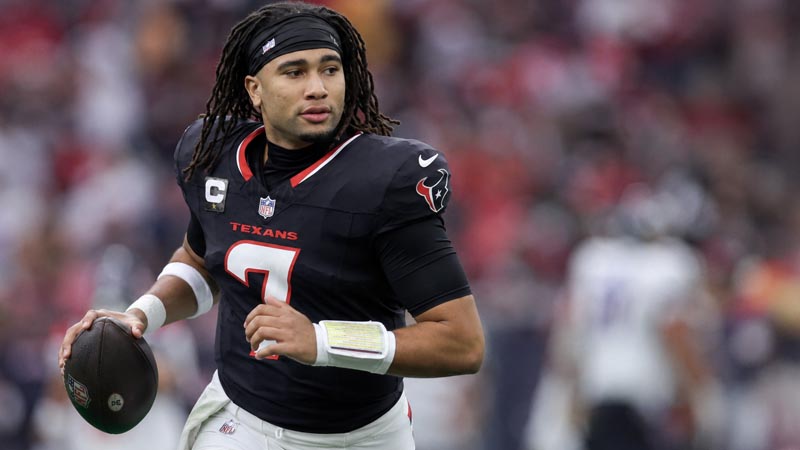
The modern National Football League is governed by a singular, high-stakes question: When do you commit franchise-altering money to a young quarterback?
For the Houston Texans and their starting quarterback, C.J. Stroud, this question has reached a critical juncture. The 2026 season represents a crucial pivot point for both the player and the franchise.
While many external observers anticipated a swift, market-setting contract extension following Stroud’s early-career promise,
Houston’s front office chose a more measured, analytical path. Instead of rushing into an immediate, long-term deal, the Texans opted to exercise Stroud’s fifth-year option for the 2027 season.
This decision sets up a high-stakes campaign where Stroud must prove he can elevate the team past previous postseason limits to command a top-tier quarterback contract.
1. The Financial Mechanics: Nick Caserio’s Calculated Patience
In a league where quarterback salaries continue to rise, contract timing is nearly as important as performance.
By exercising C.J. Stroud’s fifth-year option, the Texans secured him through the 2027 season while avoiding an immediate extension that could exceed $50 million annually.
This approach provides valuable salary-cap flexibility and prevents the massive roster sacrifices often required by a market-setting quarterback contract.
General Manager Nick Caserio also gains additional time to evaluate Stroud over a larger sample size before making a historic financial commitment.
That creates a clear proving period for Stroud in 2026 and beyond: demonstrate he can consistently elevate the Texans and carry the franchise before earning elite quarterback money.
2. The Postseason Barrier: Navigating Championship Expectations
In the NFL, expectations for quarterbacks evolve as their careers progress. Early on, simply reaching the playoffs is considered a major achievement, and C.J. Stroud accomplished that quickly with Houston.
However, the Texans have yet to reach a conference championship game, raising the standard from playoff participation to championship contention.
That shift places greater pressure on Stroud to prove his ceiling. His previous postseason struggles, including costly multi-interception performances, have raised questions about his ability to perform under intense pressure.
In 2026, Stroud must show he can read complex defensive schemes, protect the football, and execute in high-leverage situations.
Deep playoff runs will ultimately determine whether he can lead Houston toward championship success and justify elite quarterback status.
3. Statistical Analysis: Deconstructing the Sophomore Dip
Stroud’s cautious evaluation stems from his statistical regression after an outstanding 2023 rookie season.
His production and touchdown numbers dipped in Year 2, a common “sophomore slump” often caused by opposing defenses adapting rather than a decline in talent.
Once an NFL quarterback puts a full season of high-quality tape on record, opposing defensive coordinators spend the offseason dissecting every snap. They identify:
- Subtle mechanical tells.
- Pre-snap diagnostic biases.
- Preferred throwing lanes on specific downs.
- Franchise-specific offensive tendencies.
In Year 2, defenses adjusted to Stroud with tighter coverage, deceptive safety rotations, and schemes designed to limit his deep passing.
His lower efficiency and touchdown production reflected those adjustments. To earn a market-setting contract, Stroud must show he can adapt, evolve, and consistently perform at an elite level.
4. The Crucial Catalyst: Pass Protection and Pressure Mechanics
Quarterback performance depends heavily on protection, and Stroud is no exception. He thrives from a clean pocket, showcasing elite accuracy, anticipation, and decision-making. However, his efficiency declines when defenses generate quick pressure, highlighting an area he must continue to improve.
However, when opposing pass rushes penetrate the pocket quickly, his performance metrics decline. Rapid defensive pressure:
- Disrupts the timing of structured passing plays.
- Forces the quarterback off his preferred throwing platform.
- Speeds up the quarterback’s internal clock, often leading to hurried decisions and turnover opportunities for the defense.
Rapid pressure has contributed to Stroud’s costly playoff interceptions, especially when defenses generated pressure with seven in coverage. Improving the offensive line in 2026 will be crucial. Better interior protection and blocking schemes can give Stroud more time to read defenses and unlock his full potential.
                              +---------------------------------------+
                              |        2026 SEASON CROSSROADS         |
                              +---------------------------------------+
                                                  |
                         +------------------------+------------------------+
                         |                                                 |
            +------------v------------+                       +------------v------------+
            |    FINANCIAL STRATEGY   |                       |   ON-FIELD PERFORMANCE  |
            +------------+------------+                       +------------+------------+
                         |                                                 |
             Fifth-Year Option In Place                        Must Elevate Playoff Ceiling
             (Secured Through 2027)                        (Break Conference Title Barrier)
                         |                                                 |
             Avoids Immediate $50M+/Yr                         Must Handle Rapid Pressure
             Long-Term Extension                           (Minimize Postseason Turnovers)
                         |                                                 |
             Allows GM Nick Caserio to                         Requires Significant O-Line
             Evaluate Cleaner Sample                       Pass-Protection Growth
Macro Roster Construction: The Value of the Rookie Contract Window
To fully appreciate the strategic logic of Houston’s decision, it is useful to look at the broader landscape of NFL roster building. The “rookie quarterback window” is widely considered the most valuable competitive advantage in professional sports.
When a team has a highly productive quarterback playing on a rookie-scale contract, it enjoys a massive surplus of financial flexibility. The franchise can reallocate millions of dollars to other critical position groups, such as:
- Securing premium pass rushers in free agency.
- Assembling a deep, high-priced receiving corps.
- Investing heavily in veteran offensive line talent.
- Maintaining a high-quality defensive secondary.
A talented roster can accelerate a quarterback’s development and minimize the impact of mistakes.
But once a quarterback earns $50 million-plus annually, that advantage fades. The team must rely more heavily on the quarterback to elevate less expensive teammates and drive overall success.
An elite, highly paid quarterback is expected to:
- Win games when the defense is struggling.
- Deliver victories when their primary playmakers are injured.
- Maintain high-level offensive production even when the pass protection is compromised.
By exercising the fifth-year option, Nick Caserio is preserving this rookie contract window for as long as possible.
He is ensuring that the Texans do not prematurely enter the high-stress cap environment that accompanies a mega-extension until they are entirely certain Stroud is a player capable of carrying that financial weight.
It is a highly disciplined hedge against the risk of overpaying a very good, but not quite transcendent, quarterback.
Conclusion
The 2026 NFL season will be a fascinating study in organizational patience and quarterback development.
By choosing not to rush into a massive contract extension, the Houston Texans’ front office has set up a highly defined, high-leverage campaign.
For C.J. Stroud, the path forward is clear: he must elevate his play under pressure, eliminate high-stakes postseason turnovers, and demonstrate that he can lead this franchise deep into January.
If he succeeds, he will secure a historical contract and cement his status as one of the premier faces of the league. If he struggles, the front office’s cautious approach will be validated, and Houston will face challenging decisions regarding its long-term future.
The stage is set for a season of intense scrutiny. Every throw, every pocket collapse, and every postseason drive will carry immense financial and organizational weight. It is the ultimate proving ground for a young quarterback and a franchise poised at a historic crossroads.