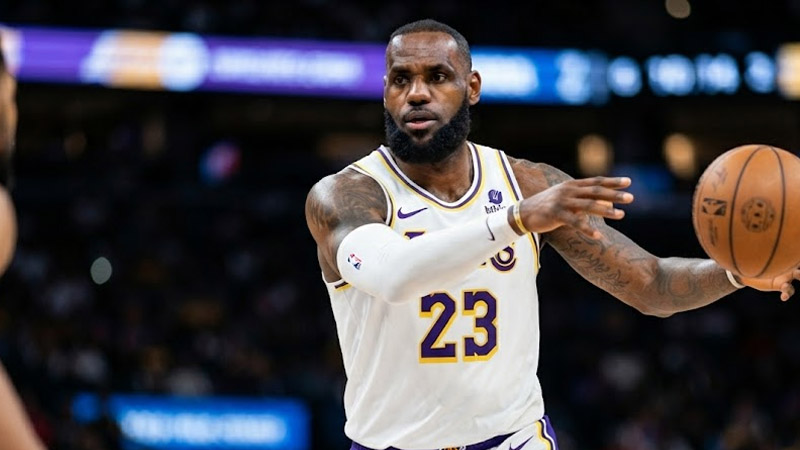
LeBron James passes up game-winning layups to prioritize the “correct basketball play,” a decision-making framework rooted in geometry and statistical probability.
By leveraging his elite size and scoring threat, James creates “defensive gravity,” forcing multiple defenders to collapse into the paint.
This tactical maneuver guarantees a wide-open shot for a teammate, which analytics suggest is a higher-percentage look than a contested layup over elite rim protectors.
Throughout his 23-year career, James has consistently maintained that making the right play—regardless of the final outcome—is the ultimate hallmark of championship-level basketball and winning strategy.
The Analytical Framework Behind LeBron’s Late-Game Passing
To understand why LeBron James consistently chooses to pass in high-stakes moments, one must look past emotional narratives and examine the raw data.
James operates on a frequency of pure efficiency, viewing the basketball court as a geometric plane where angles and probability dictate the ultimate outcome.
This analytical approach often clashes with the traditional “hero ball” expectations of fans, yet it remains the cornerstone of his longevity and success.
How Defensive Gravity Dictates the Right Play
The concept of “defensive gravity” is central to the James philosophy. Because of his 6’9″ frame and his historic ability to finish at the rim, opposing teams cannot afford to defend him with a single player during a closing drive.
Consequently, teams routinely collapse three or four defenders into the restricted area the moment James initiates his move toward the basket.
This structural collapsing of the defense is not a random occurrence; it is a calculated risk taken by opponents to prevent a high-probability layup, which in turn creates a massive strategic opening.
The Mathematics of the Uncontested Perimeter Shot
When three or four defenders commit to stopping James in the paint, it mathematically guarantees that at least one perimeter teammate is left completely unguarded.
In the James playbook, a wide-open, uncontested catch-and-shoot jumper from a professional NBA player is a statistically superior option compared to a highly contested, off-balance layup attempted over multiple seven-foot defenders.
James relies on this probability, believing that over time, the “right play” will yield more wins than forcing low-percentage shots to satisfy a narrative.
Case Studies: Breaking Down Famous Last-Second Decisions
The debate surrounding James’s passing has been fueled by several high-profile moments where he deferred to a teammate in the closing seconds. Each instance offers a masterclass in situational logic and the refusal to succumb to external pressure.
By analyzing these specific games, we see a consistent pattern of prioritizing the best available look for the team.
2007 ECF vs. Pistons: The Donyell Marshall Blueprint
During Game 1 of the 2007 Eastern Conference Finals, a young LeBron James drove the lane while trailing 78-76. As multiple Detroit defenders walled off his path to the basket, James identified a wide-open Donyell Marshall in the corner and delivered a precise pass.
Though Marshall missed the shot and the Cavaliers lost, the moment served as the structural blueprint for James’s career-long philosophy.
He famously stated afterward that he would make the exact same pass every single time because the logic of the play was sound.
2020 NBA Finals: Trusting Danny Green on the Biggest Stage
In Game 5 of the 2020 Finals against the Miami Heat, James faced a similar scenario. Trailing 111-108 with the championship on the line, he drove into a crowded paint and flipped the ball back to an open Danny Green at the top of the key.
Despite Green missing the look and the subsequent fan backlash, James defended the choice by stating he was “okay with putting a guy in position to succeed”.
This decision highlights his commitment to the process over the result, a key trait of his strategic leadership.
2022 vs. Rockets: Anatomy of an Off-Balance Drive
In a tied game against the Houston Rockets in 2022, James blew past his primary defender but found his direct angle to the rim cut off by David Nwaba.
This defensive rotation forced James to take an extended step that left him off-balance and positioned behind the backboard.
Recognizing that a reverse layup from that angle would be a “low-percentage heave,” he kicked the ball out to Carmelo Anthony for a jumper. This case proves that his passing is often a reaction to physical limitations and the preservation of shot quality.
Why Did LeBron James Pass to Rui Hachimura in 2025?
One of the most profound examples of James’s commitment to the “right play” occurred in December 2025. In this specific matchup, the stakes were not just the win-loss column but also a historic individual milestone that James had maintained for nearly two decades.
The decision he made in the final seconds solidified his reputation as a player who treats basketball as a team-first endeavor.
Prioritizing Winning Over Personal Milestones
Entering the final seconds of a tied game, James was sitting on fewer than 10 points, putting his legendary 1,297-game double-digit scoring streak at significant risk.
Rather than forcing a shot to keep his historic record alive, James drove to draw the defense and spotted Rui Hachimura for a buzzer-beater.
Hachimura converted the shot to win the game, and James finished with a single-digit scoring total, ending one of the most impressive streaks in sports history.
The Strategic Sacrifice of the 1,297-Game Streak
Postgame, James’s explanation was simple: the streak was secondary to the win. He noted that if the streak had to end, doing so while making the “correct basketball play” was the perfect conclusion.
This sacrifice serves as a powerful signal to teammates and the league that his primary objective is always the optimization of the team’s chances.
By ignoring his personal legacy to find an open teammate, James demonstrated the ultimate form of accountability and trust.
Basketball Geometry: The Advantage of 6’9″ Vision
LeBron James’s ability to pass out of double and triple teams is not merely a mental choice but a physical capability. His unique anthropometry allows him to see and execute plays that most other perimeter players cannot even visualize.
This physical advantage is what enables the “Geometry of the Right Play” to function at such a high level.
| Tactical Advantage | Description | Impact on the Play |
|---|---|---|
| Height-Vision Correlation | Standing at 6’9″, James sees over “defensive walls”. | Allows for cross-court passes to the weak-side corner. |
| Peripheral Awareness | Elite passing skills combined with high-level processing. | Enables him to anticipate defensive rotations before they happen. |
| Physical Strength | Ability to absorb contact while maintaining passing accuracy. | Ensures the ball reaches the shooter even when James is fouled. |
| Floor Manipulation | Using his scoring threat to move defenders like chess pieces. | Creates wide-open windows for teammates by forcing specific rotations. |
Seeing Over the “Defensive Wall”
Most guards who drive to the rim are limited by their sightlines once the defense collapses. However, James’s height allows him to maintain a perspective of the entire floor even while surrounded by multiple defenders.
This “over-the-top” vision is what permits him to execute cross-court passes to the opposite corner—a pass that is technically difficult and often invisible to smaller players.
Executing Cross-Court Manipulation
James does not just react to the defense; he manipulates it. By driving with a specific intensity, he “forces” the help defense to come from a particular area of the floor.
Once that defender has committed to the paint, James utilizes his elite passing skills to exploit the exact space that the defender vacated. This level of floor manipulation turns every drive into a tactical trap for the opposing coach.
Is Passing in the Clutch a Lack of a “Clutch Gene”?
The most frequent criticism leveled against James is that his willingness to pass suggests a fear of the moment or a lack of the “clutch gene” associated with icons like Michael Jordan or Kobe Bryant.
However, a deeper look at the history of the game reveals that this unselfishness is actually a shared trait among the most successful players in NBA history.
The Jordan Connection: Kerr and Paxson Examples
The narrative that “greats never pass” is historically inaccurate. Even Michael Jordan, the gold standard for “clutch” scoring, relied on his teammates to seal championships.
Jordan famously passed to Steve Kerr in the 1997 Finals and John Paxson in the 1993 Finals when the defense collapsed on him.
Like James, Jordan recognized that the “correct basketball play” involves trusting the open man when the defense over-commits to the superstar.
Living with the Results of Strategic Unselfishness
James has often stated that he can “live with the results” of a missed shot by a teammate as long as the process was correct. His philosophy is built on the belief that his job is to put the team in the best possible position to win.
If a teammate misses an open look that James created, he views it as a part of the game’s natural variance rather than a failure of his own leadership. This long-term perspective is what has allowed him to remain at the top of the league for over two decades.
Frequently Asked Questions About LeBron’s Late-Game Logic
Why doesn’t LeBron just “take over” and score?
James views “taking over” as making the play that wins the game, which often means passing to a teammate with a higher percentage look. He prioritizes efficiency and geometry over the personal glory of a contested bucket.
Does LeBron pass because he is afraid to miss?
No. His explanations of plays like the 2022 Rockets game show that he passes when his physical angle to the rim is compromised. He chooses the pass because it is the superior basketball decision, not out of fear.
Has LeBron’s passing strategy actually worked?
Yes. While media focus is often on the misses (like Marshall or Green), his passing has led to countless winning plays, including the 2025 game-winner by Rui Hachimura.
How do his teammates feel about these passes?
James emphasizes that he wants to “put a guy in a position to succeed”. This trust builds chemistry and ensures that teammates are ready to perform in high-pressure moments.
The Final Word on Basketball Logic
The career of LeBron James serves as a testament to the power of logic over narrative. While the sports world may crave the drama of a contested, fading jumper at the buzzer, James has remained disciplined in his adherence to the “correct basketball play”.
By choosing the pass, he isn’t just deferring a shot; he is executing a sophisticated tactical maneuver designed to maximize the probability of a win.
Whether it is sacrificing a historic scoring streak or trusting a role player in the Finals, James’s commitment to the geometry of the game has redefined what it means to be a “clutch” performer in the modern era.
For James, the right play is the only play, and he is more than willing to live with the results.