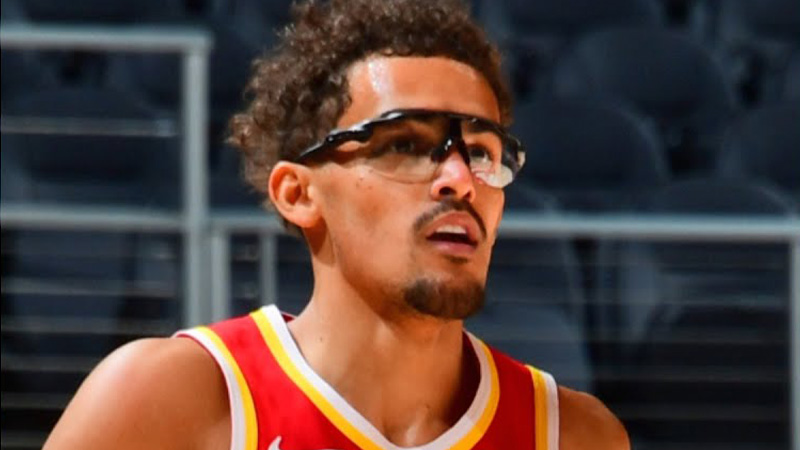
Trae Young wears goggles as a temporary medical safeguard to protect his eyes from further injury following physical on-court contact. He does not wear them for vision correction or as a stylistic choice.
These goggles eras are brief, occurring only when he is recovering from specific tissue damage like a scratched eye or bruised eyelid. He removes the protective eyewear immediately once he is medically cleared.
By understanding these specific incidents, fans can distinguish between a permanent change in gear and a short-term recovery tool. Currently, Young remains one of the few elite guards to utilize modern clear eyewear reactively.
Medical Triggers for Trae Young Wearing Goggles
To understand the tactical shift when an elite point guard adopts protective gear, we must analyze the specific medical events. These moments defined the physical hurdles Young faced during high-stakes competitive windows in the NBA calendar.
The 2021 Bruised Eyelid Incident
In April 2021, teammate Onyeka Okongwu inadvertently elbowed Young during a game against the Indiana Pacers, resulting in a severely bruised right eyelid.
To prevent secondary impact that could lead to permanent vision damage, the medical staff mandated clear protective glasses. This required a rapid transition, as Young debuted the look on April 20 against the Orlando Magic without prior practice time.
Despite the discomfort, he led the team to a significant victory while managing the physical restriction.
The 2022 Scratched Eye Trauma
In November 2022, Young faced a more severe ocular injury when Julius Randle’s hand accidentally swiped across his face during a drive. This contact resulted in a scratched left eye, causing immediate swelling and redness.
Because ocular tissue requires roughly four to five days for inflammation to subside, Young was forced to use protective gear for a two-game stretch.
This incident emphasized the necessity of a physical barrier to allow the cornea to heal while maintaining a high-intensity playstyle.
The Performance Curve: Trae Young Wearing Goggles
Adapting to eyewear in the middle of a season presents significant technical challenges for a high-usage playmaker. The transition from natural vision to a filtered lens affects every aspect of a guard’s mechanical “shooting pocket” and floor awareness.
Navigating Peripheral Vision Obstructions
Specialized sports eyewear can significantly alter peripheral vision, which is a critical asset for a player known for elite passing and court mapping. Young noted that the goggles created a visual restriction he had to master on the fly.
Without the benefit of a morning shootaround to calibrate his depth perception, the debut in 2021 was a trial by fire. He had to adjust his head-turning frequency to compensate for the frame edges during high-speed transitions.
Managing Physical Discomfort and Fogging Issues
Sweat buildup and lens fogging are persistent enemies of the professional basketball player wearing eyewear. During his April 2021 debut, Young’s frustration reached a peak in the third quarter when he briefly ripped the goggles off.
The lack of ventilation in standard protective gear can cause condensation, obstructing a player’s view of the rim.
However, he quickly realized the safety risks and replaced them to finish the match securely, demonstrating a commitment to long-term health over short-term comfort.
Statistical Output Under Restriction
Despite the physical and visual hurdles, Young’s statistical production remained remarkably stable while wearing the protective gear. In his initial 2021 “goggles game,” he recorded 25 points and 7 assists, shooting an efficient 9-of-10 from the free-throw line.
This performance proved that his muscle memory and elite skill set could override the sensory adjustments required by the eyewear. It silenced critics who questioned whether the clear frames would hinder his offensive efficiency or lead to increased turnovers.
Protective Design Specs: Trae Young Wearing Goggles
The equipment used by modern athletes is a far cry from the heavy, plastic frames of previous decades. Current professional gear focuses on a balance of impact resistance and minimal weight to ensure the athlete remains unencumbered.
- Lens Clarity: The goggles feature ultra-clear, shatterproof polycarbonate lenses designed for maximum light transmission without distortion.
- Frame Construction: Unlike retro styles, these are modern, lightweight sports goggles designed to sit flush against the face to minimize shifting.
- Security System: A thick, adjustable elastic strap wraps around the back of the head, ensuring the unit stays centered during sudden movements.
- Ventilation Ports: Strategic gaps around the foam padding help manage heat and reduce the aforementioned fogging issues during aerobic exertion.
- Impact Padding: High-density foam lines the interior frame to absorb the shock of an elbow or hand swipe, protecting the orbital bone.
- Low Profile Design: The frames are engineered to be as thin as possible to mitigate the loss of the player’s natural peripheral field.
Historical Comparisons of NBA Players with Goggles
While Young’s use is temporary, he joins a long lineage of professional basketball players who have utilized eyewear. Comparing his modern approach to the icons of the past highlights the evolution of both medical necessity and equipment technology.
Kareem Abdul-Jabbar and the Legacy of Eyewear
Kareem Abdul-Jabbar is perhaps the most famous wearer of goggles, but his usage was due to recurring corneal abrasions throughout his long career.
Unlike Young’s modern, clear aesthetics, Kareem’s gear was often bulkier and became a permanent part of his on-court identity.
Young, by contrast, views the equipment as a purely reactive tool. While Kareem’s goggles were a staple, Young’s “goggles eras” are brief flashes in his timeline, lasting only until the injury heals.
Performance vs. Aesthetic Tradition
Players like Horace Grant and Amar’e Stoudemire wore goggles for vision correction or permanent protection after major retinal issues.
Young has joked about the aesthetic, questioning if it is a “good look,” which confirms he has no intention of making it a permanent fashion statement.
This differentiation is key for fans: Young is a reactive wearer, whereas the legends of the past were often proactive or permanent wearers based on chronic conditions or vision needs.
Precise Timeline of Trae Young’s Eyewear Stretches
Tracking the exact dates and durations of these appearances is essential for understanding the medical recovery windows required for ocular injuries.
The following table provides a clear breakdown of his history with protective eyewear based on the available documentation.
| Injury Event | Start Date | Opponent | Games Worn |
|---|---|---|---|
| Bruised Right Eyelid | April 20, 2021 | Orlando Magic | 1 Game |
| Scratched Left Eye | Nov 5, 2022 | N.O. Pelicans | 2 Games |
This data confirms that Young’s total time in goggles spans only three professional matches across his entire career thus far. The 2021 stretch was particularly short because the bruising subsided rapidly, allowing him to return to normal vision within 48 hours.
The 2022 injury required a longer window of four to five days for the scratch and inflammation to heal, leading to a two-game stint in the protective gear.
Common Questions about Trae Young’s Look
Is Trae Young wearing goggles for vision correction?
No, Trae Young does not wear goggles to correct his eyesight or for any refractive needs. His vision is naturally sharp, and the goggles are strictly used as a protective shield for his eyes following physical trauma.
He has never utilized contact lenses or glasses for play outside of these specific injury recovery windows, making the eyewear a purely medical accessory rather than a performance-enhancing one.
Why did he only wear them for one game in 2021?
The April 2021 incident involved a bruised eyelid rather than a scratch to the eyeball itself. Because the swelling from Onyeka Okongwu’s elbow dissipated quickly, Young felt comfortable with his protection levels and vision by the second game.
The medical staff cleared him to discard the eyewear as soon as the risk of secondary irritation from the bruise was deemed negligible, leading to a very short “era”.
Will Trae Young wear goggles permanently in the future?
There is no indication that Young will adopt the goggles as a permanent part of his uniform. In various interviews, he has emphasized that the gear is something he “had to try” for protection, but he remains skeptical of the style.
He removes the equipment as soon as his injuries fully heal, suggesting he prefers the unrestricted field of view and comfort of playing without any facial accessories.
Future Outlook: Ocular Safety for High-Usage Guards
As the NBA continues to prioritize player safety, the use of reactive protective gear like Young’s may become more common. High-usage guards are constantly in the “line of fire” when driving to the basket, where flailing limbs and accidental contact are frequent risks.
Young’s willingness to adapt—even without practice time—serves as a model for how players can maintain their productivity while respecting medical protocols. While “Goggles Trae” may only appear for a few games every few years, the impact on his career longevity is significant.
Protecting the eyes from secondary trauma ensures that minor scratches do not turn into vision-threatening complications, allowing elite talents to remain on the court for the long term.