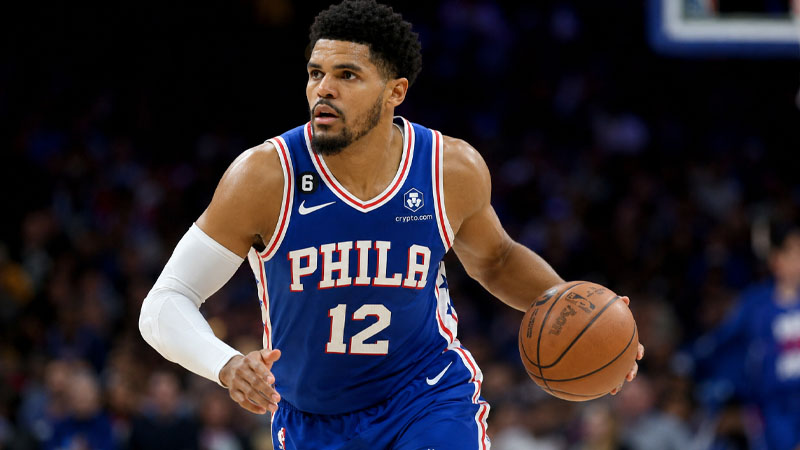
Tobias Harris is paid so much due to a strategic blend of elite timing, market leverage, and consistent professional production. His career earnings recently eclipsed $300 million, the highest in NBA history for a player never selected as an All-Star.
This financial outlier status stems from the Philadelphia 76ers’ 2019 “sunk cost” dilemma after losing Jimmy Butler, coupled with the league’s exploding salary cap. Teams prioritize his “Iron Man” durability and versatile “18 and 7” baseline.
Ultimately, Harris maximized his value by being a reliable, floor-spacing wing exactly when the market valued those specific assets most.
Why Did the Philadelphia 76ers Pay Tobias Harris $180 Million?
The most significant payday of Harris’s career came in 2019 when he signed a five-year, $180 million near-max contract with the Philadelphia 76ers.
While fans and analysts often point to this contract as an overpay, the decision was driven by intense organizational pressure and a lack of viable alternatives during a critical championship window.
The Sixers found themselves in a position where they had to pay a premium to protect the assets they had already surrendered to acquire him earlier that season.
The Sunk Cost Dilemma and Asset Management
Earlier in the 2018-2019 season, the 76ers traded away multiple valuable assets, including draft picks and promising young players like Landry Shamet, to acquire Harris from the LA Clippers.
Because they had invested so much capital into bringing him to Philadelphia, letting him walk away for nothing in free agency would have represented a catastrophic loss of value for the front office.
This created a “sunk cost” scenario where the team felt obligated to retain him at almost any price to justify the initial trade.
The Jimmy Butler Departure and Bird Rights
The leverage Harris held over the Sixers intensified during the summer of 2019 when Jimmy Butler chose to leave Philadelphia for the Miami Heat.
With Butler gone, the Sixers had no remaining cap space to find a replacement of similar caliber, meaning Harris became their only path to maintaining a competitive roster.
Harris’s agent and father, Torrel Harris, utilized this extreme leverage to secure a contract that paid an annual average salary of $36 million.
Furthermore, because the Sixers held his Bird rights, they were the only team capable of offering a five-year deal, whereas competitors like the Sacramento Kings, Dallas Mavericks, and Utah Jazz were limited to shorter terms.
How Professional Consistency Translates to Financial Value
While Harris is often criticized for not being a traditional “superstar,” NBA front offices place an immense premium on high-floor reliability and versatility.
Harris has built a reputation as an “Iron Man” forward who rarely misses games due to injury, providing a level of statistical certainty that is rare in the modern load-management era.
His ability to fit into various offensive schemes as a secondary or tertiary option makes him a plug-and-play asset for almost any roster.
The “18 and 7” Statistical Guarantee
For the majority of his career, Harris has provided a consistent baseline of production that teams find invaluable for floor spacing and offensive flow.
Over his tenure with the 76ers, he averaged approximately 17.6 points and 6.8 rebounds per game while shooting nearly 49% from the field and 38% from three-point range.
This reliable production ensures that even when he isn’t the primary focus of the offense, he remains an efficient threat that defenders must respect.
Durability as a Competitive Advantage
One of the most overlooked aspects of Harris’s earning power is his sheer availability on the court. In a league where star players often miss significant time, Harris has historically been one of the most durable players in the NBA.
This durability has allowed him to accumulate massive totals over his career; for example, he has actually scored more career points than multi-time Finals MVP Kawhi Leonard, despite both being drafted in the same year.
Teams are often willing to pay more for a player they know will be available for 75+ games a season than a higher-peak star with frequent injury concerns.
| Contract Period | Team | Total Contract Value | Context / Role |
|---|---|---|---|
| 2011 – 2015 | Bucks / Magic | ~$6.8 Million | Rookie scale contract |
| 2015 – 2019 | Magic / Pistons / Clippers | $64 Million | Emerging, versatile hybrid forward |
| 2019 – 2024 | Philadelphia 76ers | $180 Million | Secured via ultimate free agency leverage |
| 2024 – 2026 | Detroit Pistons | $52 Million | Veteran leader and floor-spacer |
The Economic Impact of the Nba Salary Cap Explosion
Harris’s career trajectory perfectly coincided with one of the most prosperous financial eras in the history of professional sports.
As the NBA’s national television deals grew, the salary cap exploded, leading to a “rising tide” effect where even non-All-Star players began earning salaries that would have been reserved for Hall of Famers a decade prior.
Harris became a primary beneficiary of this trend by entering free agency at the exact moments when league-wide spending power was at its peak.
Market Inflation and Timing
The inflation of NBA salaries in the late 2010s and early 2020s redefined what a “max” or “near-max” player looks like statistically.
As the salary cap moved toward the projected $165 million range for future seasons, the baseline for a starting-caliber wing player shifted significantly.
Harris was able to hit the open market as a top-tier unrestricted free agent during these windows of high liquidity, allowing him to command a larger percentage of the cap than his All-Star status might otherwise suggest.
The Premium for Versatile Wings
Modern NBA basketball is dominated by the need for versatile wings who can defend multiple positions, rebound, and shoot the three-point ball. This “archetype” is currently the most sought-after profile in the league.
Because there is a finite supply of players who can provide this combination of skills without being a liability on either end of the floor, players like Harris can demand premium salaries.
Even when his scoring fluctuates, his ability to function as a “Swiss Army Knife” on the court maintains his market value across different organizations.
Why Did the Detroit Pistons Give Harris a $52 Million Deal?
When his massive contract with Philadelphia finally expired in 2024, many expected Harris to take a significant pay cut to join a contender.
Instead, he signed a two-year, $52 million deal with the Detroit Pistons, once again surprising the basketball world with his earning power.
This contract was not a mistake by Detroit but rather a calculated investment in their team’s structural development and culture.
The Veteran Leadership Tax for Young Rosters
The Detroit Pistons entered the 2024 offseason coming off a franchise-worst 14-68 season and were desperate for professional leadership in their locker room.
To convince an established, productive veteran like Harris to join a rebuilding team with low immediate expectations, Detroit had to pay a “tax” or a premium over his strictly on-court value.
Harris was brought in specifically to serve as a culture setter and a reliable secondary scorer to help the development of their young centerpiece, Cade Cunningham.
Strategic Cap Space Utilization
Developing teams with massive amounts of cap space often find themselves in a “use it or lose it” situation where they must reach the league-mandated salary floor.
Detroit utilized their financial flexibility to acquire a player who could provide immediate floor spacing and professional stability without committing to a long-term deal that would hamper their future flexibility.
By offering $26 million annually over just two years, the Pistons secured the veteran they needed while maintaining a clean cap sheet for when their young stars are ready for extensions.
Is Tobias Harris Actually Worth $300 Million?
The debate over Harris’s value often centers on the disconnect between his box score production and his impact in high-pressure playoff moments.
While he is a regular-season stalwart, his performance in critical games—such as going scoreless in a season-ending Game 6 loss for Philadelphia—has fueled the narrative that he is overpaid.
However, “worth” in the NBA is determined by what a team is willing to pay in a competitive market, not by fan consensus.
Production vs. Star Power
Harris is the definition of a “high-end role player” who is compensated like a superstar. While he has never made an All-Star team, his career statistics are remarkably consistent.
The market has repeatedly shown that it values a “guaranteed” 18 points and 7 rebounds more than the potential upside of a more volatile player. He fits the “third option” role perfectly, even if his paycheck suggests he should be a “first option”.
Statistical Comparisons and Career Longevity
When examining his career as a whole, Harris’s earnings are a testament to his longevity and professional approach.
He has successfully navigated the economics of the league by being a “straight-up professional” who deals with organizational chaos without becoming a distraction.
While critics highlight his “hollow stats” in the playoffs, his ability to stay healthy and productive for over a decade has allowed him to outearn almost every peer from his draft class.
Frequently Asked Questions
Who is the highest-paid NBA player to never make an All-Star team?
Tobias Harris holds this record, having earned over $301 million throughout his career without a single All-Star selection.
Who is Tobias Harris’s agent?
His father, Torrel Harris, serves as his agent and has been credited with masterfully navigating the “sunk cost” leverage in Philadelphia to secure his $180 million contract.
How much did the Pistons pay Tobias Harris in 2024?
The Detroit Pistons signed Harris to a two-year contract worth $52 million, paying him an average of $26 million per season.
Summary: A Blueprint for Career Earnings
Tobias Harris’s $300 million career is a masterclass in professional sports economics. By maintaining elite durability and consistent production, he positioned himself as an indispensable asset for teams facing difficult roster decisions.
Whether it was Philadelphia needing to save face after a big trade or Detroit needing to stabilize a young locker room, Harris has consistently been the right player at the right time.
While the All-Star accolades may be missing from his trophy case, his bank account reflects a career spent maximizing every ounce of leverage available in the modern NBA market.