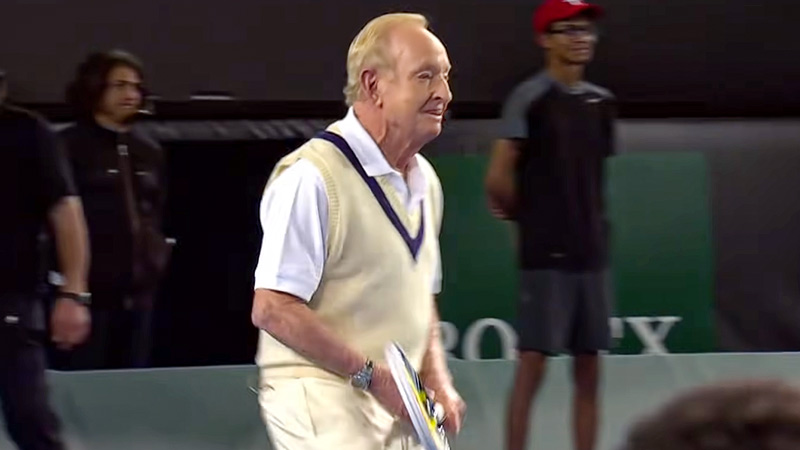
Rod Laver is famous as the only male player to achieve the Calendar-Year Grand Slam twice, winning all four majors in 1962 and 1969. Known as “The Rocket,” he bridged the amateur and Open eras, amassing a record-breaking 200 singles titles.
His dominance was so profound that despite a five-year ban from majors during his peak, he remains the ultimate benchmark for excellence.
Today, his influence lives on through the Rod Laver Arena and the Laver Cup, securing his status as a legendary figure whose technical innovations and unparalleled achievements continue to define the pinnacle of tennis.
Why is Rod Laver Famous? (The Double Grand Slam)
Winning all four major tournaments—the Australian Open, French Open, Wimbledon, and the US Open—within a single calendar year is widely regarded as the most difficult achievement in tennis. Rod Laver is the only man to have climbed this mountain twice.
The 1962 Amateur Milestone
In 1962, Laver completely dominated the amateur circuit. He displayed a level of consistency that few had ever seen, eventually defeating his fellow countryman Roy Emerson in three of the four major finals that year to secure his first calendar sweep.
This achievement established him as the undisputed king of the amateur era before he made the pivotal decision to turn professional.
The 1969 Open Era Sweep
Perhaps even more impressive was his repeat performance in 1969. After being barred from the majors for five years, Laver returned during the transition to the Open Era and proved his supremacy against both established professionals and rising amateurs.
This 1969 sweep remains the only time a male player has won all four majors in a single year during the modern era.
The Rarity of the Achievement
To put his fame in perspective, the modern “Big Three”—Novak Djokovic, Rafael Nadal, and Roger Federer—have never managed to win all four majors in a single calendar year.
Laver’s ability to maintain peak performance across different surfaces and continents within a twelve-month span remains a unique historical feat that cements his legendary status.
Analyzing Rod Laver’s Career Statistics and Milestones
To truly understand why his name is synonymous with greatness, one must examine the staggering volume of his success across a career that spanned nearly two decades.
| Category | Statistic | Historical Significance |
|---|---|---|
| Total Singles Titles | 200 | The highest number of singles titles won by any male player in history. |
| Grand Slam Singles Titles | 11 | Tied for 11th all-time despite missing twenty major tournaments in his prime. |
| Grand Slam Singles Record | 141–25 (84.9%) | One of the highest winning percentages in the history of the majors. |
| Pro Major Titles | 8 | Won 3 US Pro, 4 Wembley Pro, and 1 French Pro during his professional years. |
| Combined Major Titles | 19 | A combination of his amateur Grand Slams and Pre-Open Era Professional Majors. |
| Career Prize Money | $1.56 Million | The first player in history to surpass $1 million in career earnings (1971). |
What Happened During the Five-Year Professional Ban?
One of the most discussed aspects of Laver’s fame is the “what if” factor regarding the years he was prohibited from competing in the traditional Grand Slam events.
The Transition to Professional Tennis
In 1963, after completing his first Grand Slam, Laver signed a professional contract. At the time, the four major tournaments were strictly reserved for amateurs.
Consequently, Laver was banned from these events for five years, missing twenty consecutive majors during what most experts consider his absolute physical peak, between the ages of 24 and 29.
Dominance in the Pro Majors
While he was ineligible for the traditional Grand Slams, Laver did not stop winning. He dominated the professional circuit, winning 8 Pro Majors and maintaining the World No. 1 professional ranking for five consecutive years from 1964 to 1968.
This period proved that he was the best player in the world, regardless of whether he was allowed to play at Wimbledon or the US Open.
The Statistical Impact of the Ban
Tennis historians frequently speculate on what his final tally would have been without this forced hiatus. Estimates suggest that had he been allowed to play, he likely would have won an additional 10 to 14 Grand Slam titles.
This would have put his total between 22 and 25 majors, a figure that would rival or exceed the records set by the modern greats.
How Did “The Rocket” Change Tennis Technique?
The nickname “The Rocket” was given to Laver by his legendary coach Harry Hopman, and it perfectly described the explosive nature of his game.
Pioneering Use of Topspin
Laver is famous for revolutionizing the way the ball is hit from the baseline. During an era when flat hitting was the standard, he introduced heavy, aggressive topspin to his groundstrokes.
This technical innovation allowed him to hit the ball harder while maintaining a higher margin for error, a style that has become the foundation of the modern game.
Mastery of Every Surface
He was a pioneer in terms of versatility, becoming the first player to win titles on all five traditional court surfaces: grass, clay, hard, carpet, and wood. This adaptability was rare in his time and set a high standard for future generations who sought to be “all-court” players.
Physicality and Power
Despite being relatively small at 5-foot-8, Laver possessed an extraordinarily powerful forearm and wrist. He paired his baseline topspin with a fearless and incredibly fast serve-and-volley net game.
His ability to dictate points from both the back of the court and the net made him an intimidating opponent on any surface.
Is Rod Laver the Greatest of All Time?
The debate over the greatest player in history often pits Laver’s unique achievements against the statistical longevity of the modern era.
The Case for Peak Performance
Those who argue for Laver as the GOAT point to his two Calendar Slams as the ultimate evidence of supremacy.
They argue that winning all four majors in one year—twice—is a feat of mental and physical fortitude that surpasses simply accumulating a high number of titles over a long career.
The Modern Statistical Perspective
In contemporary discussions, Novak Djokovic is often cited as the statistical GOAT due to his record of 24 Grand Slam titles.
Critics of the older era argue that today’s game has more depth and athletic intensity, making sustained dominance more difficult than it was in the 1960s. Laver himself has been humble in this debate, publicly naming Djokovic as the greatest of all time.
A Legacy of Professional Respect
Regardless of where he sits in the rankings, Laver’s impact on his peers is undeniable. Legends such as Roger Federer, Pete Sampras, and John McEnroe have frequently cited him as their hero.
Federer, in particular, has called Laver the greatest of all time, noting that his achievements paved the way for the professionalization of the sport.
The Lasting Impact on Modern Tennis Infrastructure
The fame of Rod Laver is not just a matter of history; it is reinforced every year by the institutions that bear his name.
Rod Laver Arena
In 2000, the main stadium at the Australian Open was named the Rod Laver Arena. This ensures that every year, the world’s best players compete for one of the sport’s biggest prizes on a court dedicated to his legacy.
It serves as a permanent reminder of his status as an Australian and global icon.
The Laver Cup
The creation of the Laver Cup in 2017 further solidified his place in the modern consciousness. Created by Roger Federer’s management team, this annual team tournament was specifically designed to honor Laver’s contributions to the game.
It brings together the top players from Europe and the rest of the world, keeping his name at the center of the tennis calendar.
Frequently Asked Questions About Rod Laver
How many total titles did Rod Laver win?
Rod Laver won a total of 200 singles titles throughout his career, which is the most by any male player in history. This total includes his wins in the amateur, professional, and Open eras.
Why was Rod Laver not allowed to play in Grand Slams for five years?
He was barred from the four traditional Grand Slams—the Australian Open, French Open, Wimbledon, and the US Open—because he turned professional in 1963.
At that time, these major tournaments were only open to amateur players. This rule did not change until the beginning of the Open Era in 1968.
What is a Calendar-Year Grand Slam?
A Calendar-Year Grand Slam is achieved when a player wins all four major championship tournaments in the same calendar year. Rod Laver achieved this in 1962 and again in 1969, making him the only man to do so twice.
Did Rod Laver play with a wooden racket?
Yes, most of Laver’s career was spent playing with wooden rackets. He is considered the undisputed king of the wooden-racket era, though he successfully transitioned into the early years of the modern professional game as equipment began to evolve.
Conclusion: The Eternal Legacy of Rod Laver
Rod Laver remains famous because he represents the perfect bridge between the history and the future of tennis.
His 1969 sweep remains the ultimate, most elusive achievement in the sport, as he is the only male player in the modern era to win all four majors in a single year.
Furthermore, his technical innovations, such as the introduction of aggressive topspin, continue to influence how the game is played today.
Whether through the stadium that bears his name or the deep respect he commands from modern champions, “The Rocket” will always be a central figure in the story of tennis excellence.