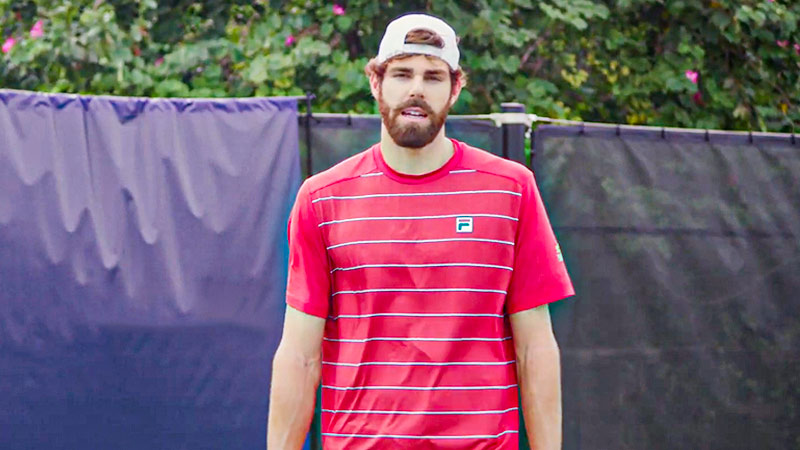
Reilly Opelka is arguably the most statistically dominant server in professional tennis history, utilizing his 6’11” frame to generate unreadable angles and massive bounce heights.
While his career-high ranking reached World No. 17, his game is highly polarized; he leads the ATP with a 304.0 serve rating but struggles with lateral movement and return games.
Effectively, Opelka is a “nightmare draw” capable of defeating any elite opponent when healthy, though major hip and wrist surgeries have hampered his consistency. He remains a dangerous wildcard with four ATP titles and a historic 46-point tiebreaker win.
Why Is Reilly Opelka Considered the Ultimate Servebot?
The term “servebot” is often used to describe players whose success is disproportionately tied to their service game, and Opelka represents the absolute peak of this archetype in the modern era.
His height allows him to execute a strategy that is physically impossible for most other professionals on the tour.
The Physics of a 6’11” Service Motion
Standing at 6 feet 11 inches, Opelka ties with Ivo Karlović as the tallest player in ATP history. This physical dimension allows him to contact the ball at a steep downward trajectory, generating bounce heights that force opponents to return balls well above their shoulders.
With first serves routinely clocking over 140 mph (225 km/h), his delivery is practically unreadable for even the quickest returners on the circuit. This extreme specialization makes his service games nearly “un-pluggable”.
Analyzing the 304.0 ATP Serve Rating
Statistical data confirms that Opelka is currently the world’s most efficient server. He holds a 304.0 ATP Serve Rating, placing him at the #1 spot globally, even ahead of elite players like Jannik Sinner and Ben Shelton.
Across the 2026 season, he has averaged 19.8 aces per match, placing him in the 99th percentile of all professional tennis players. Winning 90.6% of his service games, Opelka creates immense scoreboard pressure that forces opponents into high-stakes tiebreaks.
Reilly Opelka Ranking and Career Achievements
Understanding Opelka’s quality requires looking at his historical peaks and the titles he has secured. While his current standing has been impacted by physical setbacks, his trophy cabinet proves he belongs in the upper echelon of American tennis.
| Milestone | Achievement Details | Reference |
|---|---|---|
| Career-High Ranking | World No. 17 (Reached February 28, 2022) | |
| ATP Singles Titles | 4 Titles (New York, Delray Beach, Dallas, Houston) | |
| Masters 1000 Best | Finalist at the 2021 Toronto Masters | |
| Junior Success | 2015 Wimbledon Boys’ Singles Champion | |
| Current Ranking | Fluctuating between No. 115 and No. 131 | |
| Record Holder | Longest ATP Tiebreaker (46 points vs. John Isner) |
The statistical profile of his career is one of the most uniquely lopsided in tennis history. Despite his dominance on his own serve, he converts fewer than 18% of his break points, making his matches a battle of thin margins.
What Are Reilly Opelka’s Biggest Strengths and Weaknesses?
Opelka’s game is defined by extreme polarization. While his offensive weapons are world-class, his physical frame introduces structural limitations that opponents often look to exploit during prolonged rallies.
The Statistical Breakdown of Tiebreak Mastery
Because Opelka rarely gets broken but also struggles to break his opponents, his matches almost always conclude in tiebreaks. He uses his service pressure to “suffocate” opponents in these moments.
His career is highlighted by winning a 24–22 tiebreaker against John Isner, the longest in the format’s history since 1970.
In these high-pressure scenarios, his 90% service game win rate becomes a psychological weapon that many opponents find impossible to overcome.
Lateral Movement and Return Game Vulnerabilities
The “primary weakness” in Opelka’s game is his restricted lateral movement due to his massive 6’11” frame. This makes him vulnerable in prolonged baseline exchanges where he must defend the corners or change direction rapidly.
Furthermore, his return game is statistically among the lowest on tour; he has won only 8.4% of his return games throughout his career.
He compensates for this by utilizing “first-strike tennis,” attempting to end points with structural forehands within three shots to avoid being drawn into defensive movement.
Is Reilly Opelka Good on Clay Courts?
Common tennis wisdom suggests that massive servers struggle on clay, where the surface slows down the ball. However, Opelka has consistently defied this expectation, proving to be a formidable force on “the dirt”.
Debunking the Big-Server Clay Myth
Unlike many of his tall predecessors, Opelka plays exceptionally well on clay courts. He reached the semifinals of the prestigious Rome Masters and won the 2022 Houston Clay Court Championships by defeating John Isner.
The higher bounce on clay actually complements his service trajectory, making his kick serve even more difficult to handle. His heavy, structural forehands also allow him to dictate play from the back of the court when given time to set up.
Physical Demands of the Best-of-Five Format
While Opelka thrives in best-of-three set matches on any surface, his body has historically struggled with the grueling physical demands of Grand Slams.
In 2026, he posted a 1–2 record in Grand Slam matches, highlighting the difficulty his frame faces during four or five-hour battles.
His best result at a Major remains a 4th-round appearance at the 2021 US Open, followed by 3rd-round finishes at the Australian Open, French Open, and Wimbledon.
The Impact of Injuries on Opelka’s 2026 Season
The conversation surrounding Opelka’s quality cannot be separated from his health. After reaching his peak in early 2022, his career was nearly derailed by a series of significant physical setbacks that kept him off the tour for nearly two years.
Navigating Hip and Wrist Surgeries
Opelka did not play a single professional match between August 2022 and July 2024. During this hiatus, he underwent major hip and wrist surgeries to address the wear and tear associated with his professional workload and physical stature.
This “injury gap” forced him to restart his ranking from scratch. While he staged a notable comeback in 2025, climbing back to No. 50 with wins over Novak Djokovic and Holger Rune, his physical durability remains a primary question mark for analysts.
Current Form and the 2026 Ranking Outlook
In the early months of 2026, Opelka has struggled to find consistency, posting a 6–8 singles record. This sluggish start has caused him to drop out of the top 100, currently sitting at No. 115 on the ATP Tour.
Despite the dip in ranking, his underlying metrics remain elite. He continues to hold his serve at a 90% rate, suggesting that if his movement and fitness improve, he remains a Top-20 caliber player who can act as a nightmare draw for the world’s best.
Beyond the Court: Art, Fashion, and Personality
Opelka is widely recognized as one of the most eclectic and outspoken personalities on the tour. His interests extend far beyond the baseline, making him a unique figure in the sports world.
The Passion for Contemporary Art and Cy Twombly
A dedicated art enthusiast, Opelka is a frequent visitor to international art shows and has been described as being “deeply consumed” by contemporary art.
He cites the works of legendary artist Cy Twombly among his favorites and has collaborated on interviews with the Red Bulletin Gallery.
His dedication to the art world even crossed into his tennis career when he was fined by the ATP for carrying an “oversized logo” art gallery tote bag onto the court during a tournament.
Tour Friendships and the American Tennis Culture
Opelka is a central figure in the rising wave of American men’s tennis. His closest friend on the tour is fellow American Tommy Paul; the two were roommates during their time in the junior ranks.
This camaraderie is a hallmark of the current generation of American players, who frequently appear together on podcasts and media circuits, fostering a competitive but supportive environment that has seen multiple Americans return to the top tiers of the rankings.
Frequently Asked Questions about Reilly Opelka
How tall is Reilly Opelka?
Opelka is 6 feet 11 inches (2.11 meters) tall, tying him for the record of the tallest player in ATP history.
What is Reilly Opelka’s current ranking?
As of the 2026 season, he is ranked between No. 115 and No. 131, having recently dropped out of the top 100 due to injury recovery and inconsistent form.
How many ATP titles has Opelka won?
He has won four ATP Singles Titles: New York (2019), Delray Beach (2020), Dallas (2022), and Houston (2022).
What is Opelka’s fastest serve?
His first serve routinely clocks in over 140 mph (225 km/h), making it one of the fastest and most difficult to return on the tour.
Who is Reilly Opelka’s best friend on tour?
His closest friend is fellow American player Tommy Paul.
Final Verdict: Is Reilly Opelka an Elite Player?
When analyzing how good Reilly Opelka truly is, the answer depends on the context of the match. He possesses a single, un-pluggable “cheat code” weapon—his serve—that guarantees him a chance to win any given set against any opponent in the world.
His victories over top-tier players like Novak Djokovic and Stefanos Tsitsipas demonstrate that his peak level is undoubtedly Top-10 material.
However, the lack of a consistent return game and the ongoing struggle with physical durability are significant barriers.
Until he can demonstrate the stamina to navigate the two-week grind of a Grand Slam without his body breaking down, he will likely remain a “dangerous wildcard” rather than a consistent title contender at the Majors.
Nevertheless, his statistical dominance as the world’s best server ensures that he remains one of the most influential and feared players in modern tennis.