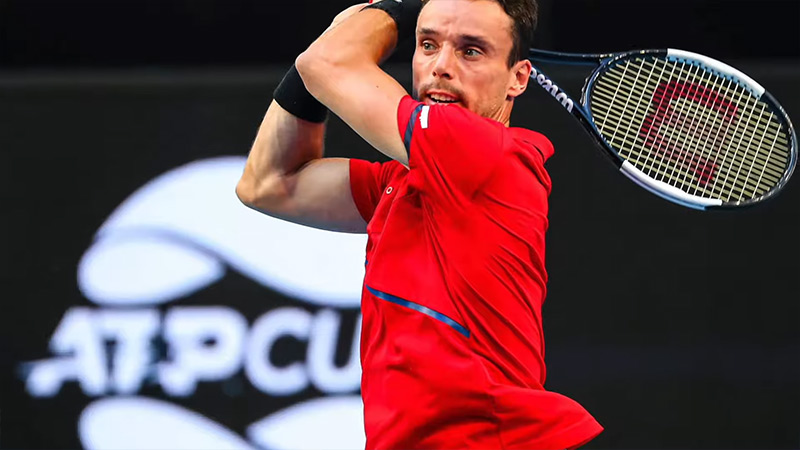
Roberto Bautista Agut is famous for being one of the most resilient, consistent, and respected Spanish tennis players of his generation, concluding a legendary 18-season career in July 2026.
Known as a “Giant Killer,” he gained global recognition for defeating world number one players like Novak Djokovic and Daniil Medvedev multiple times.
His fame is further solidified by his 2019 Wimbledon semifinal run, a career-high ranking of World No. 9, and 12 ATP titles across all surfaces. Beyond stats, his heroic return to win the 2019 Davis Cup following his father’s death remains a pinnacle of sporting grit.
Why Is Roberto Bautista Agut Known as the Giant Killer?
The professional tennis circuit is often dominated by a small group of elite players, but Bautista Agut carved out a unique space as the man the top seeds feared most.
His reputation as a “Giant Killer” was not merely a catchy nickname; it was a status earned through repeated, high-stakes victories against the most dominant athletes in the history of the sport.
Conquering Novak Djokovic Three Times
One of the primary reasons for his enduring fame is his incredible record against Novak Djokovic.
While many players go their entire careers without a single win against the Serbian legend, Bautista Agut holds the prestigious distinction of defeating Djokovic three separate times while Djokovic was the active World No. 1.
These victories occurred at major tournaments: the Shanghai Rolex Masters in 2016, the Qatar ExxonMobil Open in Doha in 2019, and the Miami Open later that same year.
Each win showcased his ability to withstand the physical and mental pressure applied by the best defensive player in the game, effectively beating Djokovic at his own style of baseline attrition.
Toppling Daniil Medvedev and the Elite Tier
His prowess against top-ranked opponents extended beyond just one rival. In 2022, he added another significant scalp to his resume by defeating Daniil Medvedev while the Russian held the World No. 1 spot.
This victory reinforced the idea that he was a universal threat, capable of neutralizing the modern, hard-hitting styles of younger champions.
Over his 18-season tenure, he became a member of an elite tier of players to record over 400 ATP singles match victories, eventually finishing with 436 professional wins.
This level of sustained excellence against the “Giants” of the game ensured his name remained a constant in tennis headlines for nearly two decades.
The Historic 2019 Season and the Wimbledon Semifinal
While consistency was his hallmark, the 2019 season stands as the defining chapter of his individual career.
This was the year he moved from being a highly respected competitor to a genuine top-10 force on the global stage, reaching milestones that few Spanish players outside of the all-time greats have achieved.
The Wimbledon Peak and the Famous Bachelor Party
Bautista Agut’s most notable Grand Slam success occurred at Wimbledon in 2019, where he reached the semifinals. This run became famous not only for the quality of his play on grass but for a humorous personal anecdote that captured the public’s imagination.
Because he had not expected to advance so far into the second week of the tournament, he was forced to delay his own bachelor party, which had been scheduled to take place in Ibiza during the final rounds of the event.
His journey eventually ended in the semifinals against Novak Djokovic, but the “Ibiza bachelor party” story remains one of the most charming pieces of tennis trivia associated with his career.
Reaching a Career-High World Ranking
The momentum from his Wimbledon run, combined with an exceptional quarterfinal performance at the 2019 Australian Open, propelled him into the upper echelon of the sport. On November 4, 2019, he officially achieved his career-high ranking of World No. 9.
Maintaining a top-10 position is a rare feat in an era of such intense competition, and it served as a testament to his year-long excellence.
During this season, he won the Qatar ExxonMobil Open in Doha, a tournament he would eventually win twice in his career, further establishing his dominance on hard courts.
Emotional Resilience: The 2019 Davis Cup Triumph
For many fans, Bautista Agut is most famous for his displays of character off the court, particularly during moments of profound personal grief.
His contribution to Spain’s national success is viewed as a masterclass in emotional strength and professional dedication.
Overcoming Personal Tragedy Mid-Tournament
The 2019 Davis Cup Finals in Madrid should have been a celebration of Spanish tennis, but for Bautista Agut, it turned into a period of mourning. During the week of the tournament, his father tragically and suddenly passed away.
Understandably, he left the national team to be with his family and attend the funeral. Most observers assumed his participation in the tournament was over, yet his commitment to his teammates and his country led to a return that would define his legacy as a national hero.
Securing the Title for Spain
Just days after laying his father to rest, he returned to the stadium to compete in the final match against Canada.
In a highly emotional atmosphere, he defeated Félix Auger-Aliassime in the opening singles rubber, setting the stage for Spain to eventually hoist the trophy.
The sight of his teammates embracing him after the win remains one of the most poignant images in modern sports.
This moment elevated him from a successful tennis player to a symbol of “steel grit” and resilience, qualities that became synonymous with his brand on the ATP Tour.
Breaking the Mold: A Unique Spanish Playing Style
Spain has a long history of producing “clay court grinders” who use heavy topspin to dominate on dirt.
However, Bautista Agut became famous for breaking this traditional mold, offering a different look that allowed him to excel on surfaces where many of his compatriots struggled.
The Power of Flat Hitting and Movement
Unlike many of his peers, his signature style relied on exceptionally clean, flat-hitting forehands. This technical choice meant that the ball traveled faster and lower over the net, making him a nightmare to play against on fast hard courts and grass.
Combined with his lightning-fast lateral movement and “relentless baseline counterpunching,” he was able to absorb the power of heavy hitters and redirect the ball with surgical precision.
This technical versatility allowed him to be competitive in every environment, reaching the second week or better at all four Grand Slam tournaments.
Success Across Every Surface
His ability to adapt to different conditions is proven by his trophy cabinet. Over 18 years, he won 12 ATP Tour singles titles, and notably, he secured at least one trophy on every major surface: hard, clay, and grass.
| Surface | Notable Titles & Highlights |
|---|---|
| Hard Court | Doha (2019, 2022), Auckland (2016, 2018), Dubai (2018), Antwerp (2024) |
| Grass Court | Rosmalen (2014), Wimbledon Semifinalist (2019) |
| Clay Court | Stuttgart (2014), Kitzbühel (2022) |
This versatility is a major component of his fame, as it demonstrated a complete game that was not reliant on specialized conditions.
The Financial Success and Longevity of an 18-Year Career
To understand why he is considered one of Spain’s most reliable modern players, one must look at the sheer scale and duration of his professional life. He was a fixture on the tour from his debut until his retirement at the age of 38 in July 2026.
A Legacy of Consistency and Earnings
Longevity in professional tennis requires an immense amount of physical maintenance and mental discipline. By competing at a high level for nearly two decades, he amassed a total of $20,435,141 in career prize money.
This places him 37th on the all-time list of career earnings, a staggering figure that highlights how often he reached the deep rounds of major events.
His 436 match wins place him in an elite club of modern players, signifying a level of dependability that made him a cornerstone of the ATP Tour.
The Villarreal CF Connection
Unique branding also played a role in his public profile. He is famous for being the first top-tier tennis professional to wear the emblem of a soccer club on his match-day shirt.
Having played in the youth academy of Villarreal CF before choosing tennis, he maintained a deep loyalty to the club throughout his career.
This connection between the world of professional soccer and tennis was a first for the sport and helped him stand out to fans of both disciplines.
Frequently Asked Questions About Roberto Bautista Agut
When did Roberto Bautista Agut retire?
He officially concluded his professional career in July 2026, with his retirement marked on July 12, 2026, at the age of 38.
How many times did he beat Novak Djokovic?
He defeated Novak Djokovic three separate times while the Serbian was ranked World No. 1. These wins occurred in Shanghai (2016), Doha (2019), and Miami (2019).
What was his highest career ranking?
He reached a career-high ranking of World No. 9 on November 4, 2019, following a standout season.
Did he win any Grand Slam titles?
While he did not win a Grand Slam title, he reached the semifinals of Wimbledon in 2019 and the quarterfinals of the Australian Open in the same year.
Why did he wear a soccer badge on his shirt?
He wore the badge of Villarreal CF out of loyalty to his boyhood club, where he was part of the youth soccer academy before pursuing a professional tennis career.
Conclusion: The Enduring Legacy of a Professional’s Professional
Roberto Bautista Agut leaves the ATP Tour not just as a champion, but as a model of professionalism and grit.
Whether it was delaying a bachelor party to compete for a Grand Slam final or returning from a family tragedy to win a national trophy, he always prioritized the game and his teammates.
His 12 titles, 436 wins, and millions in earnings are impressive, but his fame will always be rooted in his status as the “Steel Grit” warrior of Spanish tennis.
For the next generation of players, he remains the ultimate example of how consistency and mental toughness can lead to a legendary, nearly two-decade-long career at the top of the world.