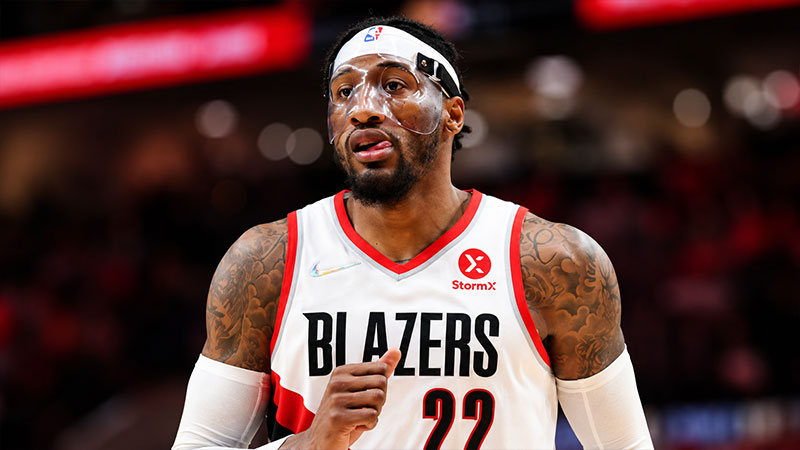
Robert Covington, a cornerstone of defensive versatility in the NBA, became a focal point of league-wide discussion during his tenure with the Portland Trail Blazers due to a distinctive facial guard.
While many fans initially questioned the physical necessity of the gear, the narrative evolved into a profound exploration of resilience and vulnerability.
Covington’s use of a protective mask was not merely a medical requirement; it served as a gateway to a broader conversation regarding athlete wellness and the “hyper-masculine” culture of professional sports.
This analysis explores the dual nature of his masks—one medical, the other psychological.
The Catalyst: Examining the Physical Injury of 2021
The primary reason Robert Covington began wearing a mask was a significant facial injury sustained during a game on January 24, 2021.
While competing for the Portland Trail Blazers, Covington suffered a high-impact collision that resulted in both a fractured nose and a concussion.
This double-pronged injury necessitated immediate medical intervention and the implementation of a medical-grade facial guard to protect the structural integrity of his nose upon his return to the court.
The NBA Concussion Protocol and Return to Play
Following the incident, Covington was required to clear the NBA’s rigorous concussion policy before returning to active competition. This process involves a series of cognitive and physical tests to ensure brain health is prioritized over immediate team needs.
Once cleared for the physical demands of basketball, the clear medical-grade mask was introduced as a secondary layer of defense, shielding his fractured nose from further trauma during the high-contact environment of professional play.
Transitioning to Protective Gear
Adapting to a facial guard is a notoriously difficult transition for professional athletes. For Covington, the mask was described as “highly annoying” during the initial phases of his return.
Because the mask is designed to fit tightly against the face to provide maximum protection, it often creates a micro-environment that is poorly suited for the intense perspiration of an NBA game.
Covington noted that the mask frequently fogged up and had a tendency to slide around due to sweat, requiring constant manual adjustments during gameplay.,
Performance Analysis: The “Masked RoCo” Era
Despite the technical frustrations associated with the guard, Covington’s performance metrics during this period were remarkably high. Many observers noted that he played some of the most efficient basketball of his career while wearing the mask.
This led to a subset of the fanbase suggesting that the guard might be providing a “groove” or a psychological edge that enhanced his focus.
Comparative Legends: The Rip Hamilton Connection
The sight of Covington in a mask drew immediate comparisons to NBA legend Richard “Rip” Hamilton. Hamilton famously wore a clear face mask for the majority of his career following multiple nasal fractures, eventually making it his signature look.
Fans and commentators began referring to Covington as “Rip City’s Rip Hamilton 2.0,” a nod to both the aesthetic similarity and the elite level of play Covington maintained while protected.
Defensive Mastery and Film Study
Covington’s success during this era was not accidental. Behind the scenes, he was dedicated to a rigorous study of defensive specialists.
He spent significant time watching tape of legendary defenders like Scottie Pippen and Tony Allen to refine his positioning and anticipation.
This dedication to his craft, combined with the physical protection of the mask, allowed him to remain a defensive anchor for the Trail Blazers even while recovering from a serious injury.
The Sacramento Incident: A Breaking Point
While the mask provided protection, it also became a symbol of the intense frustration that can boil over in the heat of competition.
In November 2021, during a particularly contested game against the Sacramento Kings, the mask became the center of a major officiating controversy.
The Ejection and Financial Consequences
Out of intense frustration with the flow of the game and officiating decisions, Covington removed his face guard and flipped it toward a game official. This action was viewed by the league as a violation of conduct standards.
Covington was assessed a technical foul and promptly ejected from the game. Following a review by the NBA league operations, he was subsequently fined $15,000 for the incident.
This moment highlighted the physical and emotional weight that the mask represented during a high-stakes season.
The Metaphorical Mask: A Journey Into Mental Health
The most significant aspect of the “mask” narrative transcends the physical plastic worn on the court. In a candid interview with The Athletic, Covington revealed that he had been wearing a psychological mask for much of his life.
He spoke openly about the concept of “masking” real emotions—putting on a front of pure physical strength and stoicism while internally battling deep-seated anxiety and depression.
The 2019 Mental Breakdown
The catalyst for this revelation was a severe mental breakdown Covington experienced in 2019. This event forced him to confront the reality that his external persona as a hardened professional athlete did not align with his internal emotional state.
By speaking out, Covington challenged the “hyper-masculine” environment of the NBA, where emotional vulnerability is often viewed as a weakness rather than a strength.
The Path to the “Best Version”
Covington’s journey toward mental wellness involved a commitment to therapy and self-reflection.
He famously stated, “I’m working on being the best version of Robert Covington that I can.” This sentiment resonated deeply with fans, who praised his willingness to show emotional vulnerability.
The community response highlighted a shifting paradigm in sports, where athletes are increasingly recognized as human beings with complex emotional needs rather than just performers.
| Aspect of the Mask | Physical Guard (Literal) | Emotional Mask (Metaphorical) |
|---|---|---|
| Primary Purpose | Protect fractured nose and concussion recovery. | Conceal anxiety and depression from the public. |
| Challenges | Fogging, sliding, and physical discomfort. | Psychological burnout and emotional exhaustion. |
| Key Incident | Ejection/Fine for flipping mask at a ref. | 2019 mental breakdown and subsequent therapy. |
| Outcome | High on-court efficiency and defensive impact. | Growth into the “best version” of himself. |
Why Robert Covington Matters Beyond the Box Score
Robert Covington’s legacy is defined by his ability to navigate both the physical and mental rigors of the NBA. As a “3-and-D” specialist, his value is often measured in steals, deflections, and three-point percentages.
However, his willingness to unmask his struggles provides a more enduring contribution to the sport.
Redefining Athlete Influence
By discussing his therapy and mental health journey, Covington has become a selfless advocate for others off the court.
He demonstrated that the same discipline required to watch film of Tony Allen or Scottie Pippen is required for the internal work of mental health maintenance.
His story serves as a case study for Fortune 500-level leadership: the understanding that peak performance is unsustainable without a foundation of psychological health and authenticity.
The Fan Connection
The “RoCo” experience in Portland was marked by a deep mutual respect between the player and the city. Fans embraced his “masked” persona, not just as a defensive stopper, but as a representative of the grit and honesty that the community values.
Whether he was battling through the discomfort of a sliding face guard or the weight of depression, Covington remained committed to his development as a person and a player.
Frequently Asked Questions (FAQ)
Did Robert Covington have to wear the mask?
Yes, the mask was a medical necessity following a fractured nose and concussion sustained on January 24, 2021. It was required to protect him from further injury during physical play.
Why was Robert Covington fined $15,000 for his mask?
In November 2021, Covington was fined by the NBA after he flipped his face guard toward an official during a game against the Sacramento Kings, resulting in an ejection.
What did Robert Covington mean by “the man behind the mask”?
This phrase refers to his journey with mental health. He used it to describe his transition from hiding his emotions (masking) to being open about his struggles with anxiety and depression.
Is Robert Covington still wearing the mask?
While he wore it for the remainder of the 2021 season and became used to it, the literal mask was a temporary medical requirement. However, he continues to advocate for “unmasking” mental health issues.
Conclusion: The Final Unmasking
Robert Covington’s story is a powerful reminder that the most significant battles are often those unseen by the crowd.
The clear plastic mask he wore in 2021 was a testament to his physical toughness, but his decision to remove his emotional mask was a testament to his character.
By striving to be the “best version” of himself, Covington has provided a roadmap for other athletes and professionals to prioritize their mental well-being alongside their physical achievements.
For fans of the game, “Masked RoCo” remains a symbol of a player who gave everything on the court while having the courage to ask for help off of it.
His journey proves that true strength isn’t found in the absence of vulnerability, but in the courage to face it head-on.