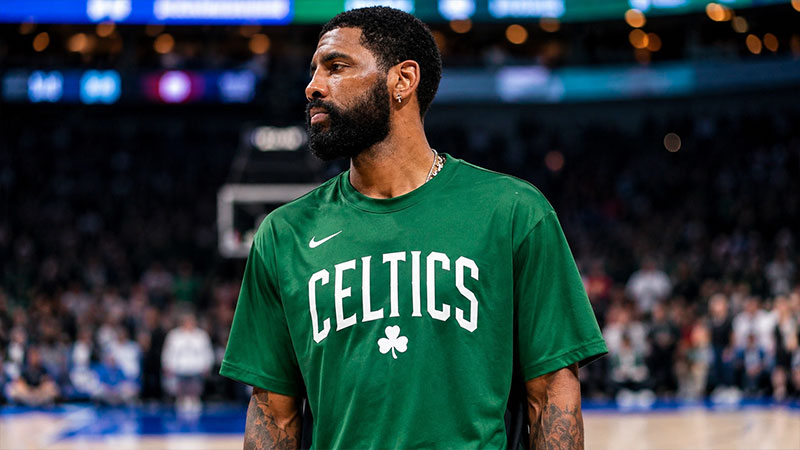
The Brooklyn Nets’ decision to suspend Kyrie Irving sent shockwaves through the professional sports world, highlighting the critical responsibility elite athletes bear when utilizing their massive digital platforms.
The disciplinary action stemmed from Irving’s promotion of a documentary featuring antisemitic tropes and his subsequent failure to unequivocally disavow hate speech during media appearances.
This incident was not merely about a social media post; it represented a fundamental clash between a player’s personal expression and an organization’s core values.
As the suspension unfolded, it became a defining case study in corporate accountability and the limits of athlete influence.
The Initial Controversy: A Single Social Media Link
The genesis of the suspension was a post on Irving’s Twitter feed that shared a link to a documentary titled Hebrews to Negroes: Wake Up Black America.
While seemingly a routine share for the star, the content of the film was quickly identified by advocacy groups and the NBA as containing “vile and harmful” material, including Holocaust denialism and antisemitic tropes.
This action immediately drew the attention of NBA Commissioner Adam Silver and the Brooklyn Nets front office, who sought clarity on Irving’s intentions and his stance on the film’s controversial messages.
The promotion of such content by a high-profile figure created immediate real-world concerns regarding the normalization of hate speech. The timing was particularly sensitive, coming amid a reported rise in antisemitic incidents across the United States.
Consequently, what started as a digital interaction quickly escalated into a major public relations crisis for the NBA and the Nets organization, demanding a swift and decisive response.
The Nature of the Content Promoted
The film linked by Irving, Hebrews to Negroes: Wake Up Black America, is noted for its inclusion of numerous historical falsehoods and antisemitic narratives.
These include claims that certain groups are the “true” descendants of biblical figures while delegitimatizing the Jewish community, a narrative often associated with extremist ideologies.
By sharing this content without context or condemnation, Irving was perceived as endorsing these views to his millions of followers.
Reaction from NBA Leadership
NBA Commissioner Adam Silver expressed profound disappointment that Irving had not offered an “unqualified apology” or specifically denounced the documentary’s hateful elements.
Silver emphasized that the league has a zero-tolerance policy for hate speech and that Irving’s failure to recognize the harm caused was unacceptable for a player of his stature.
This public rebuke from the league office signaled that the Nets were under significant pressure to take formal disciplinary action.
The Press Conference: A Breakdown in Communication
The suspension was not an immediate reaction to the tweet itself, but rather the result of Irving’s behavior in the days following the post.
The Nets organization made multiple attempts to help Irving understand the “harm and danger” of his words and actions, yet these internal efforts failed to produce a clear disavowal.
During subsequent media availabilities, Irving’s defensive posture and “confounding answers” further alienated the team and the public.
Instead of a direct apology, Irving initially reacted with emotion, feeling he was being “unjustly labeled” antisemitic.
He argued that he could not be antisemitic if he knew where he came from, a statement that many viewed as an evasion of the actual question regarding his beliefs.
This lack of clarity proved to be the final catalyst for the team’s decision to remove him from the roster indefinitely.
Failure to Disavow Hate Speech
During a critical press conference, Irving was asked directly if he held antisemitic beliefs. Rather than providing a definitive “no,” he offered a philosophical response about his heritage, stating, “I cannot be antisemitic if I know where I come from”.
This failure to provide an “unqualified apology” or a simple denial of antisemitism was described by the Nets as “deeply disturbing” and a violation of the team’s values.
Rejection of the Anti-Defamation League (ADL) Donation
Before the suspension was officially announced, Irving and the Nets had pledged $500,000 each to anti-hate causes in collaboration with the ADL.
However, after Irving’s defiant press conference, ADL CEO Jonathan Greenblatt stated the organization could “not in good conscience” accept Irving’s donation.
This rejection highlighted the perceived insincerity of Irving’s initial gestures and reinforced the narrative that he had not yet taken full responsibility for his actions.
Defining “Conduct Detrimental”: Why the Nets Acted
In their official statement, the Brooklyn Nets declared that Irving was “currently unfit to be associated” with the team.
They categorized his actions as “conduct detrimental to the team,” a contractual clause that allows organizations to suspend players for behavior that harms the franchise’s reputation or operations.
The Nets emphasized that Irving’s refusal to acknowledge specific hateful material in the film, even when given multiple opportunities, forced their hand.
The suspension was set for a minimum of five games without pay. The “without pay” aspect was significant, as it meant Irving would lose millions of dollars in salary during his time away from the court.
This move was seen as a necessary step to restore organizational integrity and send a clear message that individual players are not larger than the values of the collective franchise.
Impact on Team Culture and Stability
The Irving controversy occurred during a period of intense instability for the Nets, who had recently fired head coach Steve Nash following a poor 2-6 start to the season.
Having a superstar player embroiled in a social media scandal and refusing to comply with team expectations created a “PR nightmare” that the organization could no longer ignore.
The suspension was an attempt to clear the air and allow the team to focus back on basketball, though it initially led to further questions about Irving’s long-term future with the team.
The “Conduct Detrimental” Justification
The specific reasons cited for the “conduct detrimental” label included:
- Promotion of Hateful Material: Sharing a link to a documentary with antisemitic content.
- Repeated Failure to Disavow: Multiple media sessions where Irving refused to clarify his beliefs.
- Public and Community Harm: The negative impact of his words on the Jewish community and fans.
- Organizational Conflict: Divergence from the Nets’ core values and refusal to follow the team’s guidance on conflict resolution.
The Road to Return: Objective Remedial Measures
The Brooklyn Nets did not just suspend Irving for five games; they mandated that he satisfy a series of “objective remedial measures” before he could be reinstated.
This was an unusual step that moved beyond typical disciplinary timelines, making his return contingent on his personal growth and efforts to repair community relations.
The team wanted to ensure that Irving’s return was not just a return to the court, but a return to being a constructive member of the organization.
These measures were designed to be transformative rather than purely punitive. They included high-level meetings and educational components that required Irving to confront the impact of the content he shared.
The franchise made it clear that the length of the suspension was entirely up to Irving and his willingness to engage with the process sincerely.
The Six Requirements for Reinstatement
To return to the Brooklyn Nets, Irving was reportedly required to complete the following steps:
- Issue a Formal Apology: A clear statement acknowledging the harm caused by the post.
- Complete Sensitivity Training: Anti-hate training specifically addressing antisemitism.
- Meet with Jewish Leaders: Direct dialogue with community representatives and the ADL.
- Donation Fulfillment: Ensuring the committed funds reached appropriate anti-hate organizations.
- Meeting with Adam Silver: A personal sit-down with the NBA Commissioner.
- Demonstrated Understanding: Convincing the Nets organization that he understood the gravity of his actions.
Historical Context: A Pattern of Absences
To fully understand why the Nets were so firm in their disciplinary action, one must look at Irving’s history with the team. This was the second consecutive season that the Nets had to send Irving away for non-basketball reasons.
The previous year, he was sidelined for a significant portion of the season due to his refusal to comply with New York City’s COVID-19 vaccination mandates, which made him ineligible for home games.
This history of “unavailability” had clearly strained the relationship between Irving and the front office. During the prior summer, the team had already refused to grant Irving a long-term contract extension, citing his lack of reliability.
The antisemitism controversy was seen by many fans and analysts as the final straw in a partnership that had become increasingly defined by off-court distractions.
The Vaccine Mandate Conflict
Last season, the Nets initially told Irving he would not be allowed to be a “part-time player” before eventually allowing him to play road games.
This conflict set a precedent for the team taking a hard line against Irving’s personal choices when they conflicted with team or local regulations. The frustration from this period likely informed the swiftness and severity of the suspension during the 2022 incident.
The “PR Nightmare” Narrative
On platforms like Reddit, fans expressed that they were “done with his antics being a PR nightmare”. There was a growing sentiment that while Irving is a “top 1% talent,” his baggage was starting to outweigh his on-court contributions.
This public perception put additional pressure on the Nets to act decisively to preserve the franchise’s dignity.
The Macro Message: Accountability in the Digital Age
The suspension of Kyrie Irving serves as what one commentator called a “macro message” to the world. It emphasizes that in the modern era, “thinking before speaking” is a requirement for those who hold massive public influence.
The incident demonstrated that professional sports leagues are increasingly sensitive to the social impact of their players’ actions, particularly when it comes to the promotion of hate speech or misinformation.
Ultimately, the suspension was about more than just one player or one tweet. It was about defining the boundaries of professional conduct in a world where athletes are global icons.
The Nets’ stance—that talent does not excuse a lack of accountability—has become a benchmark for how organizations handle similar crises in the future.
Frequently Asked Questions
Why exactly was Kyrie Irving suspended by the Brooklyn Nets?
He was suspended for promoting an antisemitic documentary on social media and subsequently failing to unequivocally state that he holds no antisemitic beliefs when given multiple opportunities to clarify his stance.
How long did the suspension last?
The Nets issued a suspension of “at least five games without pay,” but his return was contingent on him completing a series of remedial steps.
What were the “remedial measures” Irving had to complete?
He was required to issue a formal apology, meet with Jewish community leaders and the ADL, and complete sensitivity and anti-hate training.
Did Kyrie Irving lose money during this suspension?
Yes. The suspension was “without pay,” meaning he lost millions in salary for the games he missed.
What was the name of the movie Kyrie Irving tweeted?
The documentary was titled Hebrews to Negroes: Wake Up Black America.
Conclusion: The Final Verdict on Athlete Influence
The Kyrie Irving suspension remains a landmark event in NBA history, illustrating the high stakes of athlete communication in the digital age.
By holding Irving accountable for the “harmful impacts” of his conduct, the Brooklyn Nets reinforced the idea that professional athletes are an extension of their organization’s values.
While Irving eventually returned to the court after fulfilling the team’s requirements and issuing an apology, the incident fundamentally changed the trajectory of his career and his public perception.
It serves as a stark reminder that with a great platform comes a profound responsibility to use it wisely, and that failure to do so can have significant professional and financial consequences.
For fans and the league alike, the situation underscored the importance of dialogue, education, and the courage to stand against hate in all its forms.