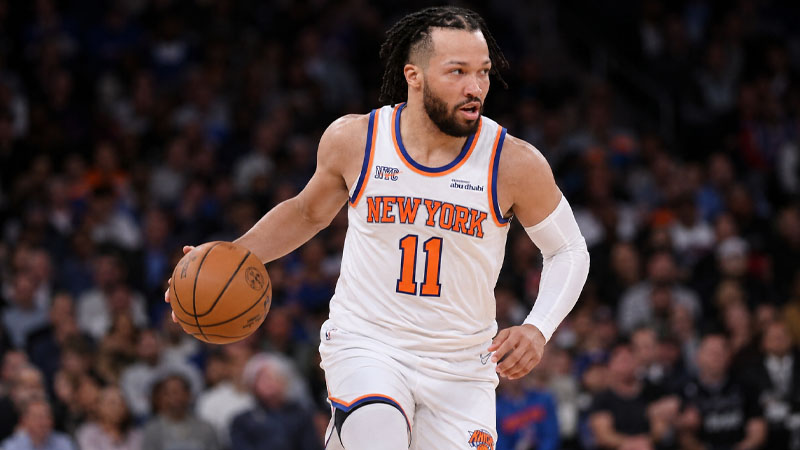
Jalen Brunson became an unrestricted free agent in 2022 because the Dallas Mavericks omitted a team option in the final year of his four-year rookie contract.
Typically, second-round picks are signed using exceptions that allow for restricted status. However, Dallas utilized open cap space for a flat $6.1 million deal.
Without a final-year option, NBA rules dictated he enter the market with zero team control. This historic front-office oversight allowed Brunson to join the New York Knicks without Dallas receiving compensation.
Today, this specific contractual gap is known as the “Brunson Loophole,” which fundamentally reshaped the league’s collective bargaining agreement.
Why Was Jalen Brunson an Unrestricted Free Agent?
The technical explanation for Jalen Brunson’s unrestricted status lies in the specific architecture of his 2018 rookie agreement.
While most elite young talents enter the league with built-in team protections, Brunson’s path was diverted by a unique application of the Collective Bargaining Agreement (CBA).
Understanding this requires a deep dive into the difference between standard rookie exceptions and the path Dallas chose to take.
The Second-Round Draft Pick Anomaly
When Jalen Brunson was selected 33rd overall in the 2018 NBA Draft, he fell into the second round, where contract rules differ significantly from the first round.
First-round picks are subject to a rigid “rookie scale” that automatically includes team options and restricted free agency (RFA) rights. Second-round picks, however, have no such scale.
Teams must negotiate these deals using available salary cap exceptions or raw cap space. Dallas opted for a flat four-year deal worth $6.1 million, which lacked the crucial final-year mechanisms required to retain matching rights.
The Missing Fourth-Year Team Option
Under the NBA’s operating rules at the time, a team could only retain restricted free agency rights on a second-round pick if the contract was for three years or fewer, or if a four-year contract included a team option for the final season.
By signing Brunson to a straight four-year deal with no options, the Mavericks essentially set a hard expiration date on their relationship with the player.
Once that fourth year concluded, Brunson was legally entitled to enter the market as an unrestricted free agent, meaning he could sign with any franchise without Dallas having the right to match the offer sheet.
How the Dallas Mavericks Lost Contractual Control
The loss of Jalen Brunson is frequently cited as a case study in failed asset management. The organization prioritized short-term financial flexibility over long-term player control, a decision that backfired as Brunson developed into an All-NBA caliber talent.
This section explores the mechanics of that failure and the internal logic that led to one of the most significant talent drains in recent history.
Choosing Cap Space Over Rookie Exceptions
At the time of the signing, the Mavericks used their open salary cap space to ink Brunson’s deal rather than using a standard rookie exception.
While this allowed them to sign him to a longer four-year term—which is often seen as a benefit for developing players—they failed to include the “team option” trigger.
This trigger is the legal bridge to restricted free agency. Without it, the contract was a “dead-end” agreement that provided no leverage to the team once the term expired in 2022.
The Impact of the 2018 CBA Regulations
The 2018 CBA was less forgiving regarding second-round pick structures than the current iteration of the league’s rules.
At that time, teams often had to choose between a two-year deal (which leads to RFA earlier) or a longer deal that risked UFA status if not structured perfectly.
Dallas attempted to get the best of both worlds—a long-term cheap contract—but ignored the “restricted” safety net. This technical oversight became a massive liability when Brunson’s on-court value far exceeded his $1.5 million annual salary.
The $56 Million Decision That Failed Dallas
Beyond the initial contract structure, Dallas had multiple opportunities to rectify the situation through extensions. However, a series of valuation disagreements and a desire to hunt for external superstars prevented a deal from being finalized until it was too late.
This timeline illustrates how a technical error was compounded by a strategic miscalculation.
Why Dallas Declined the Initial Extension
During the 2020–21 offseason and the early stages of the 2021–22 campaign, Brunson’s camp was reportedly open to a four-year, $56 million maximum extension. This was the highest amount Dallas could offer under the rules of his existing contract at the time.
The Mavericks’ front office hesitated, choosing to keep their salary cap “clean” to potentially pursue high-profile free agents or to keep Brunson available as a flexible trade asset.
This hesitation signaled to Brunson’s camp that the organization might not view him as a long-term pillar of the franchise.
The January 2022 Market Value Shift
By the time the Mavericks finally put the $56 million offer on the table in January 2022, the landscape had shifted. Brunson was in the midst of a breakout season, proving he could lead the team even when star Luka Doncic was sidelined.
His market value had skyrocketed well beyond the $14 million average annual salary of the extension offer.
Having been passed over earlier, Brunson’s camp rejected the late offer, betting that unrestricted free agency would yield a much larger payday—a bet that eventually paid off with a $104 million contract from New York.
Key Differences: Restricted vs. Unrestricted Status
| Feature | Restricted Free Agency (RFA) | Unrestricted Free Agency (UFA) |
|---|---|---|
| Matching Rights | Original team can match any offer sheet to keep the player. | No matching rights; player signs wherever they choose. |
| Team Control | High; the team essentially dictates the outcome. | Zero; the player has total autonomy. |
| Typical Origin | First-round picks or second-rounders with team options. | Veterans or second-rounders on specific 4-year deals. |
| Negotiation Leverage | Favors the incumbent team. | Favors the player and the open market. |
| Brunson’s Status | Dallas failed to secure these rights in 2018. | Brunson reached this status in the summer of 2022. |
What is the “Jalen Brunson Rule” in the NBA?
The fallout from the Brunson departure was so significant that it prompted the NBA and the Players Association to create new safeguards.
The league recognized that teams should not be punished for successfully drafting and developing second-round talent. This resulted in the creation of a new contractual mechanism designed to prevent a repeat of the Dallas disaster.
The New Second-Round Pick Exception
In the 2023 Collective Bargaining Agreement, the league introduced what is colloquially known as the “Second-Round Pick Exception”.
This rule allows teams to sign second-rounders to three- or four-year deals without needing to use their mid-level exception or raw cap space.
More importantly, it provides a clear, standardized path to restricted free agency, ensuring that teams can retain matching rights regardless of the contract length, provided they follow the new guidelines.
Protecting Team Investments in Talent
This rule change essentially “idiot-proofs” second-round contracts for front offices. It ensures that if a team finds a “diamond in the rough” at pick 33 or 45, they won’t lose that player for nothing simply because of a clerical preference in how the contract was filed.
The league-wide adoption of this rule is a direct acknowledgment that the Mavericks’ loss of Brunson was a systemic failure that needed a regulatory fix.
The Tampering Investigation and Knicks Signing
When Jalen Brunson eventually reached the open market in July 2022, the New York Knicks were waiting with a massive offer.
However, the speed and certainty of the signing raised red flags at the league office, leading to a formal investigation into the communications between the player’s camp and the Knicks’ front office.
The 2025 Second-Round Pick Penalty
Following an investigation into the timing of the deal, the NBA determined that the New York Knicks had engaged in illegal contact with Brunson before the free agency window officially opened.
As a penalty for this tampering violation, the NBA stripped the Knicks of their 2025 second-round draft pick.
While the penalty was considered a “slap on the wrist” by some, it served as a formal confirmation of the aggressive tactics New York used to secure their primary target.
Building a Championship Core in New York
Despite the penalty, the acquisition of Brunson transformed the Knicks’ trajectory. He signed an initial four-year, $104 million contract, which at the time was criticized by some as an overpay.
However, Brunson quickly outperformed the deal, leading New York to deep playoff runs and eventually a championship in 2026, where he was named Finals MVP.
His arrival turned a struggling franchise into a perennial contender, validating the front office’s aggressive pursuit.
When Will Jalen Brunson Be a Free Agent Again?
Currently, Jalen Brunson is one of the best-compensated and most successful players in the league. However, because of his savvy approach to contract negotiations, he will likely hit the open market again while still in his athletic prime.
His current deal is structured to maximize both team stability and future earning potential.
The $156.5 Million Veteran Extension
In a move that was widely celebrated as “team-friendly,” Brunson signed a four-year, $156.5 million veteran extension with the Knicks that took effect for the 2025–26 season.
By signing this extension early rather than waiting for free agency, Brunson provided the Knicks with immediate financial clarity, allowing them to continue building a competitive roster around him.
This “sacrifice” has become a hallmark of his tenure in New York, further cementing his status as a franchise icon.
The Potential $323 Million Supermax in 2028
While the current extension provides security, it also includes a player option for the 2028–29 season. It is widely anticipated that Brunson will decline this option in the summer of 2028 to become an unrestricted free agent once again.
Because the NBA’s salary cap is projected to rise significantly due to new media rights deals, a 32-year-old Brunson could be eligible for a five-year “supermax” contract extension worth approximately $323 million.
This strategy allows him to remain a Knick through his prime while positioning himself for a historic final payday.
Frequently Asked Questions About Brunson’s Contract
Why didn’t the Mavericks just match the Knicks’ offer?
Because Brunson was an unrestricted free agent, the Mavericks had no legal right to match the offer sheet. Once he chose New York, Dallas had no recourse.
Could Dallas have traded him before he became a free agent?
Yes, but his value as a “rental” was debated. Some analysts suggested his trade value was high due to his Bird Rights, but Dallas chose to keep him for their 2022 playoff run.
What are Bird Rights in this context?
Bird Rights allow a team to re-sign their own player even if they are over the salary cap. While Dallas had Brunson’s Bird Rights, they couldn’t force him to stay; he had to agree to the contract.
How did the Knicks avoid a harsher tampering penalty?
The league generally reserves the loss of first-round picks for the most egregious cases. A second-round pick is the standard penalty for early contact that results in a signing.
Lessons in Professional Asset Management
The saga of Jalen Brunson serves as a permanent reminder of the importance of contractual foresight in the NBA.
A single missing clause—a fourth-year team option—ultimately cost the Dallas Mavericks a superstar and forced the league to rewrite its rulebook. For front offices across the league, the “Brunson Precedent” is now a mandatory study in risk mitigation.
As Brunson continues his championship-winning career in New York, the focus has shifted from his departure to his future.
With a potential $323 million contract on the horizon in 2028, the man who once slipped through the cracks of the CBA is now positioned to become one of the highest-paid players in the history of the sport.
His journey from a “second-round blunder” to a Finals MVP is a testament to both his individual talent and the massive impact that contract structures have on the landscape of professional basketball.