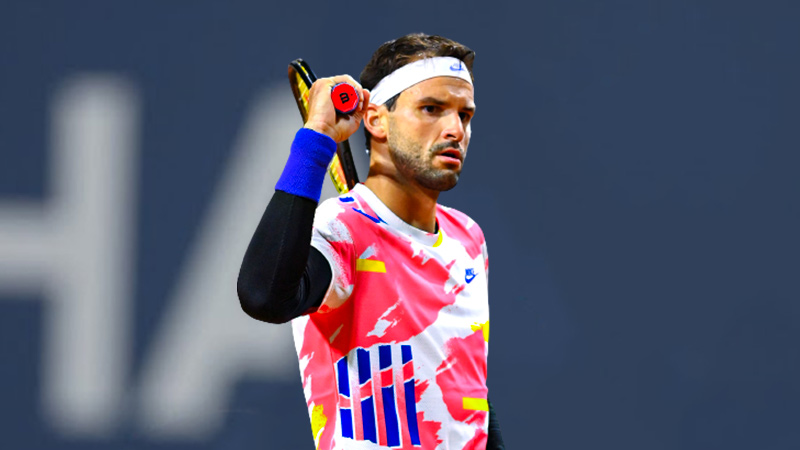
Grigor Dimitrov was nicknamed “Baby Federer” because his playing technique, fluid on-court movements, and overall style were an uncanny mirror image of Roger Federer.
The comparison took root during Dimitrov’s successful junior career, particularly after his 2008 junior Wimbledon and US Open victories.
Prominent coach Peter Lundgren, who mentored both athletes, accelerated the moniker by noting Dimitrov was more naturally advanced at 17 than Federer had been at the same age.
While initially seen as high praise, the label eventually became a psychological burden that both players publicly requested the media to stop using.
The Historical Origins of the Baby Federer Nickname
The emergence of a new talent in the tennis world often leads to immediate comparisons with established legends, and for Grigor Dimitrov, this comparison was almost instantaneous.
The roots of this association trace back to a specific era in the late 2000s when the tennis community was looking for the next torchbearer of the “Maestro’s” elegant style.
Junior Dominance and the 2008 Breakthrough
The narrative began in earnest during the 2008 season. Dimitrov was a phenom on the junior circuit, showcasing a level of maturity and aesthetic grace that was rare for a teenager.
By winning both the junior Wimbledon and junior US Open titles in the same calendar year, he signaled to the world that his talent was not merely theoretical.
These victories provided the initial platform for the media to begin drawing parallels between his trajectory and that of a young Roger Federer.
The Influence of Coach Peter Lundgren
While junior titles provided the foundation, the “Baby Federer” tag gained its most significant mainstream traction through the endorsement of Peter Lundgren.
Lundgren occupied a unique position in tennis history, having coached Roger Federer during his formative years from 2000 to 2003.
When Lundgren later began working with Dimitrov, he made a public observation that would define the Bulgarian’s early career: he stated that the teenage Dimitrov was actually more naturally advanced at 16 or 17 than Federer had been at that exact same age.
This professional validation from a man who knew Federer’s game intimately made the nickname permanent in the eyes of the global media.
Analyzing the Technical Blueprint of the Comparison
The moniker was never a superficial creation of the marketing departments; it was rooted in highly specific, visible technical mechanics that Dimitrov utilized on the court every day.
To an observer, watching Dimitrov from a distance felt like watching a “Maestro” in training due to several distinct physical cues.
| Technical Element | Specific Similarity to Roger Federer |
|---|---|
| The Backhand | A classic, single-handed backhand with an elegant, sweeping follow-through. |
| Service Motion | Utilization of the specific “trophy position,” weight transfer, and stance. |
| Footwork | A smooth, light-footed, and almost “balletic” style of movement across the court. |
| Forehand | The mechanics of the take-back bore an uncanny resemblance to the Swiss star. |
| Equipment | Use of Wilson rackets and Nike apparel, identical to Federer’s early setup. |
The Deliberate Crafting of the Serve
Interestingly, some of these similarities were not entirely accidental. Dimitrov later revealed that one of his early coaches was an immense admirer of Federer’s game.
This coach consciously taught a young Dimitrov to serve by mimicking Federer’s specific stance and weight transfer.
By internalizing these mechanics during his developmental years, Dimitrov’s service motion became a carbon copy of the Federer blueprint, further cementing the visual association in the minds of fans and commentators alike.
Aesthetic and Visual Branding
Beyond the mechanics of the swing, the visual branding played a major role in the “Baby Fed” identity. Early in his professional journey, Dimitrov utilized the same racket manufacturer, Wilson, and the same apparel sponsor, Nike, as his idol.
When combined with his “balletic” footwork and the sweeping one-handed backhand, the resemblance was so striking that it was often described as an “uncanny mirror image”.
This alignment of style, movement, and gear created a powerful, albeit unintended, brand association.
The Psychological Toll of Living in a Legend’s Shadow
While being compared to one of the greatest athletes in history might seem like the ultimate compliment, it eventually transformed into what Dimitrov described as a “toxic burden”.
The nickname did more than just describe his style; it set a standard for success that was almost impossible for any young player to meet.
Trapped by Unrealistic Expectations
As Dimitrov transitioned from the junior ranks to the senior ATP tour, the weight of the “Baby Fed” tag began to take its toll.
The nickname essentially trapped him in an impossible shadow, creating unfair pressure to win twenty or more Grand Slams before he had even fully grown into his own body.
Instead of being allowed to develop at his own pace, every loss was viewed through the lens of Federer’s perfection, leading to what Dimitrov called “unrealistic expectations”.
Resentment and the Quest for Identity
Over time, the flattery of the comparison curdled into genuine resentment. Dimitrov admitted in various interviews that there were periods where he started resenting the people who used the moniker.
He felt that the tag prevented him from establishing his own independent identity as a player. The relief he felt when the nickname finally “died” was a testament to the mental strain of being viewed as a clone rather than an individual athlete.
Roger Federer’s Public Stance on the Moniker
The discomfort with the “Baby Fed” label was not one-sided. Roger Federer himself was highly protective of younger players and their need for individual identities.
He recognized early on that the nickname was doing more harm than good for his younger colleague’s mental game.
A Call for a Media Ban
As early as 2013, Federer began publicly urging the media to drop the term. He described the nickname as “annoying” and “lazy” on the part of the press.
Federer’s stance was clear: while the comparison might have been funny or flattering at first, it had become a hindrance to Dimitrov’s professional growth.
He expressed a sincere desire for the Bulgarian to be viewed as his own player rather than a secondary version of someone else.
Protecting the Next Generation
Federer’s dismissal of the nickname was also a reflection of his respect for the sport’s competitive integrity. He understood that for Dimitrov to reach his full potential, he needed to stop being the “Maestro’s” protégé in the eyes of the public and start being a rival.
By speaking out against the term, Federer attempted to provide Dimitrov with the breathing room necessary to carve out his own path on the ATP tour.
Forging a Successful Independent Career
The true measure of Grigor Dimitrov’s career is found in how he eventually stepped out of that shadow. He successfully shifted his game away from purely mimicking “Federer-esque finesse” toward a more physical and modern style of play.
Elite Achievements and Rankings
Dimitrov proved his doubters wrong by achieving milestones that few players in the modern era can claim. He reached a career-high world ranking of No. 3, a position that solidified his status as an elite force in tennis.
His crowning achievement came in 2017 when he won the prestigious Nitto ATP Finals, a tournament featuring the top eight players in the world. This victory was a clear signal that he had arrived as a champion in his own right.
The 2019 US Open Breakthrough
Perhaps the most symbolic moment in his journey toward independence occurred at the 2019 US Open. In the quarterfinals, Dimitrov faced off against Roger Federer in a high-stakes, five-set thriller.
By defeating the man he had been modeled after on one of the world’s biggest stages, Dimitrov finally closed the chapter on the “Baby Fed” narrative. It was a poetic conclusion to years of comparison, proving he could not only play like Federer but also beat him.
Common Questions About Grigor Dimitrov’s Career
What was Grigor Dimitrov’s highest ranking?
Dimitrov reached a career-high of World No. 3 following his victory at the 2017 ATP Finals.
Did Grigor Dimitrov ever beat Roger Federer?
Yes, his most famous victory over Federer came in the 2019 US Open Quarterfinals in a historic five-set match.
Who first gave him the nickname?
While the media popularized it, the comparison gained major traction through coach Peter Lundgren, who had coached both players.
Is Grigor Dimitrov still playing?
Yes, he continues to be a prominent figure on the ATP tour, known for his incredible athleticism and one-handed backhand.
Conclusion: Legacy and Mutual Respect
Grigor Dimitrov’s journey from “Baby Federer” to a respected veteran of the tour is a story of resilience against the weight of expectation.
While he spent years trying to escape the moniker, he never lost his deep admiration for the man who inspired it. Dimitrov has frequently stated that to him, Roger Federer will always be the “ultimate pioneer of tennis”.
Today, Dimitrov is celebrated not for being a copy, but for his own longevity, his elite athleticism, and the unique identity he fought so hard to reclaim.