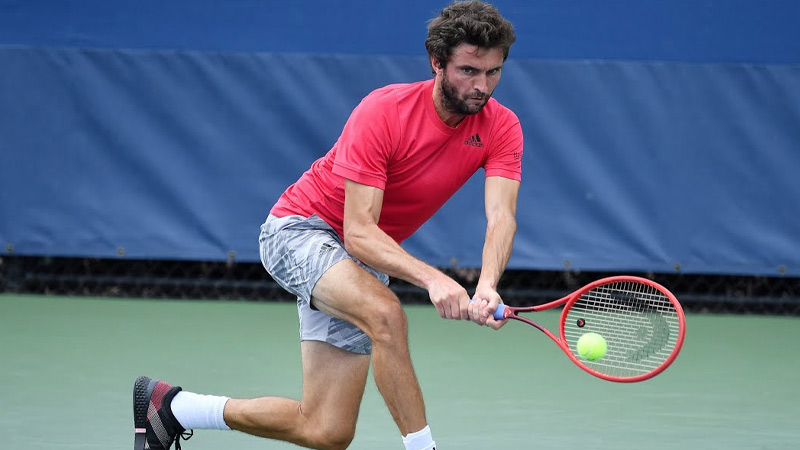
Gilles Simon is famous for being a tactical mastermind in professional tennis, earning the moniker “Le Prof” for his intellectual approach to the game.
Over a twenty-year career, the French star defied the modern trend of raw power, instead utilizing elite defensive grinding and psychological patience to dismantle opponents.
Achieving a career-high ranking of World No. 6 and securing over 500 match wins, Simon became a “Giant Killer” who famously pushed legends like Novak Djokovic and Roger Federer to their breaking points.
His legacy transcends the court through his provocative book, “Ce Sport Qui Rend Fou.”
Gilles Simon: A Career Defined by Elite Longevity
Gilles Simon’s fame is anchored in his remarkable consistency and statistical achievements as a pillar of France’s most successful modern generation.
To understand his impact, one must look at the sheer scale of his professional durability, which allowed him to compete at the peak of the sport for two decades before his retirement in 2022.
| Career Statistic | Detail |
|---|---|
| Total Career Wins | 504 Match Victories |
| Career-High Ranking | World No. 6 (January 5, 2009) |
| ATP Singles Titles | 14 Titles Across Surfaces |
| Career Prize Money | $16,045,734 USD |
| Davis Cup Status | Champion with Team France (2017) |
Simon stands as one of the few players in the Open Era to surpass the 500-win milestone, currently ranking third all-time for match victories by a French male player, trailing only Richard Gasquet and Gaël Monfils.
His versatility was equally impressive, as he captured 14 titles on both fast hard courts and slow European clay, proving that his tactical blueprint was effective regardless of the playing conditions.
His presence in the quarterfinals of both the Australian Open and Wimbledon further cemented his status as a player who could navigate the most grueling formats in tennis.
Why is Gilles Simon Called “Le Prof”?
The nickname “Le Prof” (The Professor) was not merely a term of endearment but a recognition of his ability to outthink opponents who possessed superior physical weapons.
Because he lacked a massive, point-ending serve or explosive baseline power, Simon had to develop a highly specific tactical blueprint based on geometry and psychological warfare.
Mastering the Speed Diet and Pace Deprivation
At the core of Simon’s fame was his “Speed Diet” philosophy. While most modern players seek to hit the ball as hard as possible, Simon understood that many elite hitters thrive on their opponent’s pace.
To counter this, he intentionally hit soft, central, and low-bouncing groundstrokes. This strategy effectively starved heavy hitters of the speed and angles they needed to strike winners, forcing them to generate 100% of their own power.
By depriving opponents of rhythm, he turned their greatest strengths into liabilities, often leading to a total breakdown of their game plans.
The Geometric Grind and 30-Shot Rallies
Another reason Simon became a household name among tennis purists was his commitment to the “Geometric Grind”. He was famous for dragging opponents into extraordinarily long baseline rallies that frequently extended past 30 shots.
Simon utilized minimalist stroke mechanics—compact motions that required very little energy—to maintain his accuracy while his opponents grew increasingly fatigued and frustrated.
This approach relied on extreme court coverage and endurance, allowing him to outlast competitors in the hot sun by simply refusing to commit unforced errors before they did.
A Technical Blueprint for the Minimalist
Simon’s technical profile was as unique as his strategy, focusing on efficiency over aesthetics.
He drew heavy inspiration from Michael Chang, proving that players who were shorter or less powerful could still dominate through superior movement and placement.
His signature two-handed backhand and ultra-compact stroke mechanics were designed for physical economy, ensuring he could maintain a 56.1% win rate over hundreds of matches throughout his twenty-year career.
This minimalist style made him a “nightmare opponent” who refused to give away free points.
Pushing the Big Three: The Ultimate Giant Killer
Simon earned worldwide fame for his specific ability to dismantle the rhythmic patterns of the greatest players in history: Roger Federer, Rafael Nadal, and Novak Djokovic.
He was one of the few players outside the elite top tier who could consistently push these legends to their absolute physical and mental limits.
| Opponent | H2H Record | Iconic Match Highlight |
|---|---|---|
| Roger Federer | 2 Wins / 7 Losses | 2008 Toronto: Simon shocked Federer 2-6, 7-5, 6-4 |
| Rafael Nadal | 1 Win / 8 Losses | 2008 Madrid: Defeated World No. 1 Nadal in a 3-hour epic |
| Novak Djokovic | 1 Win / 11 Losses | 2016 Australian Open: Forced 100 unforced errors |
While the head-to-head records favor the “Big Three,” the scorelines rarely tell the full story of the mental toll Simon extracted from them.
His win against Rafael Nadal in the 2008 Madrid Masters semi-final remains a legendary three-hour battle where Simon’s defensive grinding overcame the Spaniard’s baseline dominance.
Similarly, his first career meeting with Roger Federer in Toronto ended in a shocking upset that announced Simon as a premier threat on the global stage.
The 2016 Australian Open vs. Novak Djokovic
One of the most statistically significant matches in Simon’s career occurred during the 2016 Australian Open. In a grueling five-set marathon against Novak Djokovic, Simon’s unique pace-deprivation strategy reached its absolute peak.
By consistently hitting flat, low balls into the center of the court, he forced a staggering 100 unforced errors out of the world’s best player.
Although he did not win the match, the performance solidified his reputation as the premier strategist on the tour, capable of making even the most disciplined players lose their composure.
Challenging the Establishment: “The Federer Myth”
Beyond his defensive mastery on the court, Simon is famous for his intellectual contributions and his willingness to challenge tennis orthodoxy off the court.
He was not a player who sought to blend in; instead, he used his platform to advocate for a more nuanced understanding of player development and sport psychology.
“Ce Sport Qui Rend Fou” and Developmental Critique
In 2021, Simon published a highly discussed and debated book titled Ce Sport Qui Rend Fou (This Sport That Makes You Crazy). The book became a global talking point because it famously challenged what Simon called “The Federer Myth”.
He argued that the French Tennis Federation and global developmental programs were damaging young prospects by forcing them to replicate Roger Federer’s unique, aesthetic elegance.
Simon believed that by obsessing over a style that is essentially inimitable, coaches were stifling the diverse tactical identities and natural strengths of their players.
Leadership and the ATP Player Council
Simon’s intellect and unapologetic perspective earned him immense respect from his peers, leading to his election to the ATP Player Council for several years.
In this role, he served as a respected voice in tennis governance, advocating for player interests and the long-term health of the sport.
His ability to articulate complex tactical and political issues made him more than just a professional athlete; he was a philosopher of the game, consistently pushing for deeper analysis and transparency within the ATP.
The Transition from Player to Master Coach
Retirement in 2022 did not end Simon’s influence on the professional circuit; it merely shifted his tactical genius from the court to the player’s box.
His reputation as an elite strategist made him a highly sought-after mentor for modern stars who felt they lacked the necessary “Game B” to defeat the world’s best.
Strategizing for Daniil Medvedev
In 2024, Simon joined the coaching team of world-class star Daniil Medvedev, a partnership that was widely celebrated by tennis analysts.
Medvedev, whose game style already shared similarities with Simon’s counter-punching and flat groundstrokes, sought to utilize Simon’s “Professor” mindset to navigate high-stakes strategic game plans.
While the partnership was publicized as a tactical masterclass, the duo officially split in February 2025, leaving a lasting mark on Medvedev’s strategic approach to the baseline game.
Influencing the Next Generation’s Identity
Simon’s legacy is increasingly seen in players who prioritize court geometry and defensive positioning over raw power. By proving that tactical intelligence can overcome physical deficits, he has provided a blueprint for the underdog.
His career serves as a reminder that tennis is as much a mental game as it is a physical one, and his transition into coaching ensures that his specific philosophy on pace deprivation and minimalist mechanics will continue to influence the tour for years to come.
Common Questions About Gilles Simon’s Legacy
How many titles did Gilles Simon win?
He won 14 ATP singles titles and reached an additional 8 finals over his 20-year career.
What was his highest ranking?
Simon reached a career-high of World No. 6 on January 5, 2009.
Who is “Le Prof”?
“Le Prof” is the nickname given to Gilles Simon, reflecting his elite tactical intelligence and “Professor-like” ability to outthink opponents.
Did he ever beat the “Big Three”?
Yes, Simon holds career victories over Roger Federer, Rafael Nadal, and Novak Djokovic.
What is the “Federer Myth”?
It is a concept from Simon’s book arguing that players shouldn’t be forced to copy Roger Federer’s style, as it can hinder their own natural tactical strengths.
Is Gilles Simon still coaching?
Following his retirement, he joined Daniil Medvedev’s coaching team in 2024, though they split in early 2025.
The Enduring Lesson of Gilles Simon
Gilles Simon’s fame is a testament to the power of the mind in a sport increasingly dominated by athletes of incredible size and strength.
He proved that through “The Speed Diet,” “The Geometric Grind,” and a relentless commitment to physical economy, one could compete with—and beat—the greatest legends to ever pick up a racket.
Whether through his 504 match wins, his provocative writings on “The Federer Myth,” or his strategic influence as a coach, Simon has left an indelible mark on the sport.
He remains the ultimate example for any player who believes that tactics, patience, and intelligence are the truest weapons on a tennis court.