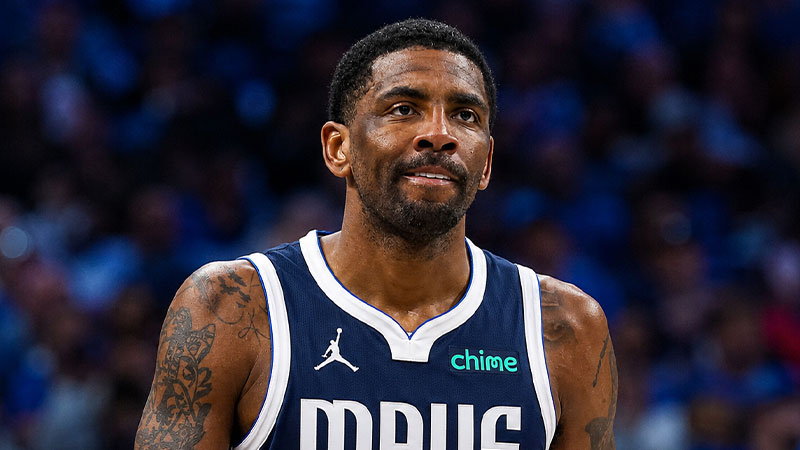
Kyrie Irving remains one of the most enigmatic figures in professional sports, a generational talent whose on-court brilliance is frequently eclipsed by a series of high-profile off-court controversies.
To understand the polarizing paradox he presents, one must navigate a complex web of cultural flashpoints, broken promises to fanbases, and a strictly guarded personal philosophy that often clashes with the mainstream media.
While his peers frequently laud him as a “pure hooper” with a “pure heart,” the public narrative is often dominated by frustration and animosity. This analysis explores the specific incidents and systemic behaviors that have fueled public ire.
The Social and Cultural Lightning Rod
The public’s frustration with Kyrie Irving is not merely about missed shots or losing games; it is deeply rooted in his involvement with sensitive cultural and social issues that resonated far beyond the basketball court.
His willingness to engage with “fringe beliefs” and conspiracy theories has made him a target for significant criticism from both fans and major organizations.
The 2022 Antisemitism Controversy
In late 2022, Irving faced intense backlash after tweeting a link to a documentary that contained heavy antisemitic tropes and Holocaust denial.
The situation escalated when he initially failed to apologize or unequivocally denounce antisemitism during subsequent media press conferences.
This led the Brooklyn Nets to declare him “unfit to be associated” with the team, resulting in a minimum five-game suspension.
The fallout was severe, leading to the termination of his lucrative partnership with Nike and a rejected donation to the Anti-Defamation League, which cited his lack of accountability at the time.
The Vaccine Mandate and Career Consequences
During the height of the COVID-19 pandemic, Irving became a prominent “vaccine holdout,” refusing to get vaccinated based on personal health choices.
This decision had massive professional ramifications, as New York City’s indoor vaccine mandates prevented him from playing in home games for the Brooklyn Nets during a significant portion of the 2021-2022 season.
Critics argued he abandoned his teammates and compromised a potential championship window for a team featuring superstars like Kevin Durant and James Harden.
Irving eventually admitted that his stance on the vaccine cost him roughly $100 million in potential earnings.
The Trail of Broken Promises and Team Instability
Beyond his personal beliefs, Irving’s reputation has been marred by what many perceive as a lack of loyalty and a history of messy departures from his NBA franchises.
Fans in multiple cities feel a sense of betrayal, viewing his tenure not as a partnership, but as a series of disruptions.
The “Villain” Narrative in Boston
Boston remains perhaps the most vocal epicenter of anti-Kyrie sentiment. In 2018, Irving famously told a stadium of Celtics fans that he planned to re-sign with the team long-term, only to leave for the Brooklyn Nets months later.
His tenure in Boston was further criticized for poor leadership, where he was accused of blaming younger players for losses and clashing with coaching staff.
The animosity reached a boiling point when, as an opponent, he intentionally stomped on the Celtics’ center-court logo after a playoff victory, an act many fans still consider unforgivable.
Forcing Trades and Franchise Collapses
Irving’s career is defined by a pattern of dismantling high-level rosters. In 2017, he requested a trade from the Cleveland Cavaliers to “step out of the shadow” of LeBron James, effectively ending a dynasty that had reached three consecutive NBA Finals.
Later, after building a “superteam” in Brooklyn with Kevin Durant, he demanded a trade in early 2023 following the vaccine drama and contract disputes.
This constant instability has led to him being labeled a “team killer” or a “cancer” by various media outlets, despite his undeniable skill.
The Peer Perspective: Why NBA Players Defend Him
While the media and fanbases often view Irving through a lens of chaos, a significant gap exists between public perception and the reality of the NBA locker room.
To many of his colleagues, Irving is a respected leader, a dedicated worker, and a supportive friend who is often mischaracterized by the “mainstream media wave”.
Public Perception vs. Locker Room Reality
| Aspect | Public/Media View | NBA Player View |
|---|---|---|
| Loyalty | Disloyal; “team killer” | Loyal to personal truth and teammates |
| Personality | “Fruity loop”; unstable | “Pure heart”; genuine; uplifting |
| Work Ethic | Distracted by off-court drama | Dedicated worker; first in the gym |
| Leadership | Blames others; creates friction | Shows love; gives props to peers |
The “Pure Heart” and Internal Professionalism
Players like Marcus Morris Sr., who spent two seasons with Irving in Boston, staunchly defend his character, stating that “his heart is pure” and that he never brought his outside drama into the locker room.
Despite the public fallout in Boston, Morris insists Irving showed up every day to work and was one of his favorite teammates.
Other peers, such as Donte DiVincenzo, highlight his humility, noting that Irving frequently goes out of his way to promote other players’ brands and “show love” to competitors across the league.
Maturity and Accountability with Peers
Irving’s relationship with Dennis Schröder provides a unique look at his personal growth. After a heated on-court altercation in Brooklyn where both were ejected, Irving sought out Schröder years later in Dallas to apologize.
He admitted he was “going through something at the time” and that his previous behavior did not reflect his true self. This act of vulnerability and accountability deeply moved Schröder, who now says he respects Irving both as a player and as a human being.
The Pure Hooper: Separating the Art from the Artist
For a segment of the basketball world, the answer to “why is everyone mad” is that people are focused on the wrong thing.
These “pure hoopers” argue that Irving’s basketball ability is so transcendent that it should be viewed as “pure art,” independent of his personal opinions or political stances.
- Generational Skillset: His ball-handling and prowess finishing around the backboard are considered among the best in NBA history, often compared to the shooting of Steph Curry or the passing of Rajon Rondo.
- Clutch Performance: He is the architect of one of the NBA’s most iconic moments—the game-winning three-pointer in the 2016 Finals that secured Cleveland’s first championship.
- Offensive Efficiency: Even during his most controversial seasons, his statistical output remained elite, often shooting over 50% from the field and 90% from the free-throw line.
- Global Influence: As a former vice-president of the NBPA, he has used his platform for numerous charitable donations and activism, even if those efforts are sometimes overshadowed by his “social miscues”.
Redemption in Dallas: A New Chapter
Since joining the Dallas Mavericks, the narrative around Irving has begun to shift. While some fans will “never forget or forgive,” others have noted a distinct lack of drama and a renewed focus on winning basketball.
Maturity and the Luka Dončić Partnership
In Dallas, Irving has successfully integrated himself as a secondary star alongside Luka Dončić, a pairing many skeptics thought would fail.
He has avoided the media-driven controversies that defined his time in Brooklyn and Boston, leading some to conclude that he has finally found a stable home.
Mavericks owner Mark Cuban has even stated that keeping Irving was the franchise’s “top priority,” signaling a level of organizational trust that Irving hadn’t enjoyed in years.
A Changing Public Sentiment
Recent discussions among fanbases, including the previously hostile Boston Celtics community, suggest a growing “peace” regarding Irving.
While many still disagree with his past actions, there is a burgeoning respect for his current mindset and his continued excellence on the court.
Some fans admit they are “over it,” preferring to focus on the current success of their own teams rather than dwelling on the “Kyrie saga”.
Frequently Asked Questions
Why did Nike drop Kyrie Irving?
Nike terminated its partnership with Irving following his promotion of an antisemitic documentary and his initial refusal to provide a clear apology for the incident.
How much money did Kyrie lose by not getting vaccinated?
Irving estimated that his decision to remain unvaccinated, which prevented him from playing home games in New York and impacted his contract negotiations, cost him approximately $100 million.
Why do Boston fans hate Kyrie more than other players who left?
The hate stems from a combination of a broken public promise to re-sign, his perceived lack of leadership during his tenure, and his subsequent “disrespectful” acts like stomping on the team logo.
What is Kyrie’s relationship with Luka Dončić like?
Despite initial doubts about their fit, Irving has embraced a protective and supportive role for Dončić, and the two have developed into one of the league’s most effective star pairings.
The Final Verdict on the Paradox
The anger directed at Kyrie Irving is a multifaceted phenomenon. For some, it is about the “unfit” nature of his public comments and the perceived harm they cause to marginalized communities.
For others, it is the frustration of a sports fan watching a brilliant talent disrupt team chemistry and championship hopes.
Yet, as he continues his career in Dallas, Irving remains a reminder of the difficulty in separating the “art” from the “artist”. Whether you view him as a “fruity loop” or a “basketball savant,” his impact on the game and the culture is undeniable.
As the vitriol of the past begins to fade for some, the legacy of Kyrie Irving will likely be defined by this very tension—the struggle between a man’s pursuit of his personal truth and the public’s demand for professional conformity.