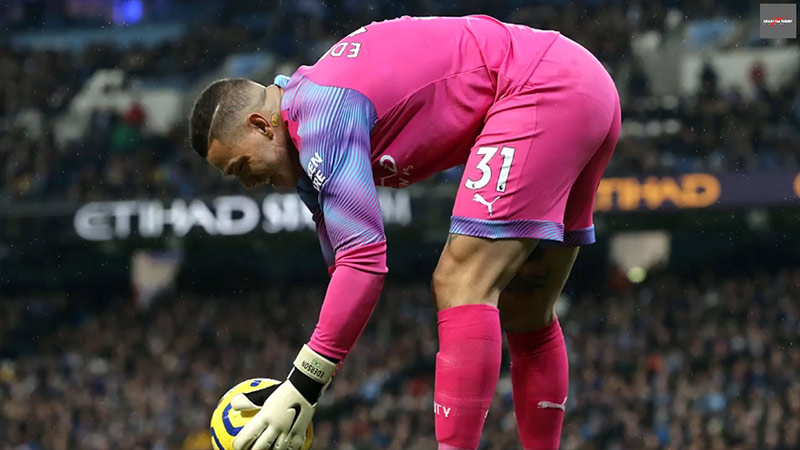
In the high-stakes world of elite football, certain numbers carry a weight that transcends the fabric of the jersey.
For goalkeepers, the number 1 is the ultimate symbol of being the “first choice,” a tradition rooted in the very origins of the sport.
Yet, one of the most revolutionary figures in modern goalkeeping, Ederson Santana de Moraes, has spent the peak of his career wearing the unconventional number 31.
This choice is not merely a random selection; it is a story of professionalism, tactical evolution, and a unique personal identity that has followed him from the Etihad Stadium to his new chapter at Fenerbahçe.
The Arrival: Why Number 31 at Manchester City?
When Ederson arrived at Manchester City from SL Benfica in 2017 for a then-staggering £36 million, the club was in the midst of a goalkeeping crisis.
Pep Guardiola’s debut season had been marred by the struggles of Claudio Bravo, who had been brought in to replace the legendary Joe Hart but failed to adapt to the Premier League’s physicality.
Despite being signed specifically to take over the starting role, Ederson did not take the number 1 shirt. At the time, Claudio Bravo already occupied the number 1 jersey.
In a world of massive egos, many might have expected the incoming “world-class” starter to demand the prestigious number, but Ederson chose a different path.
Ederson’s decision to take number 31 was rooted in mutual respect. Entering a new locker room and immediately stripping a veteran teammate of his squad number is often viewed as a “dick move” in football culture.
Instead, Ederson opted for #31, allowing Bravo to keep his number while Ederson set out to prove his worth on the pitch.
A Symbol of the “Anti-Traditional” Keeper
While most fans assumed Ederson would switch to #1 once Bravo eventually left or moved into a secondary role, the Brazilian stuck with #31 for his entire eight-season tenure in Manchester. This choice actually fits the aesthetic of his “goal-playmaker” style perfectly.
Football historians and critics often note that #31 is a mirrored image of #13, a number traditionally reserved for backup keepers.
By choosing a non-traditional number, Ederson visually signaled that he was not a traditional goalkeeper. He was a sweeper-keeper who functioned as an eleventh outfielder, a player whose left foot was more of a tactical weapon than a defensive tool.
The Historical Context: From 93 to 31
Ederson’s journey through squad numbers reveals a pattern of personal significance and situational adaptation:
- Rio Ave (Number 93): Early in his professional career in Portugal, Ederson wore number 93. This was a “birth year” choice, as he was born in 1993.
- SL Benfica (Number 1): After finding his feet and returning to Benfica in 2015, he eventually secured the number 1 shirt, cementing his status as the top choice for the Portuguese giants.
- Manchester City (Number 31): Upon moving to England in 2017, the availability of #1 was blocked by Bravo, leading to the birth of the #31 brand.
- Brazil National Team (Number 23): On the international stage, Ederson has frequently worn number 23. This is largely because the #1 shirt in the Brazilian squad has been firmly held by his long-time rival, Alisson Becker.
- Fenerbahçe (Number 31): Proving that the number had become part of his professional identity, Ederson chose to keep number 31 upon his 2025 transfer to the Turkish side Fenerbahçe.
Why Number 31 Matters in Sports Culture
Interestingly, numbers in the 30s have a deep-seated tradition in other sports, particularly ice hockey, where #30 and #31 are considered the “classic” goalie numbers.
In the early days of the NHL, backup goalies were often assigned numbers like 30 or 31 to give priority to outfield players on travel rosters.
In football, however, #31 is usually associated with youth prospects or third-choice keepers. For instance, at Wolverhampton Wanderers, the third-choice keeper traditionally wore #31.
By carrying this number as a world-class starter, Ederson helped redefine what a “starter’s number” looks like, making #31 synonymous with elite distribution and composure under pressure.
Tactical Revolution: The Playmaker in the #31 Shirt
The reason the world cares about Ederson’s number is because of the revolution he led while wearing it. Pep Guardiola famously remarked that “Ederson is the best with his feet”.
His ability to bypass an entire team’s high press with a “laser-guided” long kick changed how Premier League teams defended against Manchester City.
Key tactical highlights of his #31 era include:
- The Guinness World Record: He once held the record for the longest dropkick at 75.35 meters.
- The Assist King: In the 2024-25 season, he recorded the most assists for a Premier League goalkeeper, often finding Erling Haaland with pinpoint accuracy.
- The Penalty Kicker: Ederson’s confidence with his feet was so high that he even stepped up as the fifth kicker in a high-pressure Champions League penalty shootout against Real Madrid, scoring a perfect shot into the corner.
Personal Quirks and the Man Behind the Number
Beyond his tactical genius, Ederson is known for several eccentricities that match his unconventional choice of jersey number.
- The Boxers Superstition: In a candid interview, Ederson revealed that he has worn the same pair of matchday boxers for eight years as a ritual.
- “Gordo,” the Chubby Child: Despite his lean and athletic build today, his childhood nickname was “Gordo” (Chubby), a name he still loves because it reminds him of his roots in Osasco, Brazil.
- The “Happy” Tattoo: Among his many tattoos is a distinct “happy” smile on his neck, which he says represents his personality as a happy person.
- The Lazy Left-Back: His move to goalkeeping was born out of convenience; he originally played left-back but admitted he was “too lazy” to run back and defend, leading his coach to put him in goal.
Conclusion: A Legacy Defined by More Than a Number
Whether he is referred to by his critics as “Tyranno” due to his perceived short reach or hailed as the “GOAT” of sweeper-keepers by his fans, Ederson’s legacy is inextricably linked to the number 31.
He arrived at Manchester City as a relatively unknown prospect from Portugal and left as a six-time Premier League champion and Champions League winner, having turned an obscure squad number into a symbol of tactical excellence.
As he continues his career at Fenerbahçe, the #31 jersey serves as a reminder that in modern football, it’s not the number that makes the player, but the player who makes the number legendary.
Would you like me to create a set of flashcards focusing on Ederson’s career milestones and personal records?