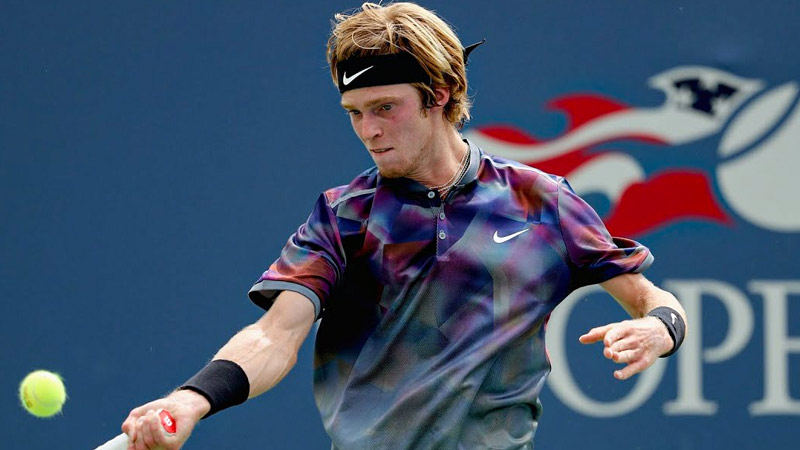
Andrey Rublev is famous for being a world-class Russian tennis professional and an elite fixture on the ATP Tour, currently holding 18 singles titles and a career-high ranking of World No. 5.
He is widely recognized for his hyper-aggressive baseline play, devastating forehand, and signature “Bweh!” grunt.
Beyond his athletic prowess, he is celebrated for his raw emotional transparency on court and his contrasting gentle, philanthropic personality off-court, notably through his “Rublo” charity clothing line.
Additionally, he shares his name with the legendary 15th-century icon painter, Saint Andrey Rublev, whose spiritual masterpieces revolutionized religious art.
What Are Andrey Rublev’s Most Significant Tennis Achievements?
The modern athlete has established himself as one of the most consistent and formidable competitors in professional sports, amassing a resume that places him among the global elite.
His journey is marked by a steady ascent in the rankings and a collection of prestigious trophies that highlight his ability to perform on various surfaces and in high-pressure team environments.
| Achievement Category | Details and Specific Honors |
|---|---|
| ATP Singles Titles | 18 career titles, including the 2026 Nordea Open in Bastad. |
| Masters 1000 Success | Champion at the 2023 Monte-Carlo Masters and the 2024 Madrid Open. |
| Olympic Achievement | Mixed doubles gold medal at the 2020 Tokyo Olympics with Pavlyuchenkova. |
| Team Competitions | Lead Russia to the 2021 Davis Cup victory; named tournament MVP. |
| Career-High Ranking | Achieved a peak position of World No. 5 on the ATP Tour. |
| Grand Slam Consistency | Reached the quarterfinals of all four Grand Slam tournaments. |
The “Bweh” and the Forehand: What Is His Trademark Style?
To understand why this athlete is so captivating to watch, one must look at the sheer intensity he brings to every point during a match. His approach to the game is uncompromising, focusing on overwhelming opponents with raw power and a high-risk strategy that leaves little room for error. This technical brilliance is accompanied by a unique vocalization that has become a recognizable part of his brand on the global stage.
High-Intensity Baseline Power and Heavy Forehands
The core of his game revolves around a hyper-aggressive baseline strategy that utilizes some of the hardest ball-striking seen in the modern era. He is famous for hitting the ball flat and lightning-fast, rarely opting for a defensive position.
His forehand is widely considered one of the heaviest and most devastating weapons in the sport, allowing him to dictate rallies and push opponents far behind the baseline.
This aggressive style requires immense physical effort and a commitment to maximum power on nearly every shot, making his matches a spectacle of high-velocity athleticism.
The Iconic “Bweh!” Grunt and Audio Identity
In addition to his physical power, he is universally recognized for his distinct vocalization during play. Every time he strikes a ball with maximum effort, he emits a loud, unique sound that fans and commentators have transcribed as “Bweh!”.
This grunt has become a beloved part of his identity, symbolizing the total exertion he pours into his craft. It serves as an auditory signature that differentiates him from other players, making his presence on the court unmistakable even from a distance.
Understanding the Andrey Rublev “Quarterfinal Curse”
Despite his immense success and consistency at the highest levels of the sport, there is a specific statistical anomaly that has defined a large part of his career narrative.
This recurring theme has become a point of major discussion among analysts and fans, as it highlights the thin margins between being a top-tier player and a Grand Slam champion.
A Record-Breaking Run of Ten Major Quarterfinals
One of the most famous, albeit frustrating, aspects of his career is the “Quarterfinal Curse”. He has achieved the rare and impressive feat of reaching the quarterfinals in all four Grand Slam tournaments—the Australian Open, Roland Garros, Wimbledon, and the US Open.
In total, he has reached this deep stage of a Major ten different times. This level of consistency proves he is a permanent fixture in the second week of the world’s most important tournaments, demonstrating his elite status and longevity.
The Mental and Physical Barrier to the Semifinals
The “curse” refers to the fact that, despite these ten appearances, he has never managed to progress past the quarterfinal stage into a Grand Slam semifinal. This recurring roadblock has become a significant psychological and professional hurdle.
Each loss at this stage adds to the narrative of his struggle to break through the glass ceiling of the sport’s four biggest events.
Overcoming this barrier remains one of the primary goals of his career as he looks to solidify his place among the legends of the game.
On-Court Fury vs. Off-Court Kindness: The Dual Personality
Perhaps nothing makes him more famous than the startling contrast between his behavior during a match and his personality once the competition ends.
He possesses a dual nature that is rarely seen in professional athletics, moving from extreme volatility to profound gentleness within minutes of a match concluding.
Explosive Volatility and Emotional Rawness
During the heat of competition, he is infamous for wearing his heart on his sleeve and losing his temper under intense pressure.
His on-court volatility often manifests in self-harmful ways; he frequently smashes his racket into his own knees until they bleed, cries out in frustration, or yells toward his player’s box.
This raw emotional display shows a man deeply affected by the stakes of the game, unable to hide his internal turmoil when things go wrong.
This vulnerability, while sometimes difficult to watch, has created a deep connection with fans who appreciate his lack of a “filter”.
The Most Liked Player in the Locker Room
In a complete reversal of his on-court persona, he is widely regarded as one of the kindest and most humble individuals on the tour. He is a self-deprecating figure who is universally liked by his peers and the tennis community.
Fans appreciate him for his honesty regarding his mental health struggles and his extreme generosity during autograph sessions.
This off-court demeanor has earned him the affectionate nickname “Ruble,” and he is often cited as a favorite among other professional players for his gentle spirit and approachability.
The Rublo Initiative and Mental Health Advocacy
His influence extends far beyond the white lines of the tennis court, as he has utilized his platform to address serious social and personal issues. By turning his own internal battles into a public mission, he has provided hope and support to a global audience.
Transforming Personal Struggles into the ARborn Brand
He launched his own independent clothing line, originally called Rublo and later evolving into the collaborative project ARborn. This project was not merely a fashion endeavor but a direct manifestation of his personal battles with depression and existentialism.
By being open about his mental health, he has challenged the traditional image of the stoic athlete. The clothing line serves as a creative outlet for his thoughts, allowing him to communicate complex emotions to a world that often only sees his athletic performance.
Social Mission: Supporting Children’s Charities Globally
The brand is built on a foundation of profound altruism, centered around the slogan “Play for the kids, play for the light”. This mission is intended to provide hope for those who feel trapped in darkness, reflecting his own journey toward finding peace.
Demonstrating his commitment to this cause, he famously declared that 100% of the profits from his inaugural collections would be donated to children’s charities around the globe.
This act of selflessness has significantly boosted his reputation as a socially conscious athlete who prioritizes the well-being of others over personal gain.
Who Was the Original Andrey Rublev, The Icon Painter?
While the modern star is a household name in sports, he shares his moniker with one of the most important figures in the history of art.
The historical master’s work remains a cornerstone of cultural heritage, representing a different kind of intensity—one focused on spiritual peace and divine harmony.
The “Trinity” and the Softening of Byzantine Art
The 15th-century painter, Saint Andrey Rublev, is famous for being the greatest medieval Russian painter of Orthodox Christian icons.
His magnum opus, the “Trinity” icon, is a masterpiece of world art revered for its perfect geometric harmony and profound spiritual depth. Before his influence, traditional art in this style was often stern and severe.
He revolutionized the medium by introducing “human warmth,” gentleness, and a serene peace that gave holy figures a comforting, introspective quality. This shift toward emotional warmth in religious art is his most enduring legacy.
Historical Legacy, Sainthood, and Cinematic Impact
The painter’s influence was so significant that the Russian Orthodox Church officially canonized him as a saint in 1988. His life, though somewhat enigmatic, inspired the 1966 cinematic masterpiece Andrei Rublev, directed by the legendary Andrei Tarkovsky.
This film is widely considered one of the greatest movies ever made, detailing the struggles of an artist trying to maintain his creative spirit during a turbulent and violent period in history.
Thus, the name carries a weight of artistic and spiritual brilliance that spans over six centuries.
Frequently Asked Questions about Andrey Rublev
How many ATP titles does Andrey Rublev have?
As of his most recent victory in 2026, he has captured 18 ATP Tour singles titles.
What is the “Bweh” sound he makes?
It is his unique, high-effort grunt that occurs when he hits his signature heavy forehand.
What is the story behind his clothing brand?
The brand, known as Rublo or ARborn, focuses on mental health awareness and donates 100% of inaugural profits to children’s charities.
Is he related to the famous painter?
No, they simply share the same name. However, the painter’s legacy of “gentle peace” is often contrasted with the tennis player’s “on-court fury”.
Has he ever won an Olympic medal?
Yes, he won the mixed doubles gold medal at the 2020 Tokyo Olympics.
Does he have any hobbies outside of tennis?
In his downtime, he produces electronic dance music and is inspired by artists like Martin Garrix and Alan Walker.
Conclusion
Andrey Rublev is a man of remarkable depth, defined by his record-breaking consistency on the ATP Tour, his revolutionary approach to athlete-led philanthropy, and a name that ties him to the very peak of historical art.
Whether he is striking a ball with unparalleled ferocity or advocating for global mental health through his Rublo brand, his impact on the world is undeniable.
As he continues to chase his first Grand Slam semifinal and look beyond the “Quarterfinal Curse,” his legacy as both a fierce competitor and a kind-hearted human being is already firmly established.