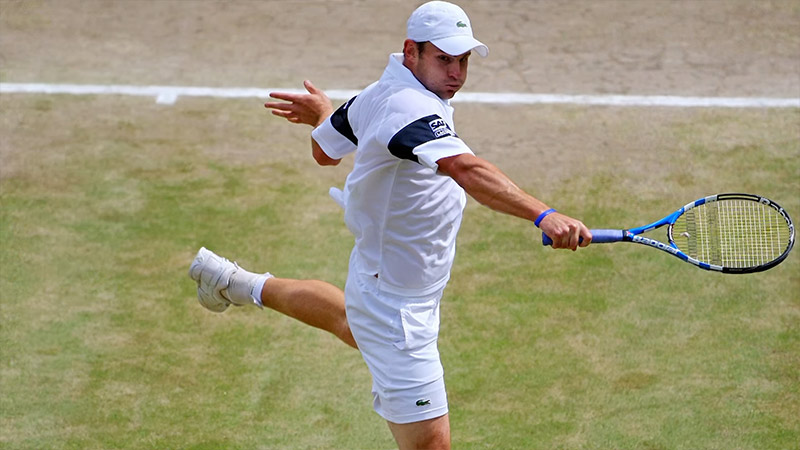
Andy Roddick won the 2003 US Open by utilizing a record-breaking serve and exceptional mental resilience. Entering the tournament as the fourth seed, he capitalized on a dominant hard-court season to navigate a challenging 128-player draw.
His journey included a miraculous five-set comeback in the semifinals against David Nalbandian, where he saved a match point while trailing by two sets.
In the final, Roddick overwhelmed Juan Carlos Ferrero in straight sets, firing 23 aces to secure his only Major title. This victory remains the last time an American man won a Grand Slam singles championship, marking a historic era.
The Strategic Foundation of Roddick’s Championship Run
Before the first ball was struck at Flushing Meadows, the architectural framework of Roddick’s success was built through a summer of unprecedented dominance on North American hard courts.
His preparation was not merely about hitting balls but establishing a psychological edge over the entire field.
Mastering the Hard-Court Season
Leading into the season’s final major, the 21-year-old American was in peak physical condition and playing the most clinical tennis of his life.
He entered the US Open having won 20 of his previous 21 matches, a streak that included capturing back-to-back titles at the Canada Open and the Cincinnati Masters.
This momentum provided him with the “Summer Slam” foundation, a rare feat that only one other man in the Open Era had achieved prior to his run.
By winning these high-stakes lead-up tournaments, he forced opponents to second-guess their defensive strategies before they even stepped onto the court.
Physical Conditioning and Seed Placement
As the No. 4 seed, Roddick was positioned perfectly to avoid the top-ranked threats until the deep stages of the tournament.
His physical readiness allowed him to maintain the high-velocity output required for his signature 140+ mph serve throughout the two-week fortnight.
Unlike many of his peers who struggled with the humidity and grueling schedule of New York in late August, Roddick’s fitness levels ensured that his explosive baseline forehand remained a weapon even in the fifth hour of a match.
This combination of seeding and stamina made him the prohibitive favorite among local fans and analysts alike.
Detailed Round-by-Round Breakdown of the 2003 US Open
The path to a Major title is a marathon of attrition, requiring a player to win seven consecutive matches against diverse playing styles. Roddick’s journey through the 128-player draw was a mix of clinical efficiency and high-pressure survival.
| Round | Opponent | Result | Key Highlight |
|---|---|---|---|
| Round 1 | Tim Henman | 6-3, 7-6, 6-3 | Defeated the British veteran in straight sets to set the tone. |
| Round 2 | Ivan Ljubičić | 4-6, 6-3, 6-4, 6-4 | Overcame a one-set deficit against a powerful server. |
| Round 3 | Flavio Saretta | 6-1, 6-3, 6-3 | A routine victory that allowed for physical recovery. |
| Round 4 | Xavier Malisse | 6-3, 6-4, 7-6 | Demonstrated tiebreak composure to finish in three sets. |
| Quarterfinals | Sjeng Schalken | 6-4, 6-2, 6-3 | Clinical dominance to reach the final four without significant fatigue. |
| Semifinals | David Nalbandian | 6-7, 3-6, 7-6, 6-1, 6-3 | Miraculously saved a match point to win in five sets. |
| Final | Juan Carlos Ferrero | 6-3, 7-6, 6-3 | Blasted 23 aces to secure the championship in 102 minutes. |
How Did Andy Roddick Overcome David Nalbandian?
The semifinal match against David Nalbandian is often cited as the defining moment of Roddick’s career. It was a test of character that pushed the young American to the absolute brink of elimination in front of a capacity crowd at Arthur Ashe Stadium.
The Third Set Tiebreak Miracle
Facing the crafty Argentinian, Roddick found himself in a dire situation, falling behind two sets to none and eventually facing a match point in the third-set tiebreak.
At that moment, the championship appeared to be slipping away, as Nalbandian’s superior counter-punching seemed to have neutralized Roddick’s power game.
However, Roddick exhibited massive mental resilience, saving the match point with aggressive play that shifted the psychological weight of the contest. This single point acted as a catalyst, deflating Nalbandian’s confidence while energizing the New York crowd.
Psychological Warfare and Momentum Shifts
Once the third set was secured, the momentum shifted entirely in favor of the American. Roddick’s serve became an unreturnable force, and he began to dictate play from the baseline with his heavy forehand.
He dominated the final two sets 6-1 and 6-3, completing an epic comeback that lasted five sets. This victory was not just a statistical win but a statement of intent, proving that he could win even when his primary weapons were being challenged.
By the time he reached the final, he was playing with a sense of destiny that few players could match.
Technical Breakdown: The US Open Final vs. Ferrero
The final match against Juan Carlos Ferrero was a stark contrast to the grueling semifinal. It was a display of pure, unadulterated power that left the Spaniard with few answers and even fewer opportunities to break serve.
The Impact of the 140+ MPH Serve
In the final, Roddick’s serve was the ultimate equalizer. He blasted 23 aces past Ferrero, often clocking speeds in excess of 140 mph.
This serving performance allowed him to hold his service games with ease, putting immense pressure on Ferrero to be perfect on his own delivery.
The sheer velocity of the ball made it difficult for the Spaniard to establish any rhythm from the baseline, which was the core of his defensive game.
By minimizing the length of service points, Roddick kept his energy levels high and his focus sharp throughout the 102-minute encounter.
Dismantling Juan Carlos Ferrero in Record Time
Roddick completely dominated the final, winning 6-3, 7-6, 6-3. While the second set was competitive and required a tiebreak, Roddick’s ability to find his best tennis during the biggest points was the difference-maker.
He dismantled the Spaniard’s defense with an aggressive baseline strategy that complimented his serving prowess.
The victory was so comprehensive that it took just 1 hour and 42 minutes to complete, a remarkably short duration for a Grand Slam final. This efficiency was the culmination of the “Summer Slam” form he had carried since his victories in Canada and Cincinnati.
Why is the 2003 Victory Called the “Summer Slam”?
The term “Summer Slam” refers to a specific and grueling achievement within the professional tennis circuit that requires sustained excellence across the most prestigious hard-court tournaments in North America. Roddick’s 2003 season is the gold standard for this feat.
Joining Patrick Rafter in the History Books
By capturing the Canada Masters, the Cincinnati Masters, and the US Open in the same season, Roddick became only the second man in the Open Era to complete this prestigious hard-court sweep.
The only other player to achieve this was Patrick Rafter, highlighting the immense difficulty of maintaining such a high level of play over several weeks of intense competition.
This achievement solidified Roddick’s status as a hard-court specialist whose game was perfectly tuned for the high-bounce and fast-paced conditions of the North American summer swing.
The Journey to the World Number One Ranking
The points accumulated during this historic run had a transformative impact on the world rankings. On November 3, 2003, the US Open triumph officially propelled Roddick to the World No. 1 spot.
At the time, he was the youngest American man to ever hold the top position, a record that underscored his role as the successor to the legendary generation of Pete Sampras and Andre Agassi.
This ascension to the top of the rankings was the ultimate validation of his “Summer Slam” performance, marking the peak of his professional career.
The Rivalry with Roger Federer and Future Finals
While 2003 was a year of triumph, the subsequent years of Roddick’s career were defined by his recurring encounters with Roger Federer. These matchups often took place on the sport’s biggest stages, leading to several “near misses” for the American star.
The 2009 Wimbledon Heartbreak
Roddick reached four other Grand Slam finals during his career, but he fell to his primary rival, Roger Federer, in every single one of them. Perhaps the most agonizing of these defeats occurred at the 2009 Wimbledon final.
In a match of incredible margins, Roddick broke Federer’s serve only once but still fought his way into a fifth set. That final set turned into a legendary marathon, eventually ending 16-14 in favor of the Swiss maestro after 30 games in the decider.
Despite his loss, the match is remembered as one of the greatest displays of serving and resilience in tennis history.
The Defensive Wall of Federer
Beyond Wimbledon, Roddick also faced Federer in the 2006 US Open final and two other Wimbledon finals in 2004 and 2005. In each instance, Federer’s ability to neutralize Roddick’s 140+ mph serve with world-class returns proved to be the deciding factor.
While Roddick remained a top-tier player for nearly a decade, his championship tally was undoubtedly limited by the presence of arguably the greatest grass-court player of all time.
Nevertheless, his consistency in reaching these finals cemented his reputation as one of the most reliable performers of his generation.
What Defines the Legacy of the Last American Champion?
As the years pass, the significance of Roddick’s 2003 victory continues to grow within the context of American sports history. It represents both a high-water mark for the nation’s tennis program and a lingering point of reflection for fans.
The Historic American Drought
Over two decades have passed since Roddick lifted the trophy at Flushing Meadows, and his 2003 triumph remains the last time an American man won a Grand Slam singles title.
This drought has created a unique legacy for Roddick; he is not just a former champion, but the current keeper of the flame for American men’s tennis.
His victory serves as a reminder of an era when American power-tennis sat at the pinnacle of the global game, and it provides a benchmark for the new generation of players currently climbing the rankings.
Frequently Asked Questions About Roddick’s Career
How many Grand Slam titles did Andy Roddick win?
Andy Roddick won exactly one Grand Slam singles title in his career, which was the 2003 US Open.
Who did Roddick beat in the 2003 US Open final?
He defeated Spain’s Juan Carlos Ferrero in straight sets, with a final score of 6-3, 7-6, 6-3.
What was the fastest serve Andy Roddick hit during his prime?
Roddick was famous for his signature blistering serve, which frequently exceeded 140+ mph.
How many times did Roddick reach a Grand Slam final?
He reached a total of five Grand Slam finals. He won the 2003 US Open and finished as the runner-up in four others (Wimbledon 2004, 2005, 2009, and the US Open 2006).
Who was Andy Roddick’s biggest rival?
His primary career rival was Roger Federer, who defeated him in all four of the other Grand Slam finals he reached.
When did Andy Roddick become World No. 1?
He reached the World No. 1 ranking on November 3, 2003, following his successful summer campaign.