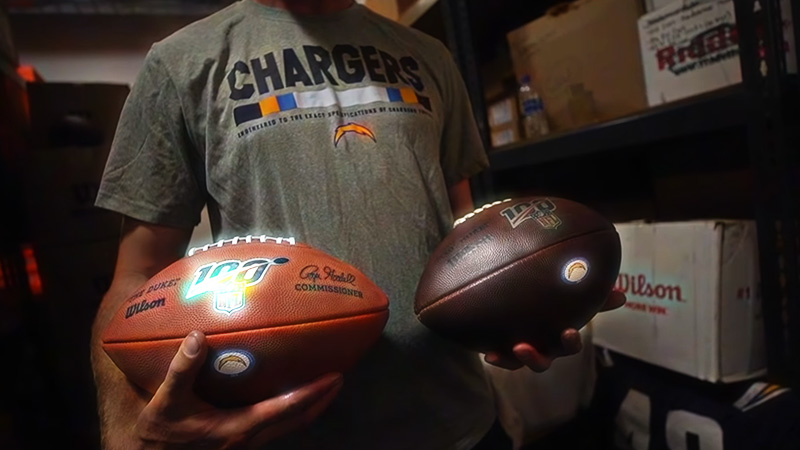
The visual identity of professional football is defined by precision, high-stakes performance, and a meticulously curated brand image.
To the casual observer, the most recognizable tool of the trade—the football—is simply a prolate spheroid of leather.
However, for those who analyze the game at the highest level, the absence of two white stripes on the National Football League (NFL) ball is a calculated decision rooted in technological advancement, ergonomic necessity, and strategic brand differentiation.
While high school and collegiate programs continue to utilize footballs featuring prominent white stripes, the NFL has moved toward a “clean” design.
This transition was not an overnight aesthetic whim; it was a response to the evolving environment of the professional game.
Understanding why the NFL ball looks different requires a deep dive into the history of stadium infrastructure, the physics of player performance, and the psychological impact of professional branding.
The Technological Catalyst: The Evolution of Stadium Illumination
In the early decades of organized football, the game was largely a daytime affair. As the sport grew in popularity and began moving into the evening “prime time” slots to accommodate larger audiences, leagues faced a significant hurdle: visibility.
Early stadium lighting systems were rudimentary, often leaving dark pockets on the field and creating deep shadows that made tracking a brown leather ball nearly impossible for players and spectators alike.
To solve this, white stripes were added to the ends of the footballs. These stripes functioned as high-contrast visual aids, allowing players to track the rotation and trajectory of the ball against the dim, poorly lit backdrops of 1930s and 40s stadiums.
The stripes provided a “flicker” effect during a spiral, which helped receivers judge the speed of the incoming pass.
However, the rapid advancement of stadium lighting technology eventually rendered these visual aids obsolete.
Modern professional venues utilize sophisticated LED arrays and high-intensity discharge lamps that provide uniform, daylight-quality illumination across every square inch of the playing surface. In this high-clarity environment, the extra help provided by white stripes became unnecessary.
As the professional game transitioned into the era of high-definition broadcasting, the focus shifted from basic visibility to the refined aesthetics of the “pro” game.
The Ergonomic Imperative: Grip, Texture, and Quarterback Performance
While visibility was a primary driver for the initial inclusion of stripes, the physical mechanics of the game eventually dictated their removal.
In the NFL, where the margin between a touchdown and an interception is measured in millimeters, the “feel” of the ball is paramount.
Professional footballs are crafted from high-quality, raw pebbled leather, specifically selected for its natural tackiness and durability.
To add white stripes to a ball, manufacturers must apply a layer of paint or synthetic material over this leather.
Historically, players—particularly quarterbacks—noted that these painted areas were significantly slicker than the natural hide.
The friction coefficient of painted leather is lower than that of the raw, pebbled surface. For a quarterback attempting to deliver a high-velocity pass, any inconsistency in the ball’s surface can lead to a slip.
By removing the paint, the league ensured a more consistent grip across the entire surface of the ball, allowing for better control during throwing and catching.
This change was an essential evolution for a league that was increasingly moving toward a pass-heavy offensive strategy where the grip of the ball could determine the outcome of a championship.
Strategic Brand Differentiation: The Professional Aesthetic
Beyond the practical applications of lighting and grip, the removal of the white stripes served a powerful marketing purpose.
The NFL has always sought to position itself as the pinnacle of the sport, a level of play that is distinct from and superior to all amateur ranks.
By intentionally removing the stripes, the NFL created a unique look that visually separated the professional game from college and high school football.
This “clean design” has become a hallmark of the NFL’s brand identity. When a fan sees a football without stripes, they immediately associate it with the professional standard.
This differentiation is crucial for brand architecture. In a marketplace where consumer attention is fragmented, having a distinct “hero product” that looks fundamentally different from its amateur counterparts reinforces the league’s status.
The stripeless ball, often referred to as “The Duke,” represents a professional standard of excellence and a departure from the “Saturday afternoon” feel of collegiate athletics.
Comparative Analysis: NFL vs. NCAA Standards
The divergence between the NFL and the NCAA regarding football design highlights different priorities within the two organizations.
While the NFL prioritizes a uniform, professional aesthetic and optimized grip for elite athletes, the NCAA maintains the stripes for reasons that are both traditional and practical for the college level.
- Visibility in Varied Environments: Unlike the NFL, which plays in highly regulated, state-of-the-art stadiums, college football is played in a wide variety of environments. From massive 100,000-seat arenas to smaller, older facilities with aging lighting systems, the white stripes still serve as a functional tool for visibility in the collegiate ranks.
- The “College” Identity: Just as the NFL uses the lack of stripes to signal professionalism, the NCAA uses the stripes to signal the tradition of amateur sports. The striped ball is synonymous with the pageantry and history of Saturday football.
- Developmental Consistency: For younger players in high school and college, the visual feedback provided by the rotation of the stripes is often viewed as a developmental aid for both passers and receivers.
The Manufacturing Process: Why “Raw” Leather Wins
The NFL’s commitment to the stripeless ball is further supported by the specialized manufacturing processes used by providers like Wilson. The leather used for these balls undergoes a specific curing and tanning process that enhances its natural “tack.”
When stripes are painted onto this leather, it disrupts the natural pores and texture of the hide. In professional play, balls are often “prepped” by equipment managers who use brushes and specific conditioners to bring out the natural oils in the leather, increasing the grip. Painting over this leather would effectively nullify these preparation efforts.
By maintaining a 100% pebbled leather surface, the NFL allows its players to maximize the utility of the material.
Conclusion: The Future of Football Design
The evolution of the NFL football from a striped utility object to a clean, professional icon is a testament to the league’s focus on performance and brand identity.
What began as a response to poor stadium lighting evolved into an ergonomic improvement for players and a strategic move for the league’s image.
As we look toward the future, the design of the football will likely continue to be influenced by technology. While the stripes may never return to the professional game, we may see the integration of sensors and smart-tracking technology embedded within the leather.
However, the core identity of the ball—the raw, pebbled leather and the stripeless, professional silhouette—is likely to remain the gold standard for the foreseeable future. The “clean design” isn’t just about looks; it’s about the pursuit of a perfect game where technology and tradition meet on the 50-yard line.
For organizations looking to understand how to balance legacy with innovation, the NFL’s approach to the football serves as a primary case study. It proves that sometimes, the most effective way to move forward is to strip away the unnecessary and focus on the raw elements that drive excellence.