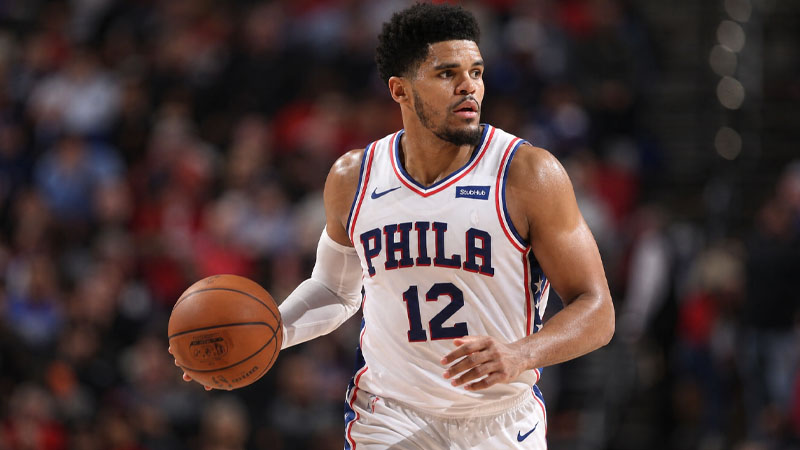
Tobias Harris earned his five-year, $180 million max contract through a unique alignment of asset retention, salary cap logistics, and market leverage.
In 2019, the Philadelphia 76ers faced a critical juncture: they had traded significant assets to acquire him and operated over the cap, meaning they could not replace his 20 PPG production if he walked.
By utilizing Bird rights, the team secured a durable, high-efficiency wing during a period of high demand.
While his accolades differ from traditional superstars, his deal was a calculated necessity to maintain a championship-caliber roster around Joel Embiid and preserve team value.
Why Did Tobias Harris Get a Max Contract?
Understanding why a player without an All-Star nod receives a max deal requires looking beyond basic box scores and into the complex world of professional basketball economics.
The market for high-level talent is rarely a vacuum; instead, it is driven by supply, demand, and the specific logistical constraints of the salary cap.
In the case of the 2019 offseason, several external factors converged to create a “perfect storm” that made a near-max offer the only logical move for the Philadelphia front office.
| Key Factor | Impact on Contract Negotiation |
|---|---|
| Asset Retention | Philly traded Landry Shamet and two first-round picks to get him; they couldn’t lose him for nothing. |
| Cap Logistics | The team was already over the cap; letting him walk didn’t create $30M in spendable space. |
| Market Competition | Teams like the Brooklyn Nets and Dallas Mavericks were prepared to offer a four-year max. |
| Positional Scarcity | High-efficiency 6’8″ wings who can shoot 40%+ from three are rare and expensive. |
The Financial Mechanics of Asset Retention
One of the most significant factors in the negotiation was the concept of maintaining team value. When a franchise invests heavily in a trade to acquire a player, that player gains immense leverage during the following free agency period.
The Cost of the Acquisition
The Philadelphia 76ers surrendered a substantial package to the LA Clippers at the 2019 trade deadline to secure Harris. This package included a promising young shooter in Landry Shamet and two valuable first-round draft picks.
Had the front office allowed Harris to sign elsewhere just months later, the trade would have been viewed as a catastrophic mismanagement of assets.
This “sunk cost” forced the team to prioritize his signature at almost any price to ensure the trade wasn’t a total loss of draft capital.
Bird Rights and Negotiating Leverage
Because Philadelphia held Harris’s Bird rights, they possessed a unique advantage that other suitors did not: the ability to offer a fifth year on the contract and higher annual raises.
This legal mechanism within the league’s collective bargaining agreement allowed the 76ers to outbid the market while technically operating above the salary cap.
Harris and his representation were fully aware of this leverage, knowing the team had no viable path to replacing his production if they let him walk.
How Did Salary Cap Logistics Force Philadelphia’s Hand?
The 2019 offseason was a unique window for the 76ers, where “cap math” dictated their decisions more than individual Player Efficiency Ratings (PER).
Fans often wonder why the team didn’t just sign a different star with that money, but the reality of the cap made that impossible.
The Looming Simmons Extension
The timing of the deal was critical because Ben Simmons was approaching his rookie scale extension. Once Simmons’s new, expensive contract kicked in the following year, the 76ers would have virtually zero cap space to sign external free agents.
The 2019 window was effectively the last time the franchise could “go over the cap” to retain their own talent before their flexibility vanished entirely. Signing Harris was a “now or never” proposition for a team with championship aspirations.
The Empty Space Fallacy
A common misconception among the public is that letting a $30 million player walk away automatically results in $30 million of spending money for someone else.
However, since Philadelphia was already operating over the salary cap, letting Harris leave would not have generated a corresponding amount of usable cap space.
The choice wasn’t between Harris and another superstar; it was between overpaying to keep an efficient 20 PPG scorer or losing him and being forced to fill his spot with a player on a minimum contract.
Supply, Demand, and the “Jimmy Butler” Effect
Free agency is rarely a series of isolated events; the decisions of one standout often trigger the payday of another. The volatility of the 2019 market played directly into the hands of Harris and his management team.
- The Departure of Jimmy Butler: During the same free agency period, Jimmy Butler chose to leave Philadelphia via a sign-and-trade to the Miami Heat. Losing both high-level starters in a single summer would have decimated the roster surrounding Joel Embiid.
- Urgent Priority: With Butler gone, securing Harris became an emergency priority for the front office to remain competitive in the Eastern Conference.
- Outside Suitors: While elite stars like Kevin Durant and Kawhi Leonard were the primary targets for teams with cap space, franchises like the Kings and Mavericks pivoted aggressively toward Harris once the top-tier options were off the board.
- Multiple Max Offers: It is reported that several teams were prepared to offer Harris a four-year max contract, which forced Philadelphia to put a five-year deal on the table to win the sweepstakes.
Is Tobias Harris Actually a Top-Tier Player?
While the “max” label carries the weight of superstar expectations, Harris provided a reliable, elite baseline of production that front offices value more than the general public might acknowledge.
His statistical profile leading up to the deal was that of a borderline All-Star in his physical prime.
Three-Level Scoring and Versatility
Prior to his arrival in Philadelphia, Harris was playing the most efficient basketball of his career with the Clippers, averaging 20.9 points and 7.8 rebounds per game. He was shooting an elite 43.4% from beyond the arc, proving he could thrive as a spacing threat.
His 6’8″ frame allowed him to toggle between forward positions, making him a versatile tool for modern defensive and offensive schemes.
The Best Ability is Availability
One of the most overlooked aspects of the Harris contract was his remarkable durability. In a league where star players frequently miss significant time for “load management” or recurring injuries, Harris was a constant presence on the floor.
For a team like the 76ers, which already dealt with the frequent absences of Joel Embiid, having a reliable, durable scorer like Harris was an insurance policy the front office was willing to pay for.
Tracking the Most Lucrative Non-Star Career
The contract signed in 2019 is just one chapter in what has become the most financially successful career for a player without an All-Star selection.
By consistently positioning himself as a high-floor, reliable starter, Harris has maximized his earnings across four different franchises.
| Year Signed | Contract Phase | Team | Terms | Total Value |
|---|---|---|---|---|
| 2011 | Rookie Scale | Milwaukee/Orlando | 4 Years | $6.8 Million |
| 2015 | Veteran Extension | Orlando Magic | 4 Years | $64 Million |
| 2019 | Near-Max Veteran | Philadelphia 76ers | 5 Years | $180 Million |
| 2024 | Veteran Free Agent | Detroit Pistons | 2 Years | $52 Million |
This career trajectory has allowed Harris to surpass the $300 million milestone in total earnings. His peak annual compensation reached $39.2 million in the final year of his Philadelphia deal, highlighting the massive inflation of NBA salaries over the last decade.
Frequently Asked Questions
Has any other player earned this much without an All-Star nod?
No. Tobias Harris holds the record for the highest career earnings in NBA history for a player who has never been selected for an All-Star Game.
This is largely due to his ability to hit free agency at the right times and maintain a high level of efficiency that appeals to teams in need of veteran leadership and scoring.
What is his current status in the league?
After his five-year deal in Philadelphia concluded, Harris returned to the Detroit Pistons on a two-year, $52 million contract. He was brought in to serve as a locker room leader and a stabilizing veteran presence for a young, rebuilding roster.
Even at this stage of his career, he remains a highly valued asset, earning an average of $26 million per season.
Why didn’t Philadelphia trade him sooner if the contract was high?
Because of the salary cap logistics mentioned earlier, trading a max contract is difficult unless you are taking back similar salary.
For most of his tenure in Philly, the team was trying to win immediately, and there were few available trades that would have objectively improved the team more than keeping a 20 PPG scorer who knew the system.
Conclusion: The Reality of Market-Driven Value
The Tobias Harris saga serves as a masterclass in NBA market logic. It demonstrates that a “max contract” is not always a reward for being one of the ten best players in the world; often, it is a tool used by teams to prevent the loss of talent when they have no other way to improve.
Harris was the right player, at the right position, with the right skillset, hitting the market at exactly the right time.
While his tenure in Philadelphia will always be debated by fans focusing on the lack of a championship, his ability to secure over $300 million in career earnings is a testament to his professionalism, durability, and the high premium the league places on efficient wing play.
In the end, value is never absolute—it is whatever the market is willing to pay.