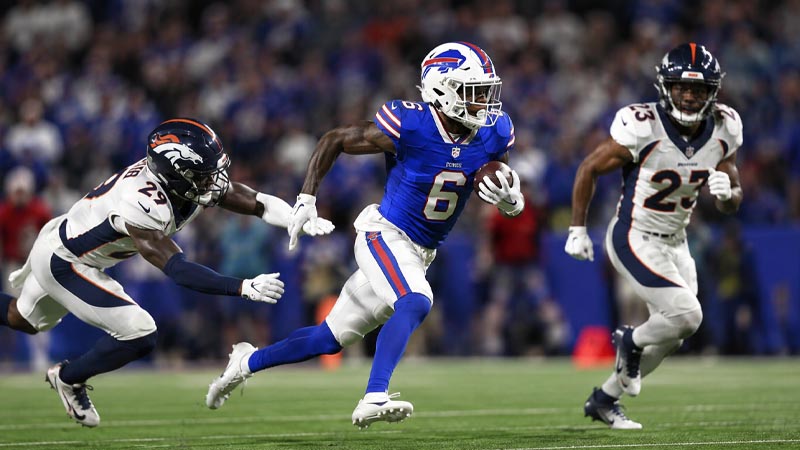
In the modern landscape of professional football, few roles are as statistically significant yet physically perilous as that of the punt returner.
Often operating in a space of less than a few yards while under the gaze of tens of thousands, the punt returner is the definitive bridge between defensive success and offensive opportunity.
While many spectators focus on the explosive touchdowns that occasionally ignite a stadium, the true value of the position lies in a disciplined mastery of physics, psychology, and split-second geometry.
To understand the role of the punt returner is to understand the gravity of field position.
In the NFL, a punt returner’s primary objective is to catch the ball kicked by the opposing team on a fourth down and advance it back downfield to secure optimal field position or, in the best-case scenario, score a touchdown.
This transition phase of the game is where games are often won or lost, tucked away in the “hidden yardage” that determines how far an offense must travel to reach the end zone.
The Split-Second Calculus: Decision-Making Under Pressure
The most critical aspect of the role is not the run itself, but the decision that precedes it. As the ball hangs in the air—often for four to five seconds of “hang time”—the returner must process a staggering amount of data.
They are required to make split-second decisions regarding whether to catch and run, signal for a fair catch, or let the ball bounce.
1. The Return: Exploiting the Seam
When a returner identifies a favorable trajectory and sees his blockers engaging the coverage unit effectively, he commits to the return.
This involves an attempt to weave through “seams” or narrow lanes created by his teammates who are actively blocking the descending defenders.
Success in this area requires more than just speed; it requires an intuitive understanding of blocking angles and the patience to let a lane develop before exploding through it.
2. The Fair Catch: Prioritizing Possession
Perhaps the most selfless act in football is the fair catch. By waving one arm overhead, the returner signals a claim to the ball that prevents him from being tackled. The play ends immediately where the ball is caught.
While this denies the crowd a highlight-reel run, it is often the most strategic move when “gunners”—the fastest players on the kicking team—have already closed the distance.
The fair catch is a tool used to prioritize ball security over the risk of a turnover or a devastating collision.
3. The “Let it Bounce” Protocol
There are moments when the risk of touching the ball outweighs any possible reward. If the punt is poorly aimed or if the coverage unit is too close to allow for a clean catch, the returner will step away.
By allowing the ball to roll downfield or into the end zone for a touchback, the returner avoids the catastrophic “muffed punt”. This decision is often made when the ball is “short” or when the returner’s focus is compromised by the proximity of defenders.
The Physical Archetype: Why Agility Trumps Speed
While a kickoff returner often benefits from a “running start” and long-stride speed, the punt returner operates in a much more congested environment.
The physical requirements for this role are highly specialized, focusing on three core athletic pillars: elusiveness, acceleration, and lateral agility.
Lateral Agility and Sharp Cuts
In the tight confines of a punt return, a player rarely has thirty yards of open space to build speed. Instead, they must rely on sharp cuts and lateral agility to beat defenders who are closing in at full speed.
This “stop-and-start” capability allows a returner to make the first man miss, which is often the difference between a three-yard gain and a thirty-yard breakaway.
Acceleration Over Velocity
While top-end speed is useful, fast acceleration is the more vital currency. A returner must reach their maximum velocity within three to five steps to exploit the temporary windows created by their blockers.
In the NFL, these “seams” close in the blink of an eye; a player who takes too long to accelerate will find themselves swallowed by the coverage unit before they reach the line of scrimmage.
The Psychology of the “High-Arriving” Ball
Beyond the physical gifts lies a mental requirement that few players can sustain: absolute focus under the threat of physical harm.
A punt returner must track a high-arriving punt while keeping their eyes locked on the football, even as multiple defenders sprint toward them at full speed.
This requires a unique brand of toughness. To catch a punt, a player must essentially ignore the “gunners” who are inches away from impact.
Any deviation in focus—any glance away from the ball to check the position of a defender—increases the likelihood of a fumble. Securing the ball tightly is the paramount duty, as a muffed punt is one of the most demoralizing and momentum-shifting errors in the sport.
Strategic Synergy: The Role of the Special Teams Unit
No returner operates in a vacuum. The success of the return is deeply tethered to the “hold-up” play of the jammers and the blocking of the front line.
- The Jammers: These are the players tasked with disrupting the “gunners” at the line of scrimmage. If the jammers fail, the returner is forced into a fair catch or a dangerous hit almost immediately.
- The Wall: Many teams employ a “wall” blocking scheme where blockers retreat to a specific side of the field to create a corridor for the returner.
- The Communication: Often, the returner will have a “lead blocker” or a teammate shouting instructions regarding the location of the ball and the proximity of the defenders.
Managing the “Hidden Yardage” Battle
In professional football, every yard has a mathematical value related to the probability of scoring.
If a returner can consistently turn a potential 40-yard punt into a 30-yard net gain through a 10-yard return, they are effectively moving their offense an entire first down closer to the goal line. Over the course of a season, this accumulated yardage can be the equivalent of multiple extra offensive possessions.
Common Challenges and Technical Pitfalls
The margin for error in this position is non-existent. Several factors can complicate the returner’s job:
- The “Knuckleball” Punt: Punters often kick the ball with a specific rotation that causes it to “dive” or “move” in the air, making the tracking process significantly harder.
- Wind and Weather: High-altitude stadiums or swirling winds in open-air venues can move the ball three to five yards horizontally during its descent.
- Crowded Catch Zones: When a punt is “short,” the returner must navigate through a crowd of their own blockers and defenders, increasing the risk of the ball hitting a teammate (a “live ball” situation).
The Future of the Position
As NFL rules continue to evolve to prioritize player safety, the mechanics of the punt return may shift. However, the fundamental need for a player who can combine “toughness and focus” with “quick acceleration” remains unchanged.
The punt returner remains the ultimate “specialist”—a player who must be a catch-mechanic, a high-speed navigator, and a brave decision-maker all within the span of five seconds.
Conclusion: The Value of the Specialist
The NFL punt returner is a role defined by the tension between risk and reward. It requires the hands of a receiver, the vision of a running back, and the nerves of a tightrope walker.
By mastering the ability to track high-arriving punts, navigate closing seams, and make the correct tactical decision between a fair catch and a return, these athletes provide their teams with a competitive edge that is often the silent architect of victory.
The next time you see a returner standing alone in the backfield, remember that they are not just waiting for a ball; they are preparing to solve a complex physical puzzle in real-time, with the outcome of the game hanging in the balance.