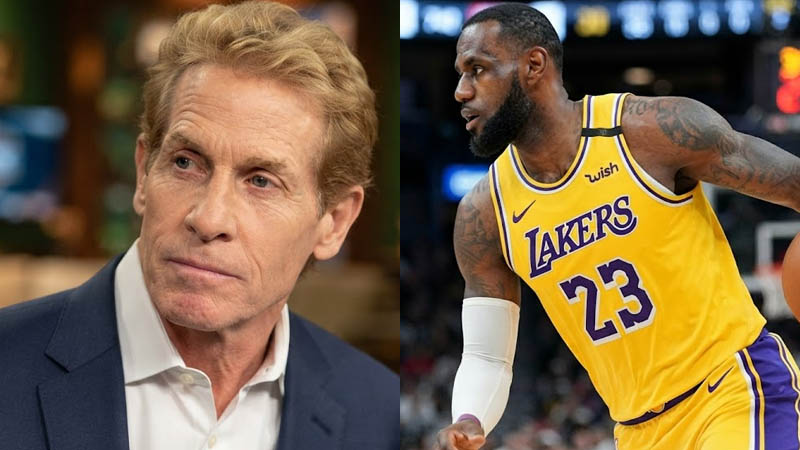
Skip Bayless’s relentless criticism of LeBron James is a calculated blend of television showmanship and unwavering allegiance to Michael Jordan’s legacy.
While Bayless maintains he does not personally hate James, he has built a lucrative media career by serving as the star’s primary critic since 2003. This antagonism stems from protecting Michael Jordan’s “GOAT” status, citing James’s 4–6 Finals record versus Jordan’s 6–0.
Additionally, Bayless exploits narratives of mental fragility following the 2011 Finals and focuses on specific metrics like free-throw shooting to create a ratings-driven persona that thrives on aggressive counter-programming.
Is the Skip Bayless and LeBron James Feud Real?
The relationship between the most prominent voice in sports media and the NBA’s all-time leading scorer is often misunderstood as a personal vendetta. However, a deeper analysis reveals that this friction is a sophisticated architectural component of modern sports entertainment.
By positioning himself as the ultimate skeptic, Bayless has filled a necessary void in a media landscape that is otherwise overwhelmingly celebratory of James’s historic achievements.
This adversarial stance is less about genuine animosity and more about the strategic “embrace debate” format that has redefined sports broadcasting over the last two decades.
The “Embrace Debate” Architecture
Television and social media platforms thrive on high-stakes conflict, and Bayless is the undisputed master of this domain. He recognized early in James’s career that being the “villain” against a global icon would generate immense viewership and social media engagement.
By consistently picking apart James’s flaws, he created a permanent persona that fans love to watch and argue against, regardless of whether they agree with his points.
This approach has transformed nightly critiques into a multi-million dollar business model that relies on the polarization of the audience.
A Symbiotic Media Relationship
There is a profound irony in the fact that while Bayless is James’s harshest critic, his career is inextricably linked to the King’s success. Without James’s longevity and consistent excellence, the critic would lack a “moving target” to analyze every morning.
This symbiotic relationship allows the media personality to maintain relevance across twenty years of basketball history.
While James has never publicly replied to or acknowledged the criticism, the silence only allows the one-sided narrative to continue indefinitely, fueling the ratings cycle for both broadcast and digital platforms.
Protecting the Michael Jordan Legacy
At the core of the critique lies an absolute devotion to Michael Jordan, whom Bayless views as the “Runaway GOAT”.
For a purist of the 1990s Bulls era, LeBron James’s entire career represents an unauthorized attempt to usurp a throne that Bayless believes should be permanently occupied by Jordan.
This creates a framework where every James accomplishment is viewed through a lens of comparison, often emphasizing what James lacks rather than what he provides.
The Unassailable 6-0 Standard
The most frequent weapon in the critic’s arsenal is the comparison of Finals records. Bayless heavily penalizes James for his 4–6 record in the NBA Finals, contrasting it with Michael Jordan’s flawless 6–0 mark and six Finals MVPs.
This metric is used to suggest that James cannot reach the same level of greatness because he has “failed” on the biggest stage more often than he has succeeded.
Even when James reaches the Finals through historic individual efforts, the critic often highlights the losses as proof of a lack of a “killer instinct”.
Mimicry Without the Killer Instinct
Bayless often critiques what he views as James’s “aesthetic mimicry” of Jordan. This includes James choosing to wear the number 23, utilizing the pre-game chalk toss, and embracing the “Chosen One” moniker early in his career.
The argument posits that while James can replicate the look and the statistics of a legend, he does not possess the same “cold-blooded” competitive drive that defined Jordan’s career.
This narrative frames James as a player who is physically gifted but mentally different from the icons of the past.
Analyzing the “Clutch Gene” and Mental Fragility
The psychological profiling of athletes is a cornerstone of the nightly broadcast, with James often being labeled as “the most mentally fragile superstar” in sports history.
This narrative is not a recent development; it dates back to James’s early tenure with the Cleveland Cavaliers. Bayless popularized the idea that James would pass up late-game shots or avoid the free-throw line in crucial moments to dodge the pressure of a potential failure.
The 2011 Finals: An Unpardonable Sin
The narrative of mental fragility was permanently locked into the media rhetoric after the 2011 NBA Finals.
During that series against the Dallas Mavericks, James’s performance was significantly below his usual standards, leading to a loss that Bayless still treats as a defining athletic failure.
The critic frequently mentions that James “buckled under pressure” during the final games of that series, which serves as his primary evidence whenever the “clutch gene” debate arises.
For the critic, one such failure is enough to permanently exclude a player from the highest tier of historical greatness.
Passing vs. Shooting in Final Seconds
A recurring point of contention is James’s tendency to make the “correct” basketball play—often passing to an open teammate—rather than taking a contested shot himself. Bayless views this as a lack of late-game courage.
For instance, even in winning efforts like the 2013 Finals, the critic focused on Ray Allen’s game-tying shot rather than James’s fourth-quarter contributions.
This selective focus allows the critic to maintain the “no clutch gene” narrative even when the team succeeds, by shifting the credit to teammates while keeping the blame on the superstar.
Specific Basketball Metrics Used for Criticism
While many fans view the criticism as irrational, the arguments are often built upon specific, data-driven points that allow the critic to maintain a level of authority.
By focusing on quantifiable weaknesses, the critique moves from purely subjective opinion to a debate centered on on-court performance metrics.
| Metric Analyzed | Skip Bayless’s Primary Critique |
|---|---|
| Free-Throw Shooting | Highlights a subpar career average (approx. 74%) as proof James cannot be trusted in late-game foul situations. |
| 3-Point Shooting | Labels the outside shot as “streaky” and unreliable during high-pressure possessions. |
| Finals Record | Uses the 4–6 record to diminish James’s standing against Jordan (6–0) and Magic Johnson. |
| Roster Control | Accuses James of orchestrating off-court drama and deflecting blame onto “scapegoats” when teams lose. |
| Career Durability | Admits he is the “Longevity GOAT” but argues that total stats are just a product of playing for 20+ seasons. |
Why Does the Criticism Focus on the Lakers Era?
The move to the Los Angeles Lakers provided a fresh landscape for narrative development, as the high-profile market amplified every win and loss.
Following recent playoff exits, the rhetoric has shifted from James’s individual skill to his impact on the organization’s long-term future. This era of his career has been met with some of the most “nuclear” social media critiques to date.
Grading the Eight-Year Tenure
The critic publicly assigned James’s eight-year run in Los Angeles a “C grade”. The logic behind this harsh evaluation includes the fact that the team missed the playoffs twice and suffered multiple sweeps during that period.
By focusing on these specific team failures, the critic can overshadow the 2020 championship and argue that the Lakers’ investment in James did not yield the expected level of sustained dominance.
The “Luka Angle” and Future Targets
As James enters the twilight of his career, the media strategy has begun to involve “moving targets,” such as Luka Dončić.
After recent Lakers eliminations, the critic claimed the front office was ready to move on and build around younger stars, even accusing James of “playing the victim role” regarding team construction.
This shift ensures that the critic has a new “standard” to hold James against, comparing his current production to the rising stars of the next generation.
The Paradoxical Praise for LeBron’s Longevity
Despite the nightly rhetorical attacks, there are moments where the critic breaks character to acknowledge the undeniable historic reality of James’s career.
This creates a paradox where the same person who ranks James as only the 9th best player of all time also calls him the greatest “driver of the basketball” in the history of the game.
The Longevity GOAT Title
The critic frequently concedes that LeBron James is the “Longevity GOAT” and the most durable athlete in the history of professional sports. He acknowledges that James’s ability to maintain an elite level of play into his 20th and 21st seasons is unprecedented.
This admission serves to add a layer of credibility to his overall critique; by acknowledging James’s physical greatness, the critic’s attacks on his “mental” and “clutch” attributes seem more focused and deliberate.
The Secret Admiration of a Superfan
Perhaps the ultimate irony of this twenty-year saga is that Skip Bayless has openly admitted to watching every single game of LeBron James’s career since 2003. This level of dedication exceeds that of even the most hardcore fans.
It suggests that while the television persona is built on opposition, there is a deep professional respect for the consistency James provides to the sports world.
This dedication ensures that every critique is informed by a comprehensive viewing of James’s entire body of work.
Frequently Asked Questions About the Rivalry
Does Skip Bayless actually hate LeBron James?
No, he has stated multiple times that he does not hate James as a person. The “hate” is a professional persona designed for television conflict and ratings.
Why does Skip rank LeBron James 9th all-time?
He prioritizes “killer instinct” and Finals records above all else. He places players like Michael Jordan, Magic Johnson, and Kobe Bryant higher because he views them as superior “closers” in championship moments.
Has LeBron James ever responded to Skip Bayless?
Throughout his entire twenty-year career, LeBron James has never once publicly replied to or acknowledged the critic. This silence is often cited as a reason the one-sided feud has been able to persist for so long.
What was the “unpardonable sin” of LeBron’s career according to the critic?
The 2011 NBA Finals against the Dallas Mavericks is viewed as the definitive moment of failure that James can never fully erase from his legacy.
What does Skip actually like about LeBron’s game?
He has praised James as an elite generational passer, the greatest driver of the basketball ever, and the most durable athlete in sports history.
The Symbiotic Legacy of Two Icons
The two-decade interaction between the critic and the athlete has reached a point of historical significance. In many ways, they have co-authored one of the most compelling narratives in sports media history.
While James has rewritten the record books on the court, Bayless has rewritten the rules for how athletes are discussed in the digital age.
Whether viewed as a “hater” or a strategic genius, the media veteran has ensured that every basket LeBron James scores is met with a counter-argument, and every loss is treated as a referendum on his soul.
This constant pressure has, perhaps inadvertently, added a layer of legendary status to James’s career that a purely celebratory media would have lacked.
In the end, both men have utilized this friction to build unmatched legacies in their respective fields, proving that in the world of modern sports, conflict is the ultimate currency.