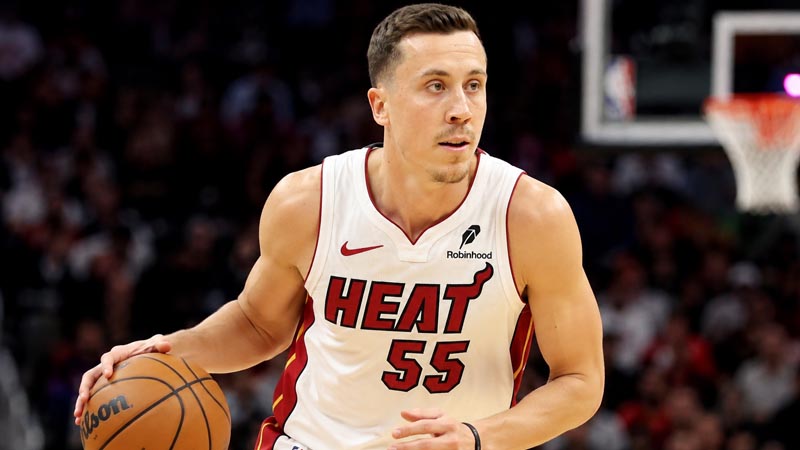
Duncan Robinson wears number 55 because it is a creative mathematical inversion of his lifelong favorite number, 2. Growing up, Robinson was deeply attached to numbers containing “2” due to his April 22nd birthday.
However, upon joining the Miami Heat in 2018, veteran players already occupied numbers 2, 20, and 22. This unexpected roster conflict forced the undrafted rookie to improvise.
By flipping his preferred number 22 upside down, the digits visually mirrored a 5, resulting in 55. This unique choice also honors Heat legend Jason Williams, establishing a professional identity that Robinson has maintained throughout his elite career.
The Core Reason Behind the Fifty-Five
While many NBA players choose their numbers based on childhood idols or random assignments, Robinson’s choice was a calculated effort to maintain a link to his personal history.
The transition from the digit 2 to 55 was not a matter of preference but a matter of necessity driven by the rigid structure of a professional basketball roster.
For a player who had spent his entire life identifying with a specific numerical value, the shift required a blend of creativity and symbolism to ensure his new professional identity still felt grounded in his amateur roots.
The Mathematical Logic of the Inversion
The primary motivation for choosing 55 was a visual trick. Robinson reasoned that if one were to take the number 2 and flip it vertically or “invert” it, the resulting shape bears a striking resemblance to the number 5.
Since his preferred choice of 22 was unavailable, he decided to “flip his luck” and apply this logic to both digits.
By inverting the two 2s, he arrived at 55, a number that allowed him to keep the spirit of his original choice while adopting a fresh, distinct look for the professional stage.
Overcoming the Roster Logjam
When Robinson first arrived in Miami on a two-way contract, he was at the bottom of the hierarchy, meaning he had no seniority when it came to jersey selection.
The Miami Heat roster at the time was filled with established players who had already claimed the “2” variants. Veteran guard Wayne Ellington was wearing No. 2, Justise Winslow was in No. 20, and Luke Babbitt occupied No. 22.
This lack of availability meant that Robinson’s traditional identity was effectively blocked, forcing the mathematical pivot that would eventually define his brand as one of the league’s premier shooters.
A Personal Connection: The Influence of April 22nd
To understand why Robinson was so adamant about the number 2, one must look back at his early life and the significance of his birth date.
In the world of professional sports, numbers often become a part of a player’s psychological “uniform,” providing a sense of comfort and continuity.
For Robinson, the digit 2 was not just a label; it was a representation of his journey from a small-town prospect to a high-major collegiate star at the University of Michigan.
The Birthday Connection and Amateur Consistency
Born on April 22, 1994, Robinson developed an immediate and lifelong attachment to the number 2. This connection was a constant throughout his rise in the basketball world.
Whether he was playing at Phillips Exeter Academy, where he wore No. 22, or during his time at Williams College and the University of Michigan, he ensured that his jersey featured the digit that matched his birthday.
This consistency helped him build a sense of self-reliance and focus as he navigated the challenges of being an overlooked recruit.
Numerical Success at Michigan and Williams College
Before reaching the NBA, Robinson’s “2” variants were symbols of his record-breaking performances. At Williams College, he wore No. 2 and led the team to a Division III championship game, earning national honors.
When he transferred to the University of Michigan, he switched back to No. 22, the same number he used in high school, and became a pivotal piece of a team that reached the NCAA Championship game.
These experiences reinforced his belief that the number 2 was lucky, making the eventual forced change in the NBA a significant psychological hurdle to clear.
Honoring Jason Williams and the Legacy of the Heat
Beyond the personal and mathematical reasons for the change, Robinson found a deeper professional meaning in the number 55 through the history of the Miami Heat franchise.
As an undrafted player trying to make his mark, connecting with the legacy of former stars provided a sense of belonging and inspiration. The number 55 was not just an inverted 2; it was a number that had already tasted championship success in South Beach.
The Jason Williams “White Chocolate” Connection
While playing for the Heat’s G League affiliate, the Sioux Falls Skyforce, Robinson realized that 55 was famously worn by Jason “White Chocolate” Williams.
Williams was a key contributor to Miami’s 2006 championship run and was known for his flashy passing and high-energy play style.
Robinson, who grew up as a massive fan of Williams, felt a deep sense of honor in wearing the same number as one of his childhood heroes.
This realization turned a forced choice into a badge of pride, linking his career to a player who also brought unique energy to the floor.
Carrying the Heat Championship Legacy
Wearing No. 55 in Miami carries a specific weight because of the 2006 title. By choosing this number, Robinson was inadvertently stepping into a role that demanded high performance and a commitment to the “Heat Culture.”
The number became a bridge between the flashy, playmaking style of Jason Williams and the modern, precision-based sharpshooting of Robinson.
This historical weight helped Robinson embrace the number as his own, moving past his initial desire for the number 2 and focusing on building a new legacy for No. 55 in the modern era.
Tracking Duncan Robinson’s Jersey History
Robinson’s career has been marked by several transitions, and his jersey numbers reflect the different chapters of his development.
From his high school days in New Hampshire to his current tenure in the NBA, the numbers on his back tell the story of a player who learned to adapt to his circumstances while staying true to his roots.
| Team / Level | Jersey Number | Years Active |
|---|---|---|
| Phillips Exeter Academy (High School) | #22 | 2012–2013 |
| Williams College (NCAA Division III) | #2 | 2013–2014 |
| University of Michigan (NCAA Division I) | #22 | 2015–2018 |
| Sioux Falls Skyforce (NBA G League) | #55 | 2018–2019 |
| Miami Heat (NBA) | #55 | 2018–2025 |
| Detroit Pistons (NBA) | #55 | 2025–Present |
The data shows a clear preference for the digit 2 during his amateur years, with a permanent shift to 55 occurring exactly at the point he entered the professional ranks. This shift highlights the moment his personal identity merged with his professional brand.
How the Number 55 Defined a Professional Brand
Once the number 55 became synonymous with Robinson’s elite perimeter shooting, it evolved from a temporary fix into a permanent brand. In the modern NBA, a player’s number is part of their marketing and fan recognition.
For Robinson, changing the number later in his career would have meant abandoning the identity he established during his historic rise as a three-point specialist.
Transition to the Detroit Pistons
When Robinson moved from the Miami Heat to the Detroit Pistons, he had the opportunity to reconsider his jersey number. However, he chose to stick with No. 55.
By this point, “55” was no longer just an inverted “22”; it was the number he had worn while setting records for the fastest player to reach 500, 800, and 1,000 career three-pointers.
Maintaining the number in Detroit was a strategic decision to preserve the professional continuity he had built since his undrafted debut.
Establishing a Visual Identity for a Sharpshooter
In the fast-paced environment of an NBA game, specific numbers become visual cues for defenders and fans alike. The double-fives on Robinson’s jersey serve as a warning to opposing defenses that a high-volume shooter is on the floor.
By sticking with the number, he has solidified a visual brand that is easily recognizable.
What began as a creative solution to a roster conflict has become one of the most feared numbers on the perimeter, proving that the man makes the number, rather than the number making the man.
Frequently Asked Questions About Robinson’s Jersey
Did Robinson ever try to switch back to No. 2?
While he initially preferred No. 2, by the time it became available, he had already established himself as a star wearing No. 55. The brand recognition he built in Miami made a switch unnecessary.
Is there any other meaning to the number 55?
Aside from the mathematical inversion of 22 and the tribute to Jason Williams, the number 55 is relatively rare in the NBA, which helps Robinson stand out as a unique player on the court.
What number did he wear in the G League?
Robinson wore No. 55 with the Sioux Falls Skyforce, the Heat’s G League affiliate, before being called up to the main roster.
Why didn’t he choose 22 in Detroit?
Even though the “2” variants might have been available in Detroit, Robinson chose to keep 55 to maintain the professional identity and brand consistency he developed in Miami.
The Enduring Legacy of the Numerical Flip
The story of why Duncan Robinson wears 55 is a masterclass in professional adaptability. It serves as a reminder that the path to success often requires improvisation and the ability to find meaning in unexpected changes.
Robinson took a restrictive situation—his favorite numbers being taken—and turned it into a creative opportunity that honored a legend and built a unique personal brand.
Today, when fans see the number 55 on a jersey, they don’t see an “inverted 22”; they see one of the greatest shooting threats in the history of the game.
For Robinson, the number 55 represents the moment he truly became a professional, proving that with enough creativity, even a forced change can lead to a legendary legacy.