In the modern era of professional football, games are decided by razor-thin margins. A single delayed play call, a misheard protection shift, or a fractured second of hesitation in the huddle can transform a championship drive into a costly turnover.
As defensive schemes grow increasingly sophisticated, the burden of execution falls squarely on the quarterback.
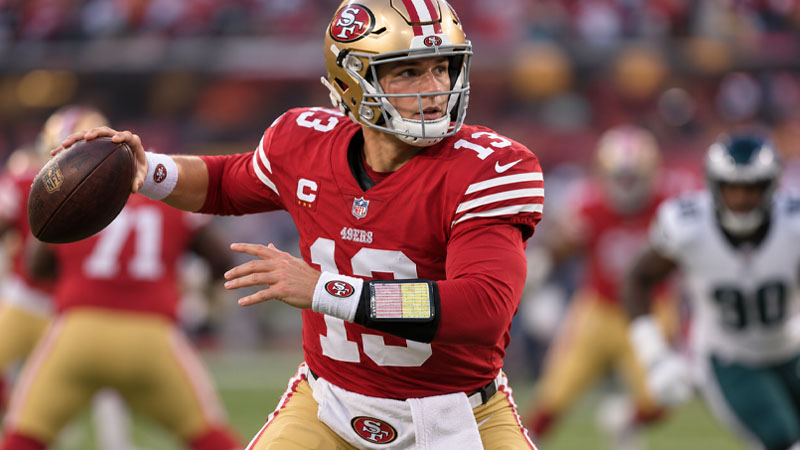
To manage this burden under intense pressure, quarterbacks rely on an understated tool: a fabric band worn on the forearm, holding a multi-page grid of text and numbers.
This tool serves as the critical node in an offense’s operational chain. It bridges the gap between complex game plans and high-speed execution under the lights.
The Anatomy of the Modern NFL Play Call
To understand why a quarterback needs a cheat sheet strapped to their arm, one must first understand the sheer scale of a modern offensive playbook.
A single play is not merely a direction for a receiver to run a route or a running back to take a handoff. It is an intricate, multi-layered command structure that must coordinate eleven players simultaneously.
A typical play call contains several distinct pieces of information:
- The Personnel Grouping: Dictates which players (tight ends, running backs, wide receivers) must run onto the field.
- The Formation: Specifies exactly where each player must line up relative to the ball and the hash marks.
- The Motion or Shift: Commands pre-snap movements to force the defense to reveal its coverage scheme.
- The Pass Protection or Run Scheme: Instructs the offensive line, tight ends, and running backs on who to block.
- The Route Concept: Outlines the specific patterns for every eligible receiver, including primary options and safety check-downs.
- The Snap Count: Tells the entire offense when the ball will be snapped to maintain the element of surprise.
When spoken aloud in its full form, a play call can easily exceed fifteen words: “West Right Tight F-Left Motion Z-Drive On Two.”
In a quiet meeting room, reciting this sequence is simple. In a hostile stadium with ninety thousand screaming fans, transmitting these exact syllables from a coach in the press box to a quarterback on the field—and then from that quarterback to ten teammates—presents an extraordinary operational challenge.
The Three Technical Drivers of the Wristband
1. Beating the Strict 15-Second Radio Cutoff
The NFL governs sideline-to-player communication with strict rules. The radio system embedded in the quarterback’s helmet is not an open channel. By rule, the communication link between the coach’s headset and the quarterback’s helmet cuts off automatically when the play clock reaches 15 seconds.
[ Play Clock Starts: 40 Seconds ]
       │
       ▼ (Coach begins transmitting play)
[ Play Clock: 15 Seconds ] ───► RADIO SYSTEM CUTS OFF AUTOMATICALLY
       │
       ▼ (Quarterback must complete huddle and snap ball before 0)
[ Play Clock: 0 Seconds ] ───► Delay of Game Penalty
If a team breaks the huddle late or faces a complex defensive alignment that requires a quick adjustment, the coach cannot simply talk the quarterback through the solution. The quarterback is entirely on their own once that 15-second threshold is crossed.
By utilizing a wristband, the coach does not need to waste precious seconds reciting a long, multi-word play call. Instead, they can transmit a simple, short code, such as “Group 3, Number 14.” The quarterback instantly glances at their wrist, locates row fourteen, and reads the full, complex play details. This streamlined process saves valuable seconds, allowing the offense to assemble, read the defense, and snap the ball before the play clock expires.
2. Overcoming Crowd Noise and Signal Degradation
While stadium broadcasts offer viewers crisp, clear audio, the reality on the field is vastly different. The noise generated in professional football stadiums is deafening, sometimes exceeding 120 decibels.
Furthermore, the wireless headsets inside quarterback helmets do not offer high-definition audio quality. Players frequently describe the connection as sounding like a muffled, low-grade walkie-talkie rather than a clear phone call. Static, audio dropouts, and stadium interference are common.
If a quarterback hears only fragments of a play call over a static-heavy connection, guessing the rest is a recipe for disaster.
The wristband acts as a fail-safe. If the audio is muffled, the coach can repeatedly shout a single two-digit number. Even through heavy static, a simple number is far easier to distinguish than a long string of specific terminology. The quarterback can verify the play visually, eliminating any doubt.
3. Compressing Complex Play Names into Coded Shortcuts
Every offensive coordinator has a distinct vocabulary. Some systems are built on brief, conceptual words, while others rely on highly descriptive, wordy chains. In high-tempo situations—such as a two-minute drill or a no-huddle offense—there is physically not enough time to utter long names.
Wristbands allow coaches to compress their entire weekly game plan into a matrix of visual shortcuts. This visual indexing speeds up the offensive tempo, forcing the defense to defend at a rapid pace without giving them time to substitute players or adjust their positioning.
How the Wristband Game Plan is Built Weekly
The sheet of paper tucked inside a quarterback’s wristband is not a static document used all season. It is a highly customized, weekly blueprint designed specifically for the upcoming opponent. The creation of this sheet is a meticulous process that begins days before kickoff.
[ Tuesday ] ────────► Film Study & Defensive Tendency Analysis
[ Wednesday-Thursday ] ► Installation of Specific Schemes & Play Designs
[ Friday ] ──────────► Final Selection of the Weekly Game Plan
[ Saturday ] ────────► Formatting, Printing, and Laminating the Wristband Sheets
[ Sunday ] ──────────► In-Game Execution and Adjustment
The Selection and Formatting Process
On Tuesday and Wednesday of a game week, coaching staffs analyze hours of defensive game film. They identify the opponent’s defensive tendencies on specific downs and distances. By Thursday, they compile a list of plays engineered to exploit those specific weaknesses.
On Friday and Saturday, this curated list is formatted into a dense grid. The sheet is broken down into specific operational categories, making it easy for the quarterback to navigate under pressure. Typical sections include:
- First and Second Down: Standard run and pass plays designed to stay ahead of the chains.
- Third Down Packages: Subdivided by distance (short, medium, long) to target the defense’s preferred blitz packages.
- The Red Zone: Specialized plays designed for the tight spaces near the opponent’s goal line.
- The Two-Minute Drill: High-speed, quick-release plays aimed at moving the ball downfield rapidly without stopping the clock.
- Shot Plays: Specific, deep-passing concepts designed to be executed when the defense shows a vulnerable safety alignment.
The final document is printed in an incredibly small, legible font and laminated to protect it from sweat, rain, and mud. It is then inserted into the transparent plastic windows of the three-panel wristband.
The Bare-Arm Philosophy: Why Some Quarterbacks Dislike Wristbands
Despite the clear structural advantages of using a wristband, a notable contingent of quarterbacks chooses to play without one. This decision is rarely about a lack of preparation; instead, it represents a fundamental philosophy of leadership and communication.
Maintaining the Human Element in the Huddle
For some quarterbacks, looking down at a wristband breaks a crucial psychological link between the leader and the team. Dallas Cowboys quarterback Dak Prescott is a prominent example of a player who prefers to play bare-armed.
Prescott’s choice is rooted in how he manages the huddle. Rather than looking down at his arm to read a play, he memorizes the game plan entirely.
This allows him to keep his head up, maintain direct eye contact with his teammates, and gauge their focus, confidence, and physical energy before calling the play.
To these quarterbacks, the huddle is not just an information delivery system; it is an emotional reset point. Looking a teammate in the eye while delivering a play call conveys a level of conviction and trust that cannot be replicated when reading off a plastic sheet.
The Cognitive Demands of Total Memorization
Playing without a wristband requires an extraordinary level of mental preparation. Historically, legendary players like Peyton Manning and Tom Brady used wristbands to navigate and manage their massive, highly detailed playbooks.
The sheer volume of pre-snap adjustments, protection variations, and situational checks in their offenses made a visual reference point highly valuable.
For a quarterback playing without a wristband, the mental filing cabinet must be flawless. They must internalize hundreds of plays, memorizing the specific assignments of all ten other players on every single concept.
If a play is modified at the line of scrimmage, they must instantly recall the ripple effects of that change across the entire formation.
The Strategic Balance of Modern Football
The quarterback wristband is a perfect symbol of how modern football balances technical strategy with human leadership.
On one hand, it represents the sterile, highly organized side of the sport—a matrix of codes, numbers, and situations designed to beat a ticking clock and overcome stadium noise.
On the other hand, the decision to reject the wristband highlights the irreplaceable value of direct human connection and eye-to-eye communication in a high-pressure environment.
Ultimately, there is no single correct path to victory. Whether a quarterback coordinates their team using a dense plastic sheet on their arm or relies on absolute memorization to command the huddle, the objective remains identical: fast, flawless execution when the ball is snapped.